Lorenz and Colossus · Volume 8
Lorenz and Colossus — Volume 8 — Tommy Flowers and the Building of Colossus
A Post Office engineer who trusted valves when no one else did, a machine Bletchley Park did not order, eleven months at Dollis Hill, and the race to have a second, faster Colossus working before the invasion of France
8.1 About This Volume
Volume 7 ended with Heath Robinson at Bletchley Park in the summer of 1943: a proof that Tutte’s statistical attack on Tunny could be run by machine, and a demonstration that two paper tapes could not be kept in step at two thousand characters a second for very long. This volume is about the engineer who saw the way round that problem, and about the machine he built.
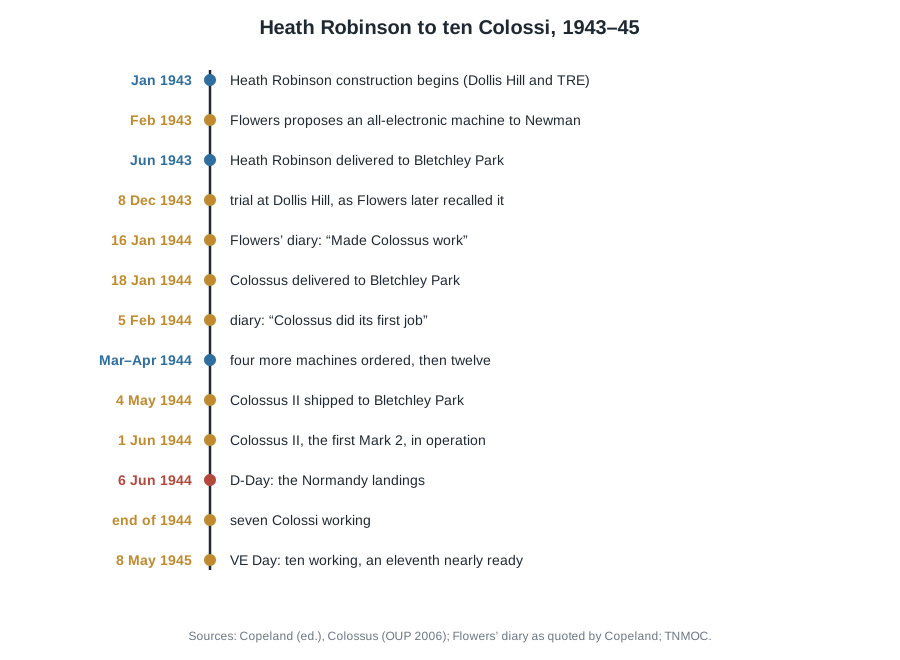
Tommy Flowers was a telephone engineer at the Post Office Research Station at Dollis Hill. He was not a mathematician, not a member of Bletchley Park, and not, in early 1943, anyone the codebreakers had much reason to listen to. What he had was a decade of experience putting thermionic valves — vacuum tubes — into telephone switching equipment, and from that experience a conviction that valves were far more reliable than almost everyone believed. He proposed a machine with more than a thousand of them. Bletchley Park thought it would not work and did not order it. Flowers and his team built it anyway, in eleven months, and delivered it in January 1944. It was called Colossus.
The volume follows Flowers from the East End to Dollis Hill; the valve exchange work of the 1930s; his first contact with Bletchley Park; the proposal of February 1943 and the reaction to it; the building of the first Colossus; the order for more and the race to have the improved Mark 2 working by 1 June 1944; the production run that gave the Newmanry ten machines by the end of the war; and what became of Flowers afterwards. How the machine actually worked, circuit by circuit, is Volume 9.
8.2 From Poplar to Dollis Hill
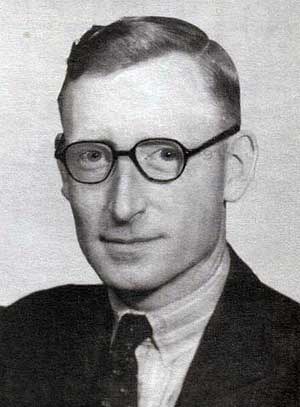
Thomas Harold Flowers was born on 22 December 1905 at 160 Abbott Road, Bromley-by-Bow, in the East London district of Poplar, the son of a bricklayer (Wikipedia). He left school to take an apprenticeship in mechanical engineering at the Royal Arsenal, Woolwich, and studied electrical engineering at evening classes, taking a University of London degree.
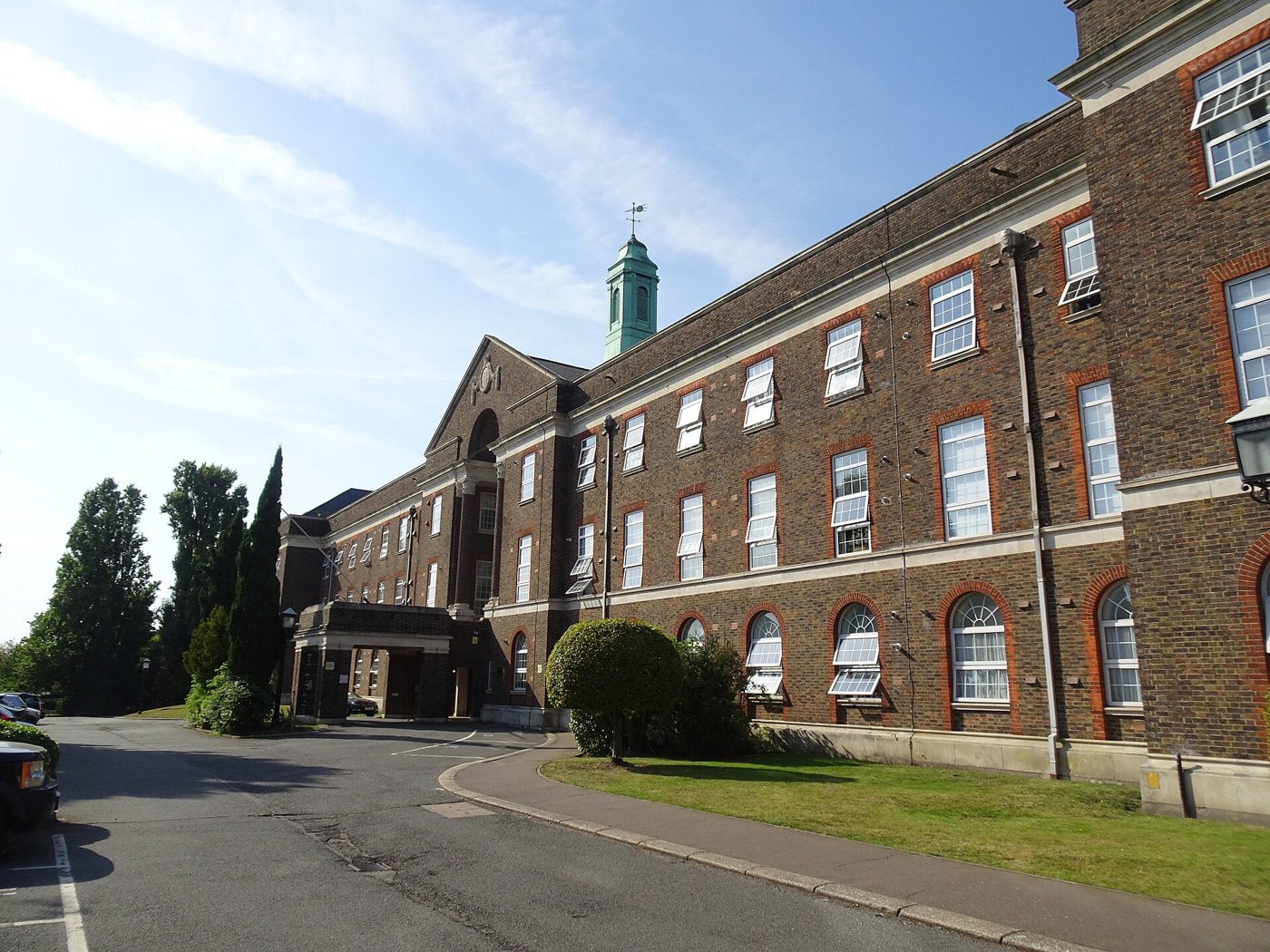
In 1926 he joined the telecommunications branch of the General Post Office, which then ran Britain’s telephone system as well as its mail. In 1930 he moved to the Post Office Research Station at Dollis Hill in north-west London, a large brick laboratory building opened only a few years earlier for work on telephone exchanges, transmission lines and radio (Copeland, colossus-computer.com).
8.2.1 Valves in the telephone exchange
A 1930s automatic telephone exchange was a building full of electromechanical switches: Strowger selectors that stepped round banks of contacts as a caller dialled, and relays by the thousand that set up and held each connection. It was reliable, but slow and bulky, and every moving part wore out.
From 1934 Flowers worked on replacing some of that switching with electronics. The idea was not to replace the whole exchange but to do the signalling and control — the parts that recognised dialled digits and routed calls — with valve circuits. Copeland records that one experimental installation used between 3,000 and 4,000 valves to control about 1,000 lines, and that it went into limited operation in 1939. By the outbreak of war Flowers had more practical experience of large valve installations than almost anyone in the country.
That experience taught him something that ran against the general opinion. The received wisdom, formed mostly by radio sets and by early radar, was that valves were fragile and unreliable, and that any machine with more than a few hundred of them would be out of action much of the time. Flowers’ observation, as he later explained it, was that most valve failures happened when the equipment was switched on or off — when the heaters warmed up or cooled, and the current surged — and that valves left running continuously, at moderate ratings, in a stable environment, lasted a very long time. A telephone exchange is never switched off. The same, he reasoned, could be true of a codebreaking machine.
8.2.2 First contact with Bletchley Park
The Post Office already did a great deal of work for the Government Code and Cypher School. Its engineers maintained teleprinter links, and its factories made equipment for Bletchley Park. In February 1941, according to most accounts, Alan Turing asked Dollis Hill for help in building a relay-based counting unit to work with the Bombe, the electromechanical machine used to find Enigma settings. Flowers was assigned the job. That project was abandoned, but it meant Turing knew Flowers, and in February 1943 it was Turing who introduced him to Max Newman, then struggling with the design of Heath Robinson.
8.3 The Proposal, February 1943
Flowers was brought in to advise on parts of Heath Robinson, and he looked at the machine as a whole. The problem, he saw, was the second tape. The whole purpose of the key tape was to supply the pattern of the chi wheels, which was known in advance. There was no need to read it off paper at all. A Lorenz wheel was just a fixed cyclic pattern of ones and zeros, and a ring of valves can hold a cyclic pattern and step it round as fast as anyone likes. Generate the wheel patterns electronically, inside the machine, and only the message tape would remain. Nothing would have to be kept in step with it: its own sprocket holes could provide the clock, and the electronics would follow wherever the tape went.
He presented the idea to Newman in February 1943. It meant a machine of something like 1,500 to 2,000 valves — far more than Heath Robinson’s couple of dozen — and that was where it ran into trouble. The experts at TRE and at Bletchley Park, Copeland writes, estimated that a machine with that many valves would be too unreliable to be useful (Copeland, Rutherford Journal 3). Heath Robinson was already being built and would soon be delivered; it seemed more sensible to make it work than to start again with something even more ambitious.
Bletchley Park did not order Flowers’ machine. It did not forbid him to build it, either. He went back to Dollis Hill and, with the support of the station’s director, W. Gordon Radley, built it on his own initiative.
8.3.1 Why Flowers was right, and they were not wrong
It is worth being fair to the sceptics. In 1943 nobody had built a digital machine of that size, and the valves of the day did fail. The Heath Robinson team at TRE included some of the best electronic engineers in Britain, and their instinct — that a huge valve machine was a risk — was reasonable. What they lacked was Flowers’ specific experience of running thousands of valves continuously in telephone service. The General Report on Tunny, written by the Newmanry’s own cryptanalysts in 1945, put the credit plainly: “Colossus was entirely the idea of Mr. Flowers” (quoted in Copeland, colossus-computer.com). Flowers himself, many years later, was blunter: “I invented the Colossus. No one else was capable of doing it.”
8.4 Eleven Months at Dollis Hill
Colossus was designed and built at Dollis Hill between February 1943 and January 1944. It was not a formally sanctioned Bletchley Park project, and for much of that time it had to compete for resources with the Post Office’s other war work. Radley’s backing gave it priority within Dollis Hill, and the engineers worked very long hours on it.
8.4.1 The team
Flowers led the design. His principal colleagues were Sidney Broadhurst and William Chandler, who worked with him on the original concept, and Allen Coombs, who joined later and led the production of the Mark 2 machines. The optical tape reader, a critical part, was the work of Arnold Lynch and Eric Speight, who had designed the reader for the Robinson bedstead (Wikipedia, “Colossus computer”; IEEE Milestone citation). Harry Fensom, who had commissioned Heath Robinson, worked on both marks of Colossus.
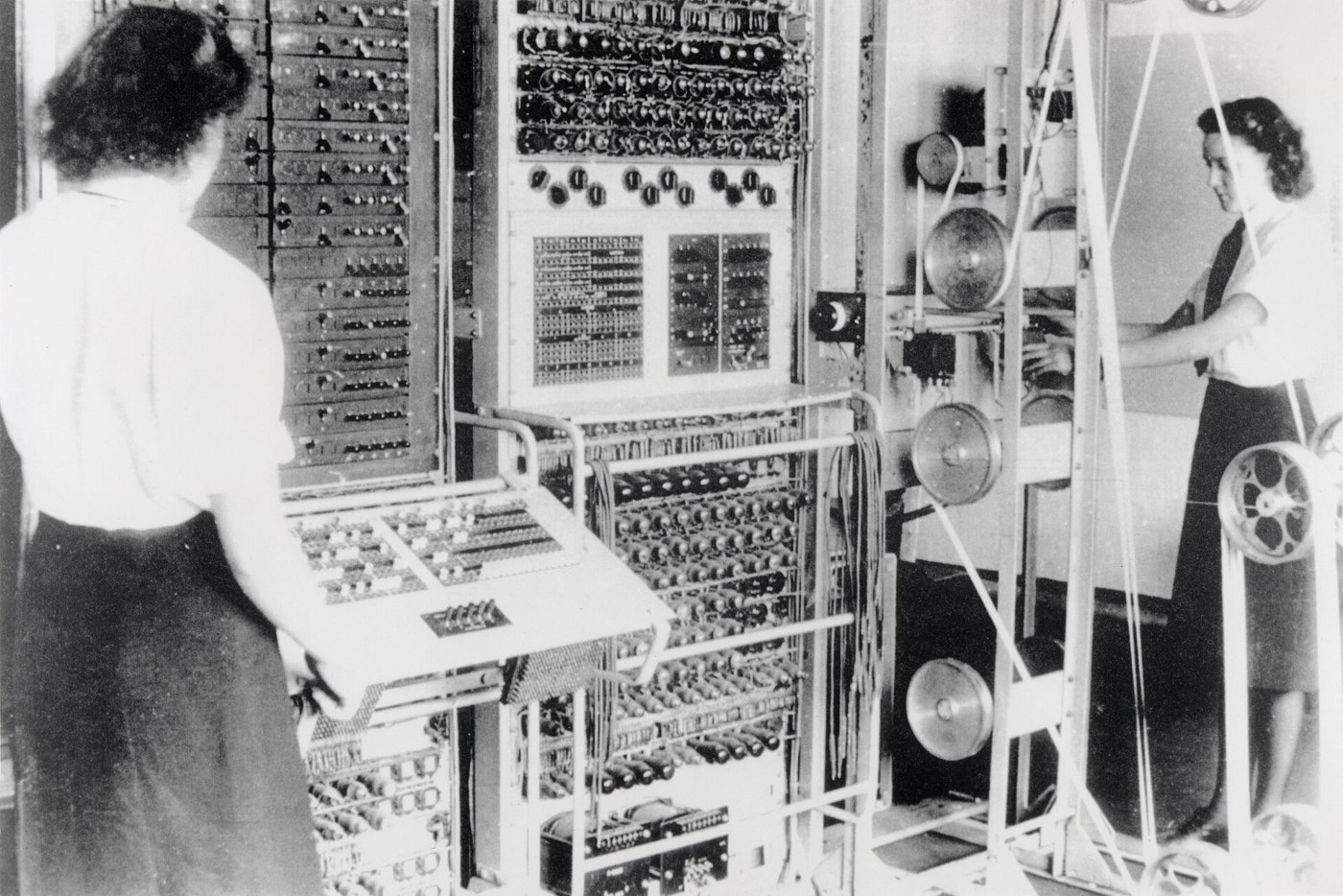
Much of what they built was standard Post Office equipment pressed into an unfamiliar use: Post Office racks, relays, uniselectors (rotary stepping switches from the telephone exchange), plugs, jacks and cords. The valves were what made it new.
8.4.2 Flowers’ own money
Flowers paid for some of the components himself. Copeland records that the personal costs of building the Colossi left his bank account overdrawn at the end of the war. The amount is not reliably recorded, and the claim should not be inflated; but it is consistent with a project that began without an order from the people who would use it.
8.4.3 Design decisions
A few early choices shaped the machine.
Only the message on tape. Flowers at first considered storing the cipher text itself in valves as well, eliminating paper entirely. He dropped the idea because messages of five thousand characters or more had to be processed, and no valve store of that size was practical in 1943. The message stayed on a loop of tape; the wheel patterns went into valves.
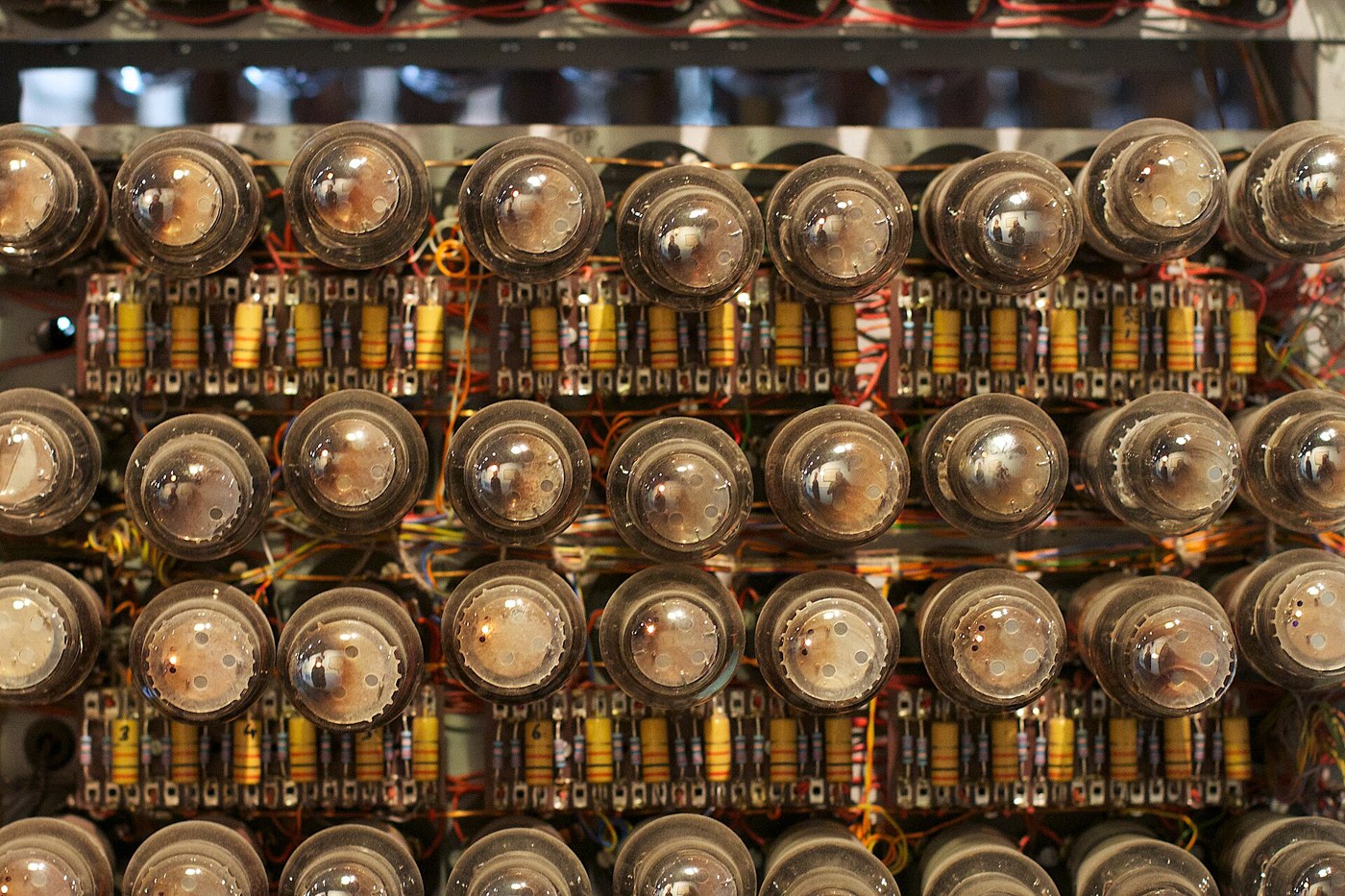
Thyratron rings for the wheels. Each wheel pattern was held in a ring of thyratrons, gas-filled valves that latch on when triggered and stay on until reset. A ring with one stage per wheel position, of which exactly one is “on” at any moment, steps round like the wheel it imitates; patch links set which positions carry a cam. The twelve rings of a fully equipped machine needed 501 stages, one for every cam on the twelve Lorenz wheels (Volume 3).
The tape as clock. The sprocket holes along the tape were read optically along with the data, and the pulse from each one timed everything that happened to that character. However fast or slow the tape moved, the electronics followed it.
Speed set by paper. The reader ran at 5,000 characters a second, two and a half times the best Heath Robinson could manage on short tapes. Tests reportedly pushed the tape to about 9,700 characters a second before it tore apart; 5,000 was chosen as the speed at which the paper could be trusted.
Programmable by hand. The logical test applied to each character was set up with switches and plugs, not built into the wiring. This was a direct inheritance from Heath Robinson’s jack field, and it meant that one machine could run Tutte’s 1+2 test, then the follow-on runs for the other wheels, then other statistics altogether, without rewiring.
8.4.4 How many valves?
The usual figure for the first Colossus is about 1,600 valves (Copeland). Other sources give 1,500 (Tony Sale, who rebuilt the later model) or about 1,800 (the figure sometimes given for Flowers’ original proposal). The differences reflect what is counted — thyratrons, photocell amplifiers, power-supply valves — and should not be pressed. The Mark 2 is usually given as about 2,400 valves, with Sale’s rebuild figure at 2,500.
8.5 Colossus Arrives
The date the first Colossus first worked is less certain than it might seem. Flowers recalled, in later accounts, a trial at Dollis Hill on 8 December 1943, and that date appears in many histories. Copeland, working from Flowers’ own diary, found the entries “Made Colossus work” on 16 January 1944 and “Colossus delivered to B.P.” on 18 January 1944 — evidence that the machine was still being finished at Dollis Hill in mid-January (Copeland, colossus-computer.com). It is possible that parts of it ran in December and the whole machine only in January. Either way, it arrived at Bletchley Park in pieces on 18 January, when Newman wrote to the Director, Edward Travis, a one-line memo: “Colossus arrives to-day.”
It was reassembled in the Newmanry, and on 5 February 1944 Flowers wrote in his diary: “Colossus did its first job. Car broke down on way home.”
8.5.1 What it did
The first Colossus ran the same kind of job as Heath Robinson — Tutte’s chi-setting statistic, and its follow-on runs — but on one tape, at two and a half times the speed, and without the synchronisation failures that had dogged the Robinsons. Copeland’s account says Colossus immediately doubled the codebreakers’ output.
Its timing could hardly have been better. In December 1943, Copeland notes, the Germans had introduced a further change to the Lorenz machines that made reading by depths — the Testery’s old route in — effectively impossible. From then on, statistical machine methods were not an improvement on hand methods; they were the only method. Volume 10 describes what the traffic was carrying at the time: the German high command’s preparations against the expected Allied invasion of France.
8.6 The Order for More
Once Colossus had shown what it could do, the attitude at Bletchley Park changed completely. In March 1944 the authorities asked Dollis Hill for four more machines. By the end of April they wanted twelve (Copeland, Rutherford Journal 3). There was also a deadline. The invasion of France was expected in early summer, and Bletchley Park wanted a second, improved Colossus working by 1 June 1944.
Flowers told them that only one new machine could possibly be ready by that date. That alone required extraordinary priority: Copeland records that Churchill’s support gave the project first call on scarce components and labour.
8.6.1 The Mark 2
The machine that was built to the deadline was not a copy of the first. Experience with the prototype, and with Heath Robinson, had shown what the cryptanalysts wanted, and the Mark 2, its production led by Allen Coombs, was a substantially better machine:
- Five times faster in effect. The tape still ran at 5,000 characters a second, but a short shift register — a chain of stores holding the last few characters read — let the Mark 2 apply the same test to five different wheel positions on each character, in five parallel circuits feeding five counters. A run that needed 1,271 passes of the tape on the prototype needed only about a fifth as many. Volume 9 explains how.
- Simpler to operate, with the run set up on a large switch panel rather than by replugging.
- About 2,400 valves.
- Wheel breaking as well as wheel setting. In February 1944 Donald Michie and Jack Good worked out how Colossus could be used to help find the patterns of the wheels, not just their starting positions — a job that until then had been done by hand. Copeland records that Colossus II incorporated this capability. It mattered sooner than anyone expected (Volume 10).
8.6.2 June 1944
Colossus II was shipped from Dollis Hill on 4 May 1944. Getting it working at Bletchley Park took the rest of the month. Copeland’s account, from the engineers’ recollections, describes the last night: in the early hours, with the deadline close, Chandler traced a fault that had been defeating the team, while a leaking radiator spread a puddle across the floor and the Wren operators worked in gumboots. On 1 June 1944 Flowers wrote in his diary: “Colossus 2 in operation”. Most accounts give the time as 08:00.
The Normandy landings began five days later.
8.7 Ten Colossi
After the first Mark 2, new machines arrived at Bletchley Park at intervals of roughly six weeks. Flowers had earlier proposed building them at a factory in Birmingham and estimated that it could turn out about one new Colossus a month (Copeland). By the end of 1944 seven Colossi were working; at the German surrender in May 1945 there were ten, and an eleventh was nearly ready. The first machine was later brought up to Mark 2 standard. Of the ten, seven were used for wheel setting and three, equipped for the purpose, for wheel breaking.
The machines were numbered, and some acquired names; the surviving wartime photographs, published in the General Report on Tunny, show Colossus 10 in Block H at Bletchley Park with an extended bedstead that could hold a longer tape. By April 1945 the ten Colossi were running around the clock, with the Wrens on shifts and the Post Office engineers maintaining them in place.
8.7.1 Reliability in practice
Flowers’ argument about reliability was borne out. The Colossi were kept running continuously; they were not switched off at night or between jobs, and valve failures, when they came, were found and fixed by engineers on hand. There is no wartime record in the published sources of the machines being out of action for long stretches, and the cryptanalysts’ complaints in the General Report on Tunny are about tapes, setting-up errors and the statistics, not the electronics. A machine of 2,400 valves running day and night for months was the strongest possible answer to the objection of February 1943.
8.8 What Kind of Machine Was It?
Colossus is often called the first electronic digital computer, and the claim needs care. It was electronic: its logic and counting were done by valves, not relays. It was digital: it worked on ones and zeros. It was programmable, in the sense that its test was set up by switches and plugs and could be changed between runs without rewiring.
It was not a general-purpose computer, and it did not store its program in memory. It could not, for instance, be set up to multiply two numbers or to invert a matrix. It was a special-purpose machine for applying Boolean tests to a stream of teleprinter characters and counting the results — a statistical engine for one family of cryptanalytic problems, of very high performance. Copeland emphasises that it did not produce plaintext at all: it produced counts that told the cryptanalysts what the wheel settings or patterns probably were.
Those distinctions matter for the arguments about precedence taken up in Volume 11, but they do not diminish what Flowers did. In 1943 he designed and built the largest electronic digital machine yet made, using a technology most experts thought could not be trusted at that scale, and he was right.
8.9 After the War
Flowers was made an MBE in June 1943, for earlier war work. After the war he was paid £1,000 by the government in recognition of Colossus, which by his account did not cover what he had spent on it. Everything he had done remained covered by the Official Secrets Act, and he could not tell anyone — including the people he hoped would fund his peacetime work — what he had built.
8.9.1 The ACE and other machines
In 1946 the National Physical Laboratory asked Flowers to build the hardware for Turing’s Automatic Computing Engine, the stored-program computer Turing had designed after the war. In March 1946 Flowers said that a minimal ACE could be ready by August or September that year; but Dollis Hill had a backlog of urgent telephone work, and the timetable could not be kept (Copeland). He later said that he had sought a loan from the Bank of England to build a computer and been refused, because the bank did not believe such a machine could work — the very objection he had overcome in 1943, and one he could not answer without breaking the Official Secrets Act.
He returned to telephone engineering, leading work on electronic exchanges at Dollis Hill. In the 1950s his division also produced ERNIE, the Electronic Random Number Indicator Equipment that has drawn the winning numbers for Britain’s Premium Bonds since June 1957; National Savings and Investments’ own history credits Flowers with overseeing the project and Harry Fensom as its chief engineer (NS&I, “From codebreakers to millionaire-makers”).
8.9.2 Recognition
Flowers’ part in Colossus began to emerge only in the 1970s, through the research of Brian Randell and the release of official photographs in 1975 (Volume 11). In 1983 he was allowed to publish a technical account of the first machine, “The Design of Colossus”, in the Annals of the History of Computing (volume 5, number 3, pages 239–252), alongside Allen Coombs’s “The Making of Colossus”. The same year he received the first Martlesham Medal. He died in Mill Hill, north London, on 28 October 1998, aged 92 — two years after he had watched the Duke of Kent switch on the first working parts of the Colossus rebuild at Bletchley Park.
8.10 The Engineer’s Achievement
Seen from the Newmanry, Colossus was the answer to a cryptanalytic problem. Seen from Dollis Hill, it was a piece of engineering that should not have been possible on that timetable. Flowers and his team took an idea in February 1943, built it without an order in eleven months, delivered a better version on a deadline set by the invasion of Europe, and then put ten of the machines into round-the-clock service. They did it with Post Office racks, telephone-exchange relays and valves that had never before been asked to work in such numbers, and they were proved right about every one of the points on which they had been doubted.
The next volume opens the racks and follows a single character of cipher text through the machine.
Next — Volume 9: How Colossus Worked — Tapes, Valves, Counters and the 1+2 Break-In. A loop of tape racing round the bedstead at nearly thirty miles an hour; sprocket holes that set the beat for 2,400 valves; twelve rings of thyratrons pretending to be Lorenz wheels; a switch panel on which a Wren set up a Boolean test; five counters, a threshold and an electric typewriter — and Tutte’s statistic, step by step, run by this series’ own software on a message enciphered on a real Lorenz SZ42 for the 2007 Cipher Challenge.
Comments (0)