Lorenz and Colossus · Volume 6
Lorenz and Colossus — Volume 6 — The Testery — Breaking Tunny by Hand
Major Ralph Tester's section, from four German speakers in July 1942 to 118 people on three shifts in 1945: depths, cribs, padding sentences and Turing's pencil-and-eraser method; the October 1942 indicator change that nearly shut them out; the limitations that made the plain text drive the machine; and the long partnership with Newman's machines, in which Colossus set the chi wheels and the Testery finished the job by hand
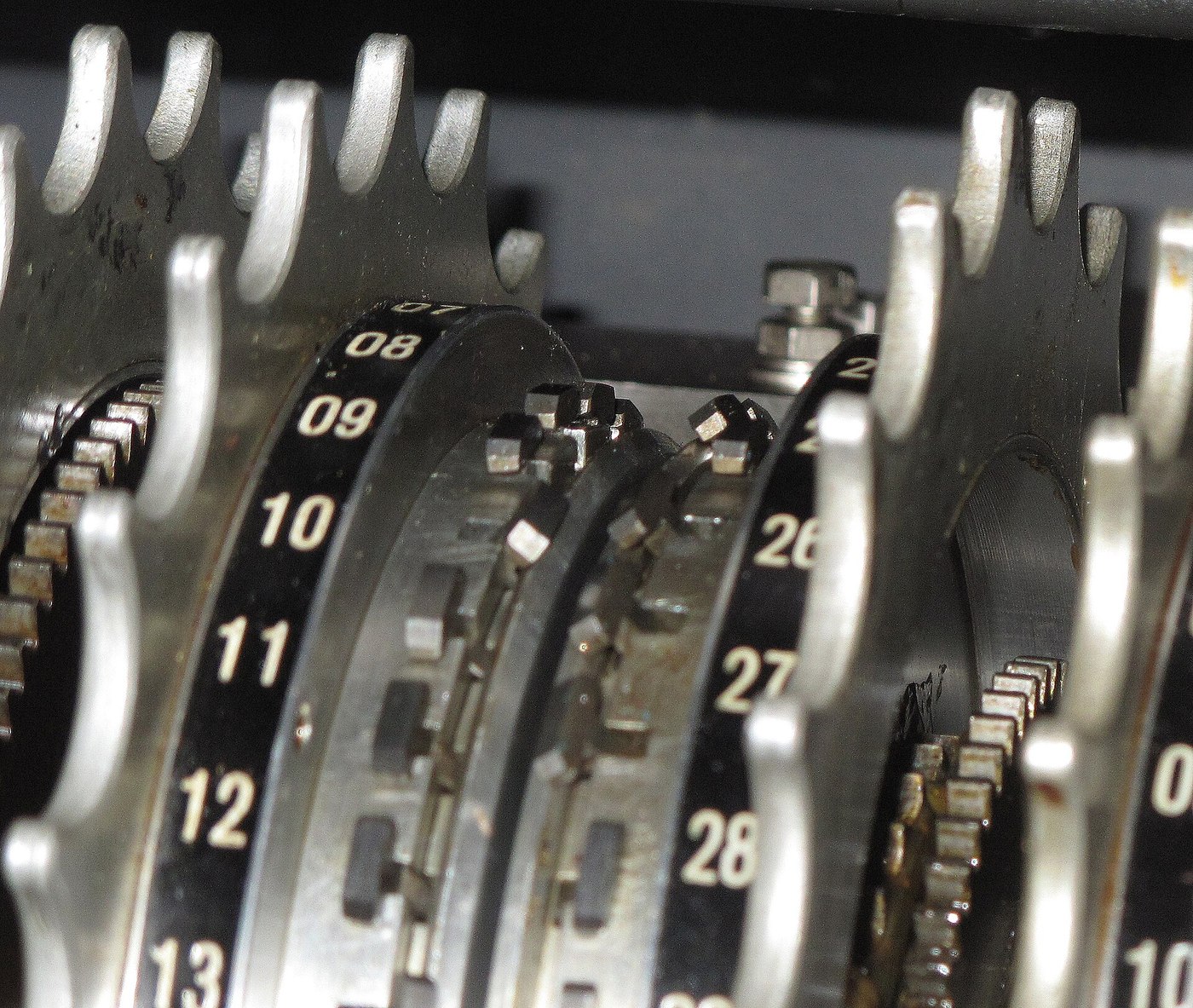
6.1 About This Volume
By the spring of 1942 Bletchley Park knew how the Lorenz machine worked (Volume 5). Knowing how it worked did not mean reading its messages. For each month, on each link, someone had to recover the cam patterns of all twelve wheels; for each message, someone had to find the twelve start positions; and then someone had to run the cipher text through a copy of the machine and turn the result into readable German. For the first year and a half of the Tunny war, all of that was done by hand, by a section that never numbered more than nine codebreakers.
That section was formed in July 1942 under Major Ralph Tester and known, inevitably, as the Testery. This volume describes who its people were, the methods they used — reading depths, dragging cribs, Turingery — how they coped with each change the Germans made, and how, after the arrival of Colossus in 1944, the work divided between the Testery’s hands and the Newmanry’s machines. Its main source is the Testery’s own history, chapter 43 of the General Report on Tunny, “Testery Methods 1942–44” (Good, Michie and Timms 1945, transcribed by Tony Sale), supplemented by the recollections of Tutte, Peter Hilton and Jerry Roberts.
6.2 Major Tester’s Section
Ralph Paterson Tester (1902–1998) was not a codebreaker and did not pretend to be one. He was an accountant who had spent much of his career in Germany and spoke fluent German; before the war he held a senior post in the accounts division of Unilever, and when war broke out he joined the BBC Monitoring Service, which listened to German public broadcasts. Recruited to Bletchley, he led a small group working on the double Playfair cipher of the German military police from late 1941 (Wikipedia, “Ralph Tester”). In July 1942, as the volume of Tunny traffic grew and the methods for reading it matured, he was given a new section to exploit it: the “Fish Sub-section of the German Military Section”, in its own official title. Jerry Roberts, one of its first members, remembered him as “the imperturbable, pipe-smoking Tester” who “spoke fluent German, but did not pretend to be a codebreaker.”
The section began with four people, all fluent German speakers: Tester himself, Captain Jerry Roberts, Captain Peter Ericsson and Major Denis Oswald. Most of its early cryptanalysts came, like Tutte, from the Research Section. By the end of the war in Europe the Testery had nine cryptanalysts, 24 members of the Auxiliary Territorial Service (the ATS, the women’s branch of the Army) and a total staff of 118, organised in three shifts working round the clock (Wikipedia, “Testery”). Its codebreakers over the years included:
Table 1 — The section began with four people, all fluent German speakers: Tester himself, Captain Jerry Roberts, Captain Peter Ericsson and Major Denis Oswald. Most of its early cryptanalysts came, like Tutte, from the Research Section. By the end of the war in Europe the Testery had nine cryptanalysts, 24 members of the Auxiliary Territorial Service (the ATS, the women's branch of the Army) and a total staff of 118, organised in three shifts working round the clock ([Wikipedia, "Testery"](https://en.wikipedia.org/wiki/Testery)). Its codebreakers over the years included
| Name | Later known for |
|---|---|
| Jerry Roberts (1920–2014) | Shift leader; market research; campaigned for recognition of the Tunny codebreakers |
| Peter Ericsson | Shift leader and senior codebreaker |
| Denis Oswald | Senior codebreaker and linguist |
| Peter Hilton (1923–2010) | Algebraic topologist |
| Roy Jenkins (1920–2003) | Labour Chancellor of the Exchequer and Home Secretary |
| Peter Benenson (1921–2005) | Founder of Amnesty International |
| Donald Michie (1923–2007) | Pioneer of artificial intelligence (shared with the Newmanry) |
| Peter Edgerley, John Christie, Jack Thompson | Codebreakers |
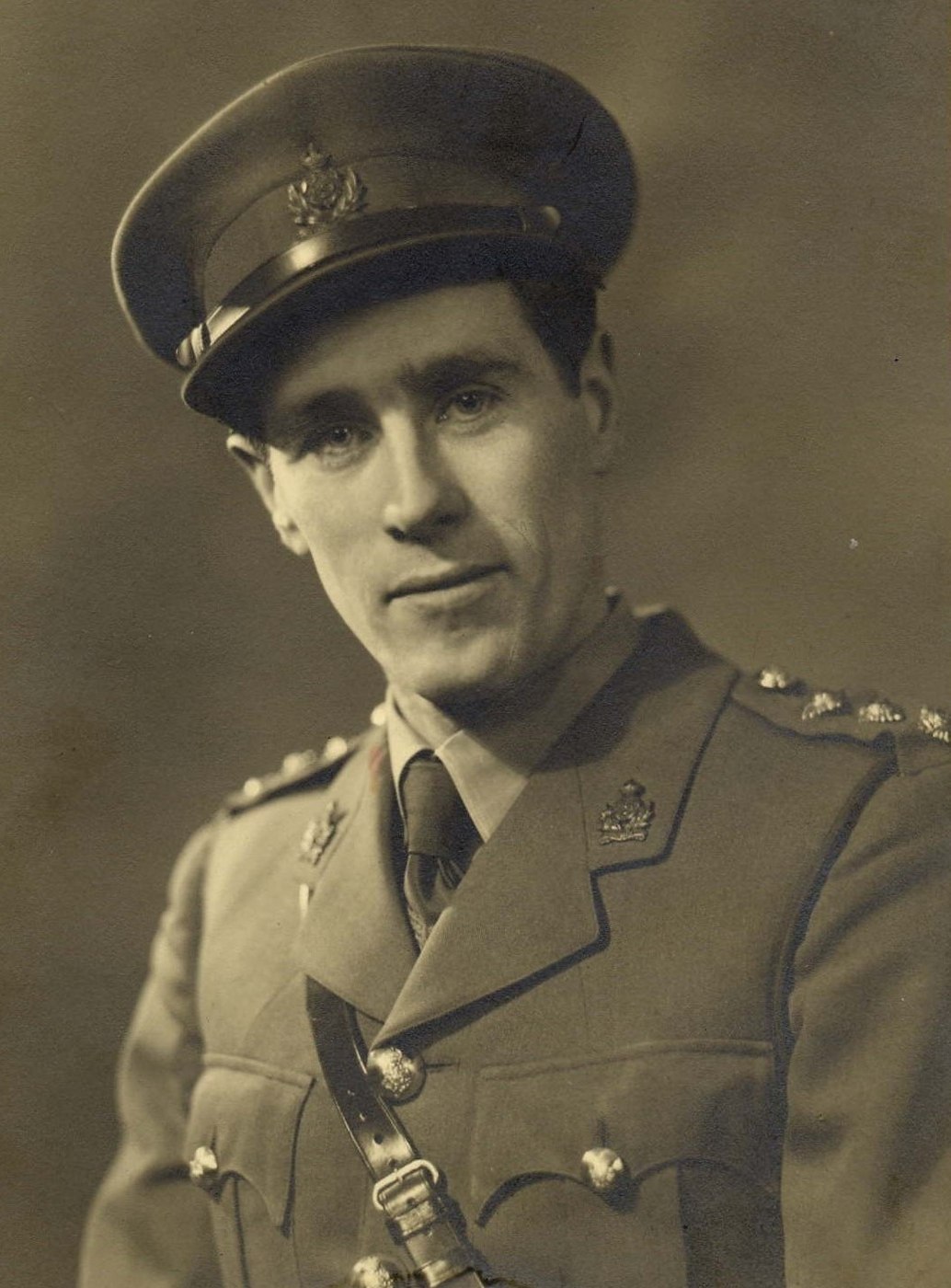
The mixture is characteristic of Bletchley: linguists and mathematicians, older men with business careers and undergraduates barely out of school. Peter Hilton arrived at Bletchley on 12 January 1942, aged eighteen, an Oxford mathematics student who had been offered a Foreign Office job without being told what it was. He started in Hut 8 on naval Enigma, moved to Tunny in late 1942, and worked between the Testery and the Newmanry. He had an unusual gift for depth reading — he could visualise two teleprinter streams at once — and remembered it as the best part of the work: “the real excitement was this business of getting two texts out of one sequence of gibberish” (Daily Telegraph obituary, 2010, via MacTutor). Roy Jenkins, the future Chancellor of the Exchequer, was a Testery codebreaker too (sources differ on whether he joined in 1942 or 1944); GCHQ’s history records, with evident pleasure, that he and Peter Benenson were disciplined in September 1945 for misappropriating lunch sandwich tickets (GCHQ, “Roy Jenkins”).
6.3 What “Breaking a Message” Meant
Every Tunny message, to be read, needed four things:
- The chi patterns — which of the 150 cams on the five chi wheels were raised.
- The psi patterns — the 253 cams of the five psi wheels.
- The motor patterns — the 98 cams of the two motor wheels (which were changed more often than the others).
- The settings — the start position of each of the twelve wheels for this message.
The first three, together, Bletchley called wheel patterns or simply “the wheels”, and recovering them was wheel breaking. Finding the fourth, given the patterns, was setting. In 1942 and most of 1943 the Germans changed chi and psi patterns monthly and the motor patterns daily, and each link had its own patterns; so breaking a link’s wheels for a month “released” that month’s traffic for setting, message by message. From the summer of 1944 every pattern changed daily, and wheel breaking became an every-day task (General Report, §43D(e)).
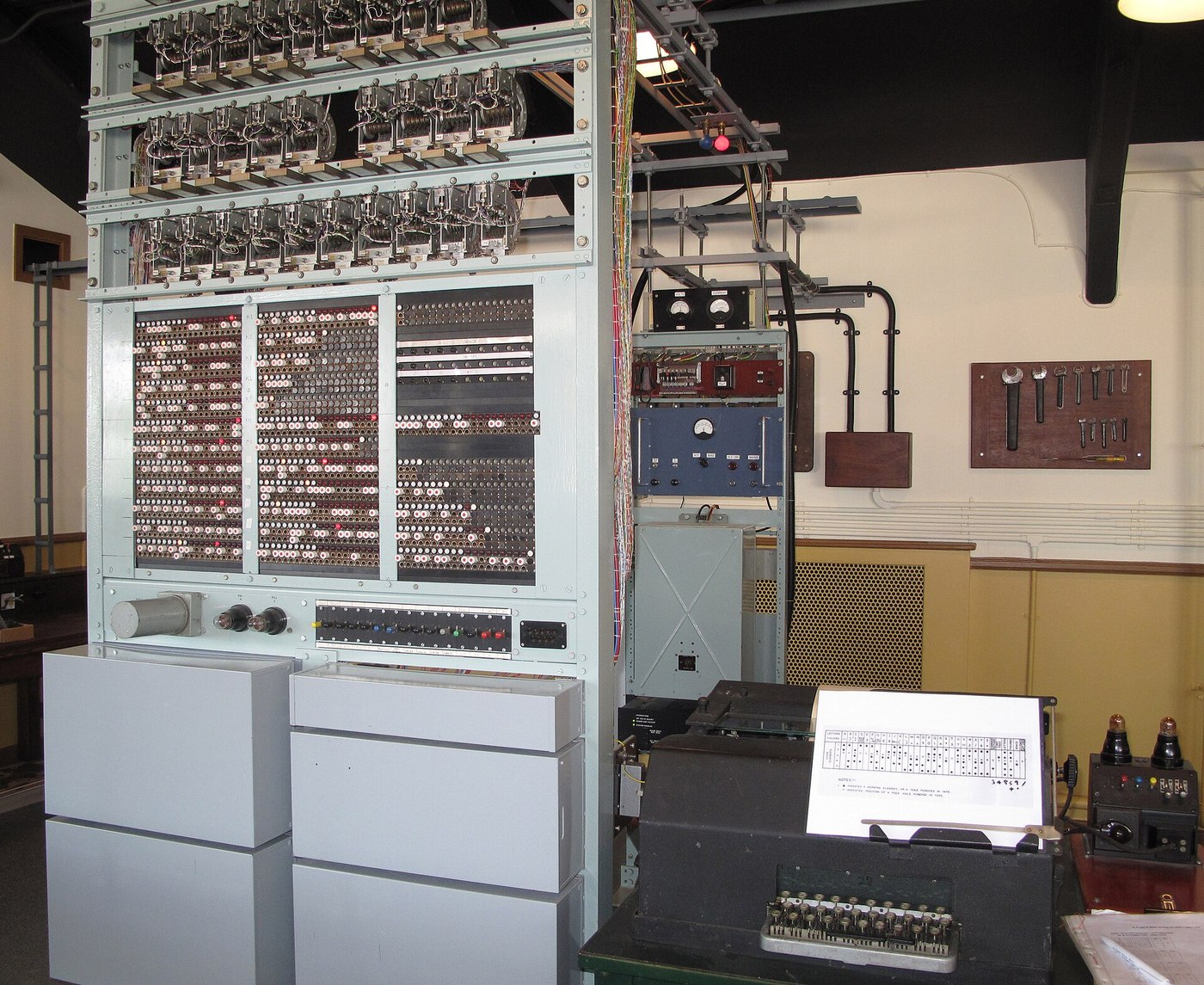
Once both were known, the message could be deciphered — and here the Testery had help from the start. The Post Office Research Station at Dollis Hill built relay-and-uniselector copies of the Lorenz machine, known at Bletchley as British Tunnies: the patterns were set up on plug panels, the start positions dialled in, the cipher tape run through a teleprinter, and the plain text came out on paper. Wren operator Dorothy Du Boisson later said setting one up was like working an old telephone exchange. Ten British Tunnies were in Testery use by the end of the war.
6.4 The First Months: Indicators, Depths and Padding
The Testery’s first major job, in August 1942, was to break that month’s wheels. It began with a method that used the indicators. Under the twelve-letter indicator system, each message told its receiver, in clear, which letter each wheel should be set to; and the same letter always meant the same position on a given wheel. Every message read therefore placed one known letter on each wheel, and every message whose indicator shared a letter with it shared that wheel’s setting. By reading messages that began with stereotyped openings — SPRUCHNUMMER and the like — and fitting them together through their indicators, the Testery could build up the wheel patterns and the settings at the same time.
For the first ten days of August, the General Report records, “the traffic responded well, except for the bad corruption caused by exceptionally poor intercept conditions. But from the 11th onwards only a very few messages seemed to produce the stereotyped openings.” The German operators had begun to open their messages with a few sentences of nonsense padding — Quatsch, rubbish, as the Testery called it — which “continued as the invariable preliminary to the message text throughout Fish history” (General Report, §43A). The padding was meant to deny the codebreakers predictable openings. It worked, but not completely: “it was often possible to predict the next letter of partially obtained words and thus progress was made”, and by the time the Germans sent a depth on the 27th the Testery had built up the χ5 wheel.
6.4.1 Depths, again
The depth was the Testery’s bread and butter. Two messages on the same key — recognisable, in this period, from their identical indicators — could be read against each other exactly as Tiltman had read the long depth of 1941 (Volume 4): guess a word in one, add it to the sum of the two cipher texts, and see whether German comes out in the other. It was linguists’ work as much as mathematicians’, and the best depth readers could carry a reading forward letter by letter, using the habits of German military prose, the operators’ abbreviations and their characteristic mistakes. The result was key — and from key, given the patterns, the settings; or, given enough key, the patterns themselves.
6.5 Turingery
Breaking the wheel patterns from a stretch of key was a different problem from Tutte’s diagnosis. Tutte had worked from 1941 key with conveniently flawed psi patterns. By 1942 the Germans had improved them, and the simple period-finding methods no longer worked. In July 1942 Alan Turing, on loan from the naval Enigma section, spent a few weeks with the Research Section on the key from which the July wheels had been broken, and devised a hand method that produced the correct wheels. It became known as Turingery — or, in the mock-German of Hilton, Michie and Ericsson, Turingismus — and for a time it was “the only known way of breaking wheels” (General Report, §43B).
Turingery’s lasting contribution was an idea, not a procedure. It introduced differencing: instead of looking at the key K, look at ΔK, the key with each character added to the next. Wherever the psi wheels stood still, Δψ′ is all dots, and there ΔK equals Δχ exactly. The General Report is emphatic about the importance of this step: “This Delta principle was to be the fundamental basis of nearly all statistical methods of wheel-breaking and setting” — including Tutte’s statistical method and everything Colossus did (Volume 5).
The procedure itself, as the General Report reconstructs it, went like this.
- Write out ΔK. The differenced key was written in ink on squared paper, one column per character, and the five rows beneath marked off with vertical lines at the period of each chi wheel. Everything after that was done in pencil.
- Guess a still point. Pick a position and assume that the psi wheels did not move there, so that Δψ′ = / (all dots) and ΔK at that position is Δχ. Enter those five Δχ signs on their chi periods throughout the key, underlined.
- Spread the guess. From every underlined sign, deduce a sign on each of the other four impulses, using the statistical tendency of ΔK and Δχ to agree. Each deduction is only probable, not certain.
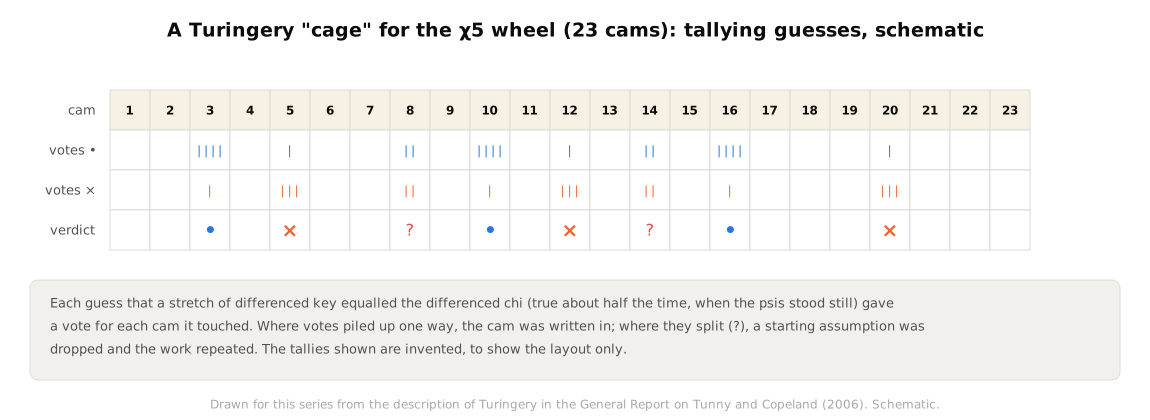
- Fill the cages. Write all the deduced signs into five cages — sheets of columns, one column for each cam of a chi wheel: 41 columns for χ1, 31 for χ2, and so on down to 23 for χ5. If the original guess was right, the signs falling in each column will agree with one another more often than they disagree.
- Judge the guess. Count agreements and disagreements column by column. If the excess is poor, “we scrap the cages, erase the workings and take the next Delta-K letter” as a new guess. If it is good, accept the column scores as a first, rough Δχ for each wheel.
- Iterate. Use the rough Δχ to find more still points, re-score, and refine, working round the wheels from χ5 (the shortest, which accumulates evidence fastest) to χ1 and back, until all five Δχ patterns are consistent. Integrate them into chi patterns; strip the chi from the key; what remains is ψ′, from which the psi patterns are read off by removing the repeats.
The original method needed 500 characters of key or more. Tutte called it “a method requiring great artistry. I never used it successfully myself” (Tutte 1998), and Copeland describes it as “a hand method, involving paper, pencil and eraser” (Copeland 2010). It was refined steadily throughout the war — more accurate scoring, recognising the repeats in the psi stream, exploiting new statistical regularities as they were found — until wheels could be broken from much shorter stretches of key in a fraction of the time.
With Turingery in hand, the Testery broke the September wheels from a depth sent on 5 September, and October’s from a near-depth. Between July and October 1942, Copeland writes, it “read nearly every message”.
A simulation shows why the known patterns make a crib so much more powerful once the chi wheels are set. A 48-letter message containing the word SPRUCHNUMMER was enciphered by the unit’s simulator (lorenz_sim.py, via 03-outputs/tools/slot_examples.py) on invented SZ40 wheel patterns, and the chi stream was then removed, leaving the de-chi D = P + ψ′:
DGN+DCE4RERWU8+DBLLG+3IJFQKSIEMQBHKUPHCZYGG4PNF4
The crib was laid against D at each of the 37 possible positions. At each one, D + crib gives twelve letters that would have to be extended psi. That is a strong condition, because ψ′ can only do two things from one letter to the next: repeat (the psis stood still) or step once along the five known psi patterns together. A program tried every possible pattern of stops and moves over the twelve letters (2¹¹ of them) against every start of every psi wheel. At 36 of the 37 positions no combination fitted; at position 0, for example, the implied ψ′ is NNIMUGFSPXJB, which no run of the real psi wheels can produce. At one position — the true one, 20 letters in — the implied ψ′ was VVNNAAA4GXXX — runs where the psis stood still, joined by single steps — and exactly 3 of the 2,048 patterns of stops and moves fitted it, differing only over the last two letters. All three put ψ1 at the same position, which is the true one. The crib was placed, and the psi wheels were already all but set. This is a simulation with invented patterns, not wartime traffic.
6.6 October 1942: The Indicators Go
At the end of October 1942 the original Tunny link closed down. For a while Bletchley wondered whether the Germans had abandoned the machine. Two new links appeared — Codfish, between Salonika and Berlin, and Octopus — and an analysis of depths of three showed that both were using the same machine (General Report, §44A). But they no longer sent twelve-letter indicators. Instead the preamble carried only a number, at first prefixed QSN and later QEP; the operators looked up their twelve wheel settings against that number in a book issued to both ends of the link.
The effect on the Testery was immediate. With the indicators gone, messages could no longer be related to one another through shared letters, and the indicator method of breaking wheels was dead. What remained was the depth. Two messages with the same QEP number on the same day on the same link were in depth, and could be recognised as such; nothing else could be read. “This meant a serious reduction in the amount of traffic decoded,” the General Report says, “because we had to rely entirely on depths” (§43C). For the first half of 1943 the Testery “confined itself to the reading of depths” (§44A).
It was saved, for a while, by German carelessness. “Fortunately the Germans sent frequent and sometimes multiple depths — sometimes as many as 10 messages on the same QEP number.” Codfish was particularly generous: “Depths of more than a dozen messages were not unknown on this link.”
6.6.1 Setting from a depth
With the month’s patterns known, a depth gave a stretch of key, and the key had to be set — placed against the patterns to find the twelve start positions. The Testery’s method was to “make a drag”: take the fifth impulse of the key, strip off the χ5 contribution at each of the 23 possible settings of χ5, and look at the 23 resulting candidate ψ′5 streams. Most could be discarded at once because they could not be fitted to the known ψ5 pattern however its repeats were arranged. The survivors were tested against a second impulse, then a third, until all the psis and chis were set; the motor was then broken or set by “anagramming” the known pieces. The key needed was short: “the length normally used is from 14 to 30” characters (§43C(b)).
6.7 The Limitations
The Germans’ next changes were to the machine itself. From February 1943 the SZ42A introduced the first of a series of limitations — modifications to the motor logic that made the movement of the psi wheels depend not only on the motor wheels but on other parts of the machine. Volume 3 describes them; their effect on the hand methods is the point here.
The first, which Bletchley called χ2 one-back, made the psi motion depend in part on the previous position of the second chi wheel. The Germans doubled the number of dots on μ37 to keep the overall proportion of psi movement about the same. It complicated setting and key breaking, and it destroyed a convenient rule — that the old motor could never hold the psis still for more than two characters running — but it could be handled: the Testery adapted its drags to work on the second impulse, and found ways to use the limitation itself as evidence.
The second was far more serious. On the Herring link, between Rome and Tunis, which operated from December 1942 until the German collapse in Tunisia in May 1943, a limitation appeared that brought in the fifth impulse of the plain text two characters back (Bletchley’s “P5 two-back”). That made the machine an autoclave: the key now depended on the message. Two messages started at the same settings would diverge as soon as their plain texts differed, so even genuine repeats of the setting no longer produced depths. “Thus work on Herring was made impossible” — until the Germans themselves gave it up. A single error in the fifth impulse on reception now garbled the rest of the message and forced a complete retransmission, and under the pressure of the Tunisian campaign the attachment proved unworkable. It was abandoned, and “from then on the Germans sent an enormous quantity of traffic; the majority was sent in depth (often multiple depth), presumably because they could hardly spare the time to reset their machines” (§43C(g)).
The Testery’s output in that spring reached a level it would not see again until the machines were in full swing:
The effort and production of the Testery reached an unprecedented peak, at a time when the messages broken were of great operational importance. In May the section decoded over 1,400,000 letters, a figure which was not equalled until March, 1944, when the Newmanry was in full swing.
— General Report on Tunny, §43C(g)
6.8 Enter the Newmanry
Meanwhile Tutte’s statistical method (Volume 5) had shown that a single message, not in depth, could be set by counting — if the counting could be mechanised. Max Newman was given the job in December 1942; his section received its first machines, a Heath Robinson and a British Tunny, in the spring of 1943 and began operational work that summer (the General Report dates the section’s formation variously, from December 1942 to July 1943, according to what is being counted). Its purpose, as chapter 43 puts it, was “to set messages not sent in depth, by mechanical and statistical methods. Since the introduction of QEP’s these messages had not been touched.”
For the first few months the Newmanry struggled to get its machines working reliably, and the Testery helped out by hand: given a print-out of a partly de-chied message from Robinson, it would find a break opposite a run of dots in the motor stream and extend it until the psis could be set.
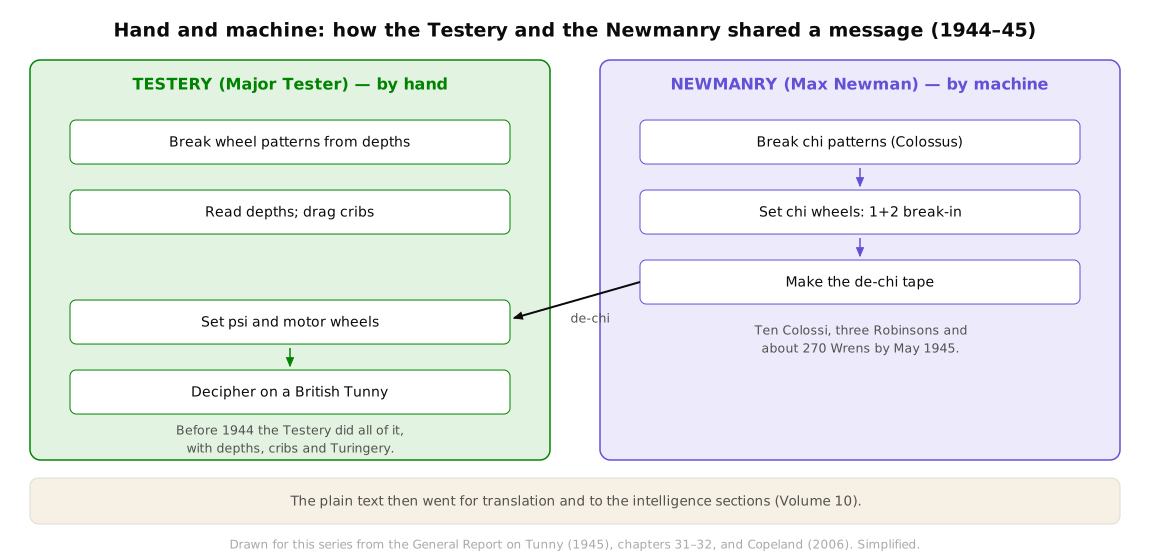
Then, in mid-December 1943, the Germans brought the plain-text limitation back, on nearly all links. Depths “could no longer occur” — and with them went “the main source of decodes and the whole source of employment for the Testery” (§43D(c)). The two sections had to find a new division of labour. The Newmanry’s machines would set the chi wheels by Tutte’s statistics and produce the de-chi: the cipher text with the chi component removed, leaving plain text plus extended psi. The Testery would take the de-chi and set the psi and motor wheels by hand. “So the Testery had to master the art of setting the psis by hand from the de-chis prepared by the Newmanry, and this became their main job.”
6.8.1 De-psi-ing
A de-chi looks like a depth of a peculiar kind: plain text plus a key that is constant for long stretches and changes only when the psi wheels move. The Testery’s codebreakers read it by looking for the stretches where the psis had stood still and the de-chi therefore showed the plain text’s own character differences, recognising German words through the extended psi, and then building outwards. The process was called de-psi-ing, and, when it went badly, “deep sighing” (Tutte 1998). It depended above all on how often the psis stood still, which depended on how many dots the Germans had set on the motor wheel μ37. The General Report records the January 1944 Bream psi patterns being broken from two de-chis “within an hour” — μ37 had 26 dots that month — and the February patterns only “with great difficulty and effort from one de-chi”, because μ37 had only 19.
The first operational Colossus arrived at Bletchley in January 1944 and attacked its first message on 5 February (Volume 8). From then on the partnership became routine. Jerry Roberts emphasised, in his later campaign for recognition, that the hand work in the Testery remained the heavier load: Colossus set the chi wheels in minutes, but every message it set still had to be finished by people.
6.9 Daily Change, and the Last Year
In the summer of 1944 the Germans began changing all wheel patterns every day — from 1 August on all links. “The time and energy previously expended to release a whole month’s traffic for setting now only released one day’s traffic,” the General Report notes. “The emphasis in the Testery as well as the Newmanry changed from wheelsetting to the much more difficult job of wheelbreaking.” This was the change that should have defeated Bletchley, and it did not. Methods for breaking wheels had been refined throughout 1943 and 1944 — more accurate scoring formulae, new statistical regularities in the chi patterns, ways of exploiting the χ2 one-back limitation — and the Newmanry now had Colossi able to break chi patterns from cipher text alone. “The concerted efforts of both sections met with such success that the production figures for August, 1944, the first month with daily change on all links, was higher than ever before, and the figures continued to rise steadily month after month” (§43D(e)).
By March 1945, according to the American liaison officer Walter Jacobs, more than five million letters of Tunny were being deciphered in a single month (Wikipedia, “Fish (cryptography)”). The last steps for every one of those messages — setting the psi and motor wheels and running the tape through a British Tunny — were done in the Testery.
6.10 After the War
The Testery was disbanded with the rest of the wartime Bletchley organisation. Its members went back to civilian life under the Official Secrets Act, and most of them never spoke of Tunny again. Ralph Tester went to Germany in 1945 with the TICOM teams sent to interrogate German cipher experts and recover their equipment; with Arthur Levenson of the US Army he brought back to Bletchley an SZ42B, one of two found in Field Marshal Kesselring’s communications train near Salzburg — the first Lorenz machine the Testery had ever handled (Tiltman, c. 1961). He then returned to Unilever. Roy Jenkins went into politics; Peter Benenson into law and, in 1961, to the founding of Amnesty International; Peter Hilton into mathematics, at Manchester, Cornell and Binghamton; Donald Michie into genetics and then artificial intelligence at Edinburgh.
Jerry Roberts (1920–2014) worked after the war for the War Crimes Investigation Unit in Germany, then spent fifty years in market research in London, Venezuela and New York. In his last years, as the last survivor of the Testery’s codebreakers, he campaigned for public recognition of the Tunny work and of the people who did it — above all Tutte, Turing and Flowers — appearing in the BBC Timewatch film Code-Breakers: Bletchley Park’s Lost Heroes in 2011. He was appointed MBE in 2013. His memoir, Lorenz: Breaking Hitler’s Top Secret Code at Bletchley Park, was published posthumously in 2017 (Wikipedia, “Jerry Roberts”). Most of his colleagues, he pointed out, had died before Tunny was declassified, without ever being able to tell their families what they had done.
How many Tunny messages the Testery read in all is not recorded in a single figure in the sources consulted for this series. The General Report gives monthly production in letters rather than messages; the National Museum of Computing gives some 63 million characters for the whole Tunny effort. The numbers matter less than the method: for eighteen months before Colossus, and for every message after it, Tunny was finished by hand.
6.11 The One-Paragraph Version
The Testery was formed in July 1942 under Major Ralph Tester, a German-speaking accountant, with four founding members — Tester, Jerry Roberts, Peter Ericsson and Denis Oswald — and grew to nine codebreakers and 118 staff. At first it broke each month’s wheels from the twelve-letter indicators, stereotyped openings and depths, and from July 1942 with Turing’s hand method, Turingery, which introduced the decisive idea of differencing the key; from July to October 1942 it read almost every message. The QEP code-book indicators of October 1942 left it only depths to work on, which careless German operators supplied in quantity until the plain-text “limitation” of December 1943 ended depths altogether. From then on the Newmanry’s machines set the chi wheels and produced de-chis, and the Testery set the psi and motor wheels by hand and deciphered every message on its relay British Tunnies. When the Germans went to daily wheel changes in August 1944, the two sections together produced more than ever before. Most of the Testery’s members kept their secret for life; Jerry Roberts, the last of them, spent his final years making sure it was told.
Next — Volume 7: Max Newman and Heath Robinson. A Cambridge topologist who taught Turing about computable numbers, given the job of mechanising Tutte’s statistics; a section that began with one cryptographer, two engineers and sixteen Wrens in a single room; and a machine of photoelectric tape readers, pulleys and counters named after a cartoonist’s contraptions — how it worked, why its two tapes kept slipping, and why its failings led straight to Colossus.
Comments (0)