Lorenz and Colossus · Volume 10
Lorenz and Colossus — Volume 10 — Fish at War — Tunny Links, Sturgeon and D-Day
The radio teleprinter network that carried the German high command's orders to its army groups, the Kent farm where it was taken down as ink on paper, the other 'Fish' machine that was not a Lorenz at all, and what the decrypts said about Kursk and Normandy
10.1 About This Volume
The earlier volumes followed the codebreakers and their machines. This one follows the traffic. It asks what the Lorenz machines were used for, how the British got hold of their signals, how a decrypt travelled from a German radio transmitter to an Allied commander, and what difference it made.
It covers the family of German teleprinter ciphers that Bletchley Park called Fish; the network of Tunny links that connected the German army high command with its army groups from Norway to the Black Sea; the intercept station at Knockholt in Kent; the other important Fish machine, the Siemens & Halske T52 — Sturgeon — which is often confused with the Lorenz and is a quite different device; the changes the Germans made to the Lorenz machines and their procedures during the war; and two moments at which Tunny decrypts mattered: the German offensive at Kursk in 1943 and the Allied invasion of Normandy in 1944.
Military intelligence is the hardest part of this story to state precisely. Many claims about what Tunny “revealed” are repeated without a citation, and most of the decrypts themselves are still not published in full. This volume keeps to what Copeland, GCHQ and the documentary record support, and says where a story rests on one person’s recollection.
10.2 Fish
In 1941 British intercept operators began to hear a new kind of German army transmission: not Morse code, but the rapid five-unit signals of radio teleprinters. Bletchley Park gave the general name Fish to the enciphered teleprinter traffic, and individual machines and links got fish names of their own. The origin of the cover name is usually traced to a German term, Sägefisch (sawfish), used for a radio teleprinter system (Wikipedia, “Fish (cryptography)”; Crypto Museum, “T-52”).
Three Fish machines mattered:
Table 1 — Three Fish machines mattered
| British name | German machine | Users | Broken? |
|---|---|---|---|
| Tunny | Lorenz SZ40, SZ42A, SZ42B (Schlüsselzusatz, cipher attachment) | Army high command and army groups; radio links | Yes, routinely from 1942 |
| Sturgeon | Siemens & Halske T52 (Geheimschreiber, “secret writer”) | Luftwaffe, navy; largely landlines and fixed circuits | Diagnosed and broken, but little read |
| Thrasher | probably the Siemens T43, a one-time-tape machine | a few circuits late in the war | Diagnosed; considered unbreakable |
Sources: Copeland, Rutherford Journal 3 (2010); Wikipedia, “Fish (cryptography)” and “Siemens and Halske T52”.
Volumes 3 to 9 are about Tunny. This volume returns to Sturgeon below, because the two machines are so often mixed up in captions and museum labels.
10.3 The Tunny Network
The Lorenz machine was not a field cipher. It was heavy, it needed mains power and a teleprinter, and it was used where the German army’s highest levels of command needed to exchange long written messages fast: between the Oberkommando des Heeres and Oberkommando der Wehrmacht around Berlin and the headquarters of army groups and theatre commands across occupied Europe. The messages were orders, situation reports, strength returns, supply states and appreciations of the enemy — the material from which a commander’s picture of a whole front was built.
10.3.1 The first links
The first Tunny transmissions the British picked up were on an experimental link to the Balkans in June 1941 — Copeland’s account, from the General Report on Tunny, gives the first messages as passing between Vienna and Athens (Copeland, colossus-computer.com); other accounts describe the first link as Berlin to Athens and Salonika. The link was known at first by a technical label, “NoMo1” (non-Morse 1), and later renamed Codfish.
From that beginning the network grew. Wikipedia’s summary, citing the wartime records, gives eight radio links in mid-1943 growing to fourteen or fifteen; by D-Day in June 1944, Copeland writes, twenty-six links were known to the British (Copeland, Rutherford Journal 3). The western links were centred on Strausberg, near Berlin, and the eastern links on Königsberg in East Prussia; in July 1944, with the Red Army advancing, a new eastern hub opened at Golssen.
10.3.2 The fish names
Each link got its own fish name at Knockholt. Some of the best known:
- Jellyfish — Berlin to Paris: the link serving the German command in the West.
- Bream — Berlin to Rome: the link serving the German command in Italy.
- Turbot — Berlin to Copenhagen.
- Mullet — Berlin to Oslo.
- Squid — Königsberg to Army Group South on the Eastern Front.
- Codfish — Berlin to Salonika, the original Balkan link.
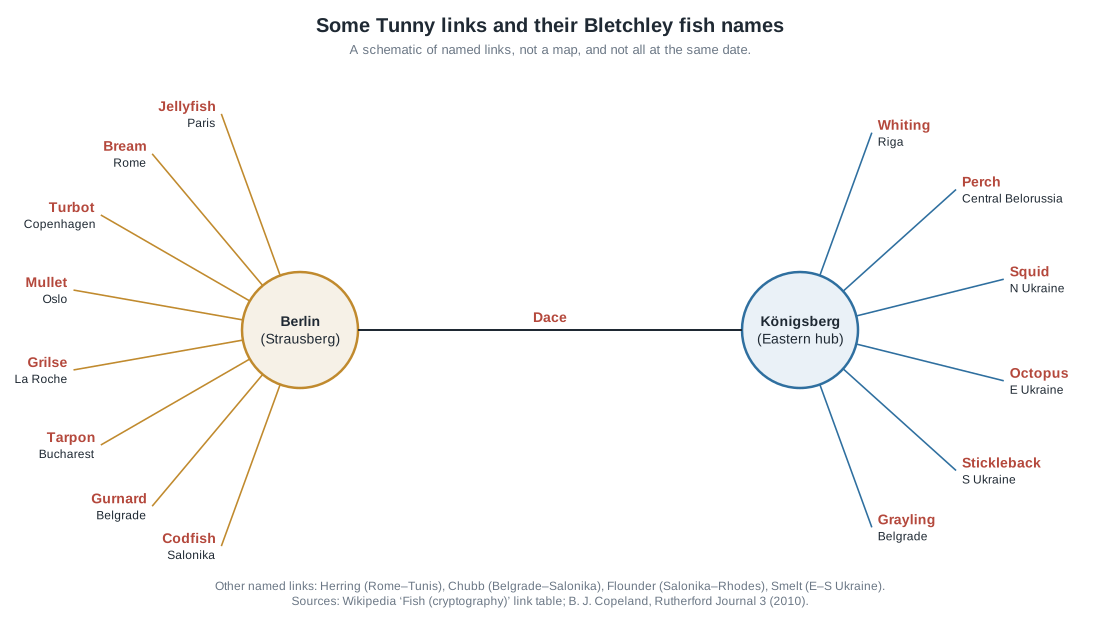
The British could not read every link equally well, or all the time. Traffic volume, operator discipline, signal quality and the length of messages all varied. Some links were broken regularly and some rarely; the Newmanry and Testery chose what to work on according to its likely intelligence value and the chance of success.
10.4 Knockholt: Taking It Down
The signals were intercepted not at Bletchley Park but at stations run with the Foreign Office. The first work was done at Denmark Hill in south London, in a station staffed with the help of the Metropolitan Police. In April 1942 its technical chief, Harold Kenworthy, was moved to set up a new station dedicated to the non-Morse traffic at Ivy Farm, Knockholt, on the North Downs in Kent. Knockholt became fully operational early in 1943. Accounts give it some thirty receiving sets and some six hundred staff, rising later to more than eight hundred (Wikipedia, “Cryptanalysis of the Lorenz cipher”; Times Higher Education review of Copeland (ed.), Colossus, 2006).
10.4.1 Ink on paper
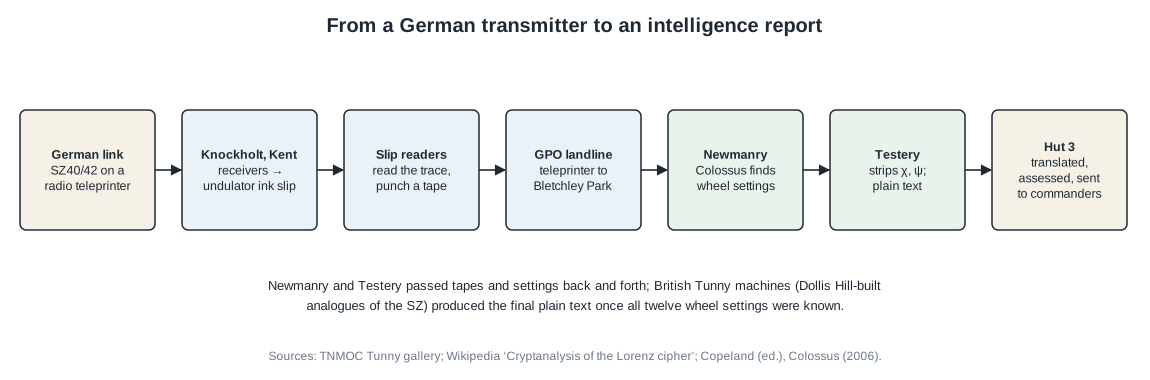
A radio teleprinter signal cannot simply be printed by a British teleprinter. The receiving machine has to be in exact step with the sender, and radio signals fade and break up. Knockholt therefore did not try to print the messages directly. The output of each receiver was fed to an undulator — a high-speed pen recorder that drew the signal as a continuous ink trace on a narrow paper strip called slip (TNMOC, Tunny gallery). Each character appeared as a pattern of five marks and spaces between the start and stop elements.
Slip readers read the trace by eye, recognised the five-unit characters, and punched them on to teleprinter tape. Where the signal was poor they had to judge which marks were real. Their accuracy mattered enormously. A single wrong character in a 4,000-character message would not stop Tutte’s statistic from working, but a dropped or inserted character would put everything after it out of step, which is one reason Colossus had a span counter to ignore damaged stretches (Volume 9). The punched tapes were sent to Bletchley Park by teleprinter over Post Office landlines.
10.4.2 How much
The figures that survive are partial. A review of Copeland’s Colossus reports that from November 1942 Knockholt intercepted almost 168,000 transmissions, which yielded 13,500 decrypts containing 63 million characters; Tony Sale also gave the figure of 63 million characters decrypted by the end of the war. Walter Jacobs, an American codebreaker at Bletchley Park, reported that in March 1945 alone “upward of five million letters of current transmission” were deciphered (Wikipedia, “Fish (cryptography)”). By the end of the war, Wikipedia’s summary of the official record says, about 90 per cent of the Tunny messages selected for attack were being broken. These numbers come from different points in the war and are not directly comparable, but they show the scale: tens of thousands of long, high-level messages.
10.5 The Germans Tighten Up
The Lorenz machines and their procedures did not stand still. Each change made the British work harder, and several of them came at moments that mattered.
October 1942 — the QEP books. Until then, German operators had sent a twelve-letter indicator in the clear at the start of each message to tell the receiving operator the wheel settings. The Testery had read nearly every message from July to October 1942, partly by exploiting these indicators and the depths they revealed. From October the settings were taken from printed lists, the QEP books, and the indicators gave nothing away (Copeland, Rutherford Journal 3).
February 1943 — the SZ42A. The SZ42A added a “limitation”: the motor wheels’ control of the psi wheels was made to depend also on the chi-2 wheel’s previous position, making the psi motion less regular (Volume 3).
December 1943. Copeland records a further change that made depth-reading impossible, just as the first Colossus was about to arrive.
June 1944 — the SZ42B. The SZ42B extended the limitation to depend on psi-1 as well.
Summer 1944 — daily wheel patterns. The most important change for Colossus was to the patterns themselves. In the weeks after the invasion of Normandy, Copeland writes, the Germans ordered the chi and psi wheel patterns to be changed daily, not monthly; Wikipedia gives August 1944 as the date by which all links were changing daily. Hand methods of wheel breaking could not keep up. The wheel-breaking capability built into Colossus II, and the three Colossi later dedicated to breaking, were what kept the traffic readable (Volume 9).
10.6 Sturgeon: The Other Geheimschreiber
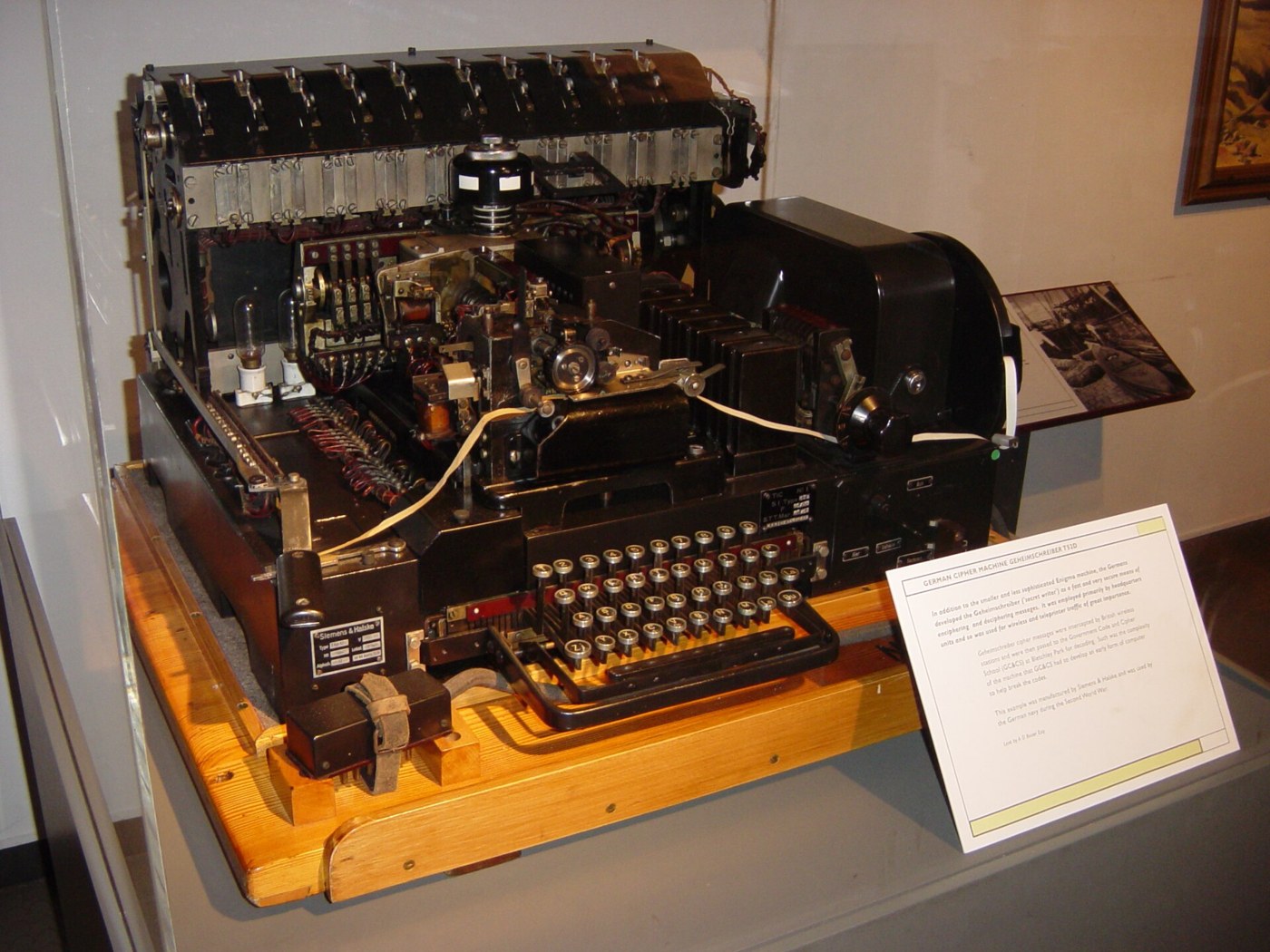
The Siemens & Halske T52 is the machine most often mistaken for the Lorenz in photographs. Both were German, both enciphered five-unit teleprinter signals with pinwheels, and both were called Geheimschreiber in some German usage. They are different machines, built by different firms on different principles, and broken in different ways by different people.
10.6.1 How it differed
Table 2 — How it differed
| Lorenz SZ40/42 (Tunny) | Siemens & Halske T52 (Sturgeon) | |
|---|---|---|
| Form | cipher attachment between a teleprinter and the line | complete cipher teleprinter (Schlüsselfernschreibmaschine) |
| Wheels | twelve: 5 chi, 5 psi, 2 motor | ten pinwheels of different sizes |
| Operation | adds two key streams to the plaintext, modulo two | adds a key stream modulo two, then swaps bits according to further wheels |
| Main users | army high command and army groups | Luftwaffe and navy, largely on landlines and fixed circuits |
| Models | SZ40, SZ42A, SZ42B | T52a, b, c, ca, d, e |
| Broken by | Bletchley Park, 1942 onward | Sweden (Beurling), 1940; Bletchley Park later, partially |
Sources: Wikipedia, “Siemens and Halske T52”; Crypto Museum, “T-52”; Copeland (ed.), Colossus (2006).
The T52’s addition of a transposition — conditionally swapping pairs of bits after the Vernam-style addition — made it, in principle, considerably stronger than the Lorenz. Its later models, the T52d and T52e, also stepped their wheels irregularly. The early models, however, had serious weaknesses, including a regular stepping that made them vulnerable.
10.6.2 Beurling’s break
The T52 was first broken not in Britain but in Sweden. After the German invasion of Norway in April 1940, German teleprinter traffic between Berlin and Oslo ran over landlines through Swedish territory, and the Swedes tapped it. In May and June 1940 the mathematician Arne Beurling, working alone with pencil and paper and messages in depth, worked out the T52a/b’s logic and its keys in about two weeks. Ericsson then built machines to decipher the traffic. Over about three years, Wikipedia’s account records, the Swedes intercepted some 500,000 messages and decrypted about 350,000, until poor security revealed the break and German upgrades in 1943 closed it (Wikipedia, “Siemens and Halske T52”).
10.6.3 Sturgeon at Bletchley Park
Bletchley Park first detected T52 traffic in the summer and autumn of 1942, on radio links it called Sturgeon (Sicily–Libya) and Mackerel (Aegean–Sicily). The cryptanalyst Michael Crum worked on message depths, and the machine was diagnosed and broken. But comparatively little Sturgeon traffic was read. Much of what the Luftwaffe sent on T52 links was also sent, in other forms, on Enigma, which Bletchley Park was already reading, and the effort was better spent on Tunny.
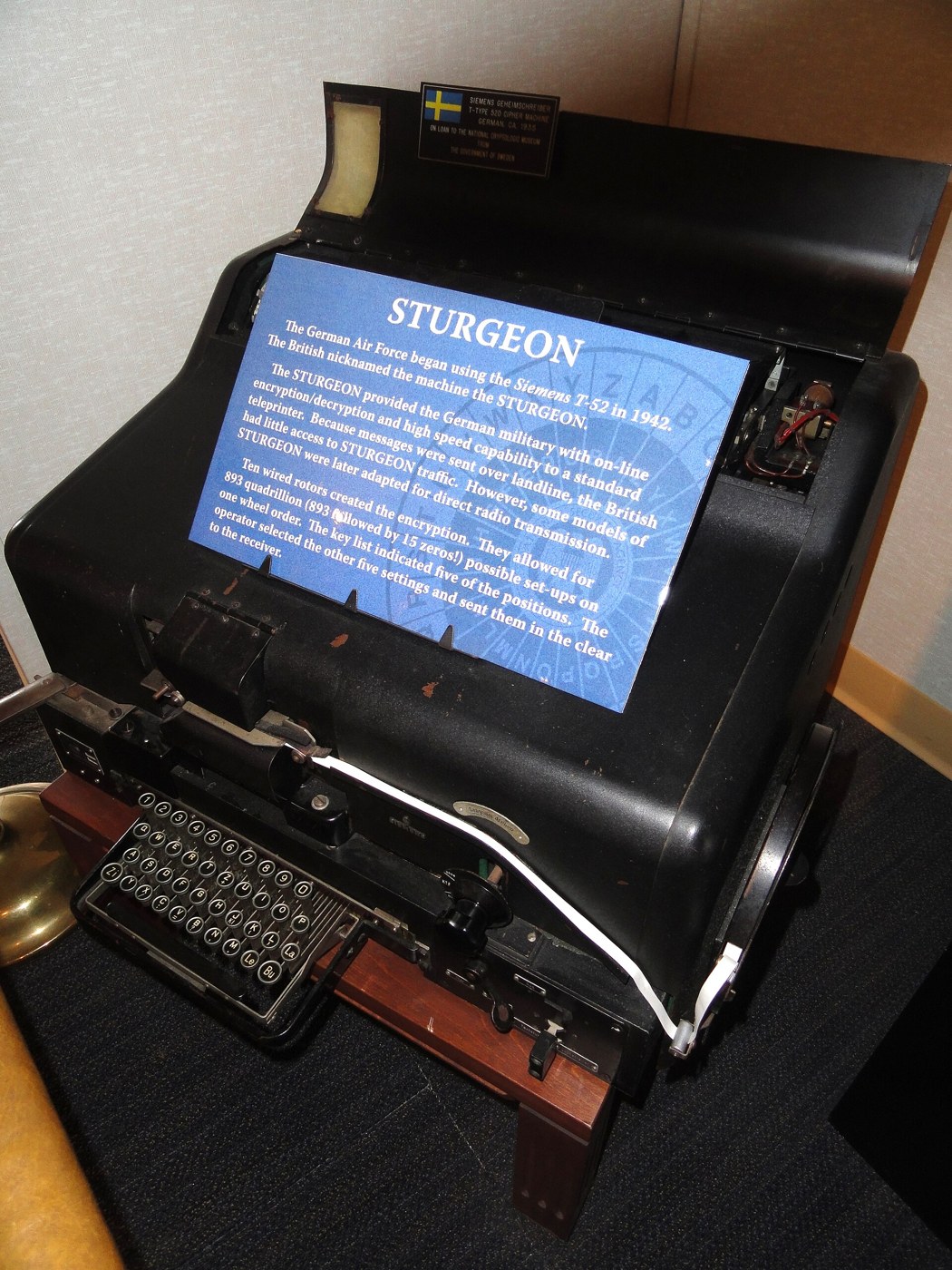
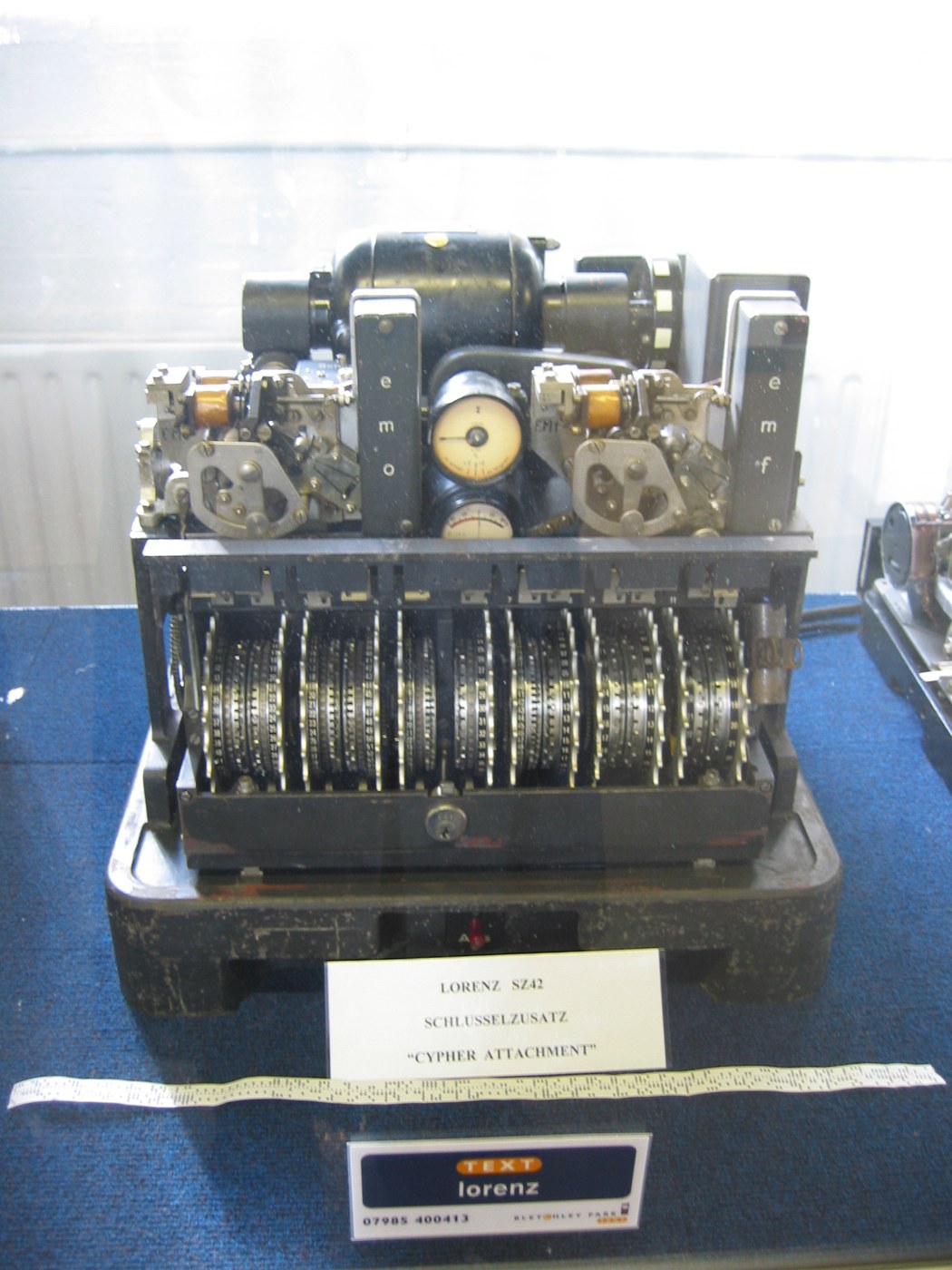
A note on captions. A photograph of a large black machine with a keyboard, a printer and a row of wheels across the top is very probably a T52. A Lorenz SZ is a separate box, without keyboard or printer, with its twelve wheels standing in a row across the front, usually shown alongside a Lorenz teleprinter. Museums and websites have mixed them up; this series identifies each machine pictured.
10.7 Kursk, 1943
The most frequently cited example of Tunny intelligence before Colossus is the battle of Kursk.
In the spring of 1943 the German army planned an offensive, Operation Zitadelle (Citadel), to pinch off the great Soviet salient around Kursk with simultaneous attacks from north and south. On 25 April 1943, according to Copeland, Field Marshal von Weichs, commanding Army Group South, sent a long Tunny message giving details of the plan, including the forces to be used. Bletchley Park broke it. British analysts deduced the shape of the pincer attack, and on 30 April an intelligence report based on the message — with its source disguised — was passed to the Soviet government (Copeland, Rutherford Journal 3).
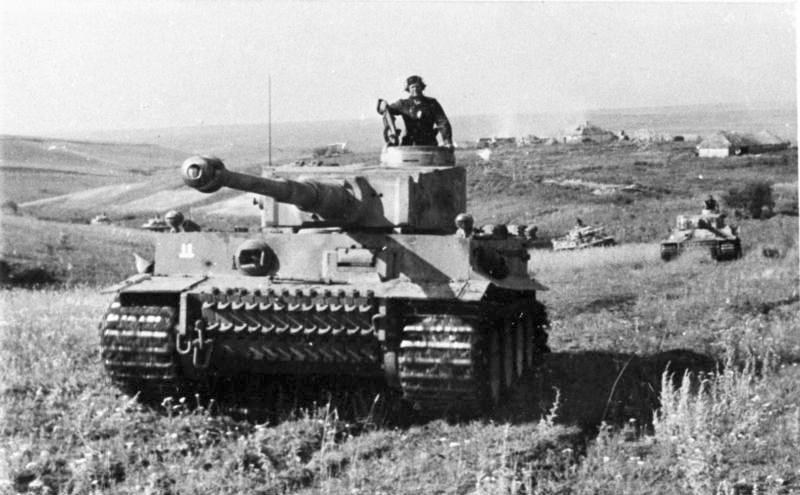
The offensive was postponed several times. When it finally began on 4 July 1943, the Red Army had built deep belts of defences across the expected lines of attack. Hitler called the offensive off on 13 July. Copeland quotes Stalin as saying the German plan had been “completely frustrated”.
How much the British report contributed is impossible to measure. The Soviets had their own intelligence on the German preparations, from their own sources and from agents, and the German build-up was visible from the air. What the Tunny decrypt shows is that by the spring of 1943 the British could, at least sometimes, read the German army’s own detailed plans for a major offensive — before any Colossus existed, by the Testery’s hand methods and the first statistical runs.
10.8 Normandy, 1944
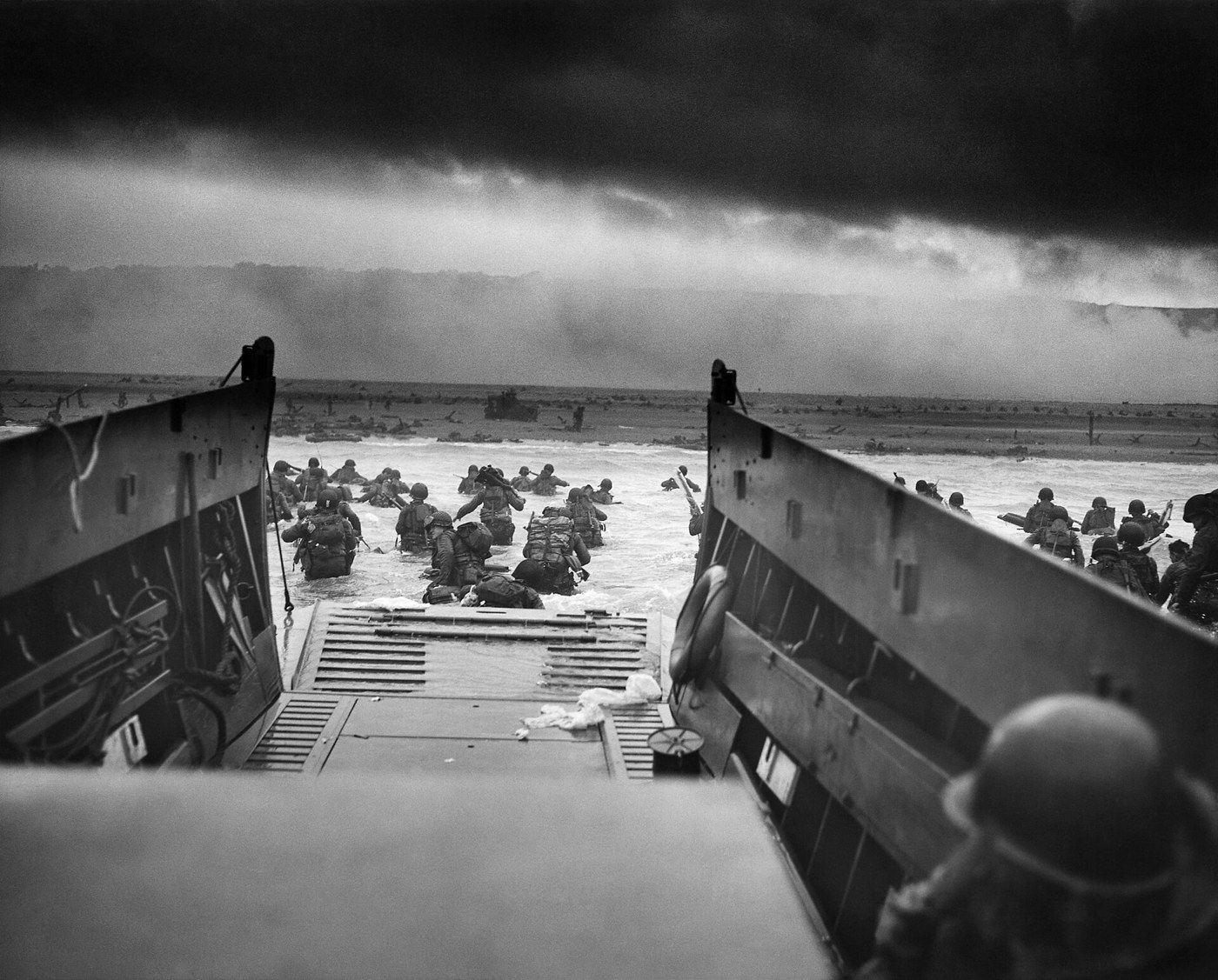
The Normandy landings were the reason Colossus II was built to a deadline (Volume 8), and the invasion is where Tunny’s value is most often asserted. The documented core is this.
10.8.1 The German view of the invasion
From early 1944, Copeland writes, Colossus I gave Bletchley Park “an unparalleled window” on German preparations to meet the invasion. GCHQ’s own account of D-Day says that the work begun by Tiltman, Tutte and Flowers gave Bletchley Park access to the communications between Rundstedt, as commander-in-chief in the West, and Berlin, and that this gave the Allied supreme headquarters (SHAEF) insight into enemy capabilities, dispositions and intentions (GCHQ, “D-Day: 75 years on”). The Berlin–Paris link, Jellyfish, was the obvious route for that traffic, though the published sources do not tie individual D-Day decrypts to named links.
What the Allies most needed to know before the landings was whether the Germans had seen through Operation Fortitude, the elaborate deception designed to convince them that the main invasion would come in the Pas de Calais, with Normandy at most a diversion. Copeland records that Tunny messages “supplied vital confirmation” that the German planners had been taken in. Tunny was not the only source of such evidence, but it was the one that carried the German army command’s own assessments in its own words.
10.8.2 The courier story
One story is repeated in many accounts. In an essay published after his death in Copeland’s Colossus (2006), Flowers recalled being told that, shortly before the invasion, a courier brought General Eisenhower a summary of a decrypt showing that Hitler did not intend to move additional troops to Normandy, believing the real attack would come elsewhere, and that Eisenhower then confirmed the invasion would go ahead. The story rests on Flowers’ recollection of what he was told; this series has not been able to check the essay’s exact wording, and no document confirming the message and its timing has been published. It is best treated as Flowers’ account, consistent with the documented evidence about Fortitude but not proven by it.
10.8.3 After the landings
Once the Allies were ashore, the value of Tunny shifted to the conduct of the campaign: German assessments of the fighting, reinforcements, supply and intentions, as reported up the chain from Normandy to Berlin. It was precisely then, as described above, that the Germans began changing their wheel patterns daily, and Colossus II’s wheel-breaking capability — barely weeks old — became essential.
10.9 The Last Year
From the summer of 1944 to the end of the war the Newmanry and Testery ran at full stretch. Colossi arrived roughly every six weeks; by the end of 1944 seven were working, and ten at the German surrender. The traffic followed the war: the collapse in the East in the summer of 1944, the battles in the West through the winter, the Ardennes, the Italian front, the final defence of Germany. Copeland notes that by the end of 1944 the Colossi could find all twelve wheel settings by machine for a large proportion of the messages broken.
The last Tunny messages were sent as the German command structure collapsed in May 1945. The machine on long-term loan to The National Museum of Computing, serial number 1137, was used at the German headquarters at Lillehammer in Norway; the museum believes it received the final surrender instruction at midnight on 8 May 1945 (Volume 11).
10.10 What Tunny Was Worth
The question of how much Tunny shortened the war cannot be answered with a number, and the most quoted ones are guesses. What can be said is narrower and firmer:
- Tunny carried the German army’s highest-level communications — the strategic picture, as seen and reported by its own commanders — which Enigma, mostly used lower down, did not.
- Bletchley Park read a large fraction of the traffic it chose to attack, and by 1945 about nine in ten of the selected messages.
- At at least two moments — the planning of Kursk and the preparation for Normandy — Tunny decrypts gave the Allies the enemy’s own view of a decisive operation.
- After the summer of 1944 that reading was possible only because of Colossus.
The Newmanry’s cryptanalysts, the Testery’s linguists, the Knockholt slip readers and the Dollis Hill engineers knew none of this outcome in detail at the time. Their work went into the system, and the intelligence came out elsewhere. For thirty years afterwards, almost none of them could say what they had done. That is the subject of the last history volume.
Next — Volume 11: Secrecy, Destruction and the Rebuild — From 1945 to Tony Sale’s Colossus. Churchill’s order to break up the machines; two Colossi that went on working in secret until 1960; drawings burnt and veterans silent; a Newcastle computer scientist who began asking questions in the 1970s; the official photographs of 1975 and Flowers’ paper of 1983 — and a retired engineer with eight photographs, a few circuit fragments and his own savings, who set out in 1993 to build Colossus again.
Comments (0)