Lorenz and Colossus · Volume 1
Lorenz and Colossus — Volume 1 — Tunny and Colossus — The Codebreaking Machine Nobody Was Told About
A twelve-wheeled German cipher attachment that carried Hitler's High Command traffic, the handful of British mathematicians who reconstructed it from its output alone, and the valve-filled machine built to break it at speed — then dismantled, sworn to silence and forgotten for thirty years — the orientation volume for the fourteen-part series
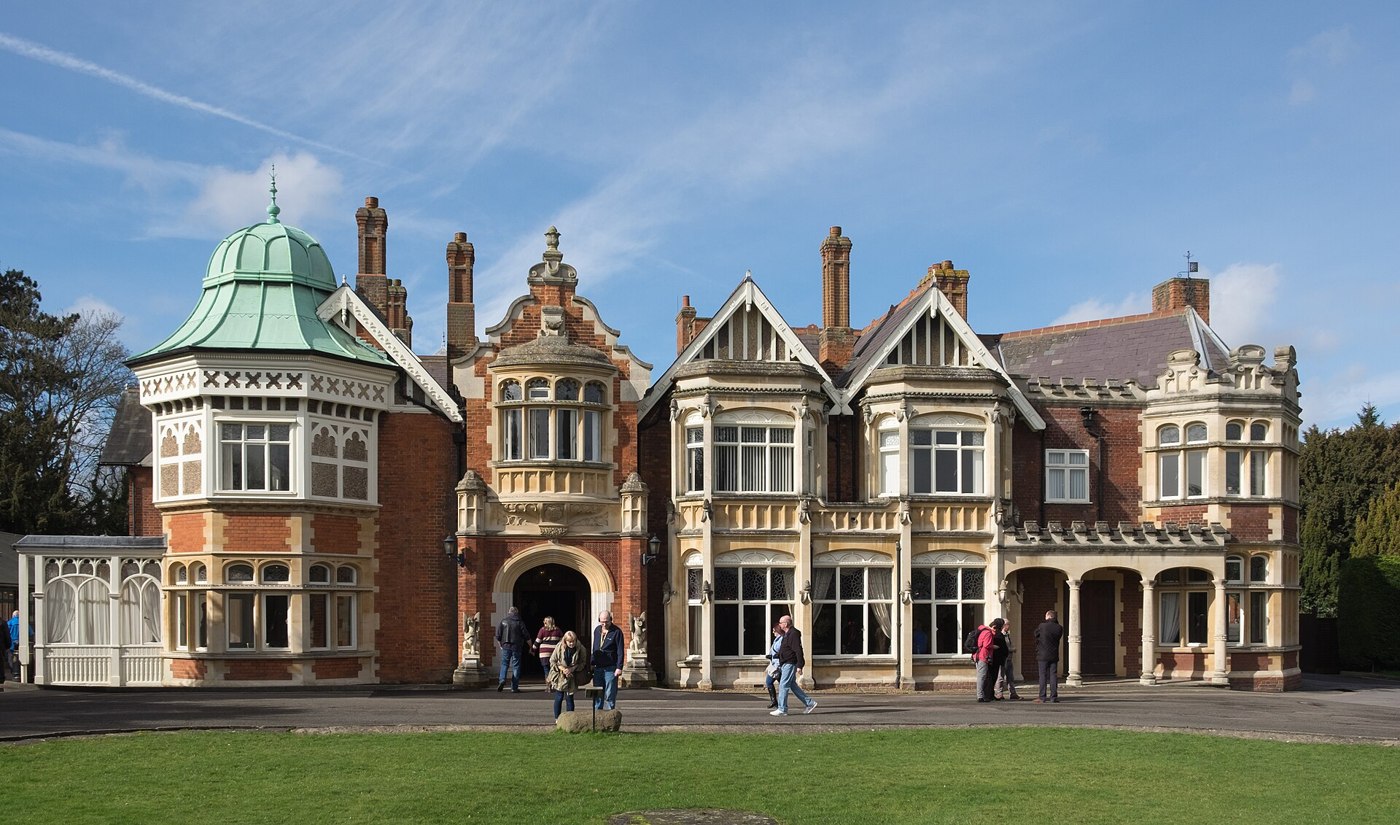
1.1 About This Volume
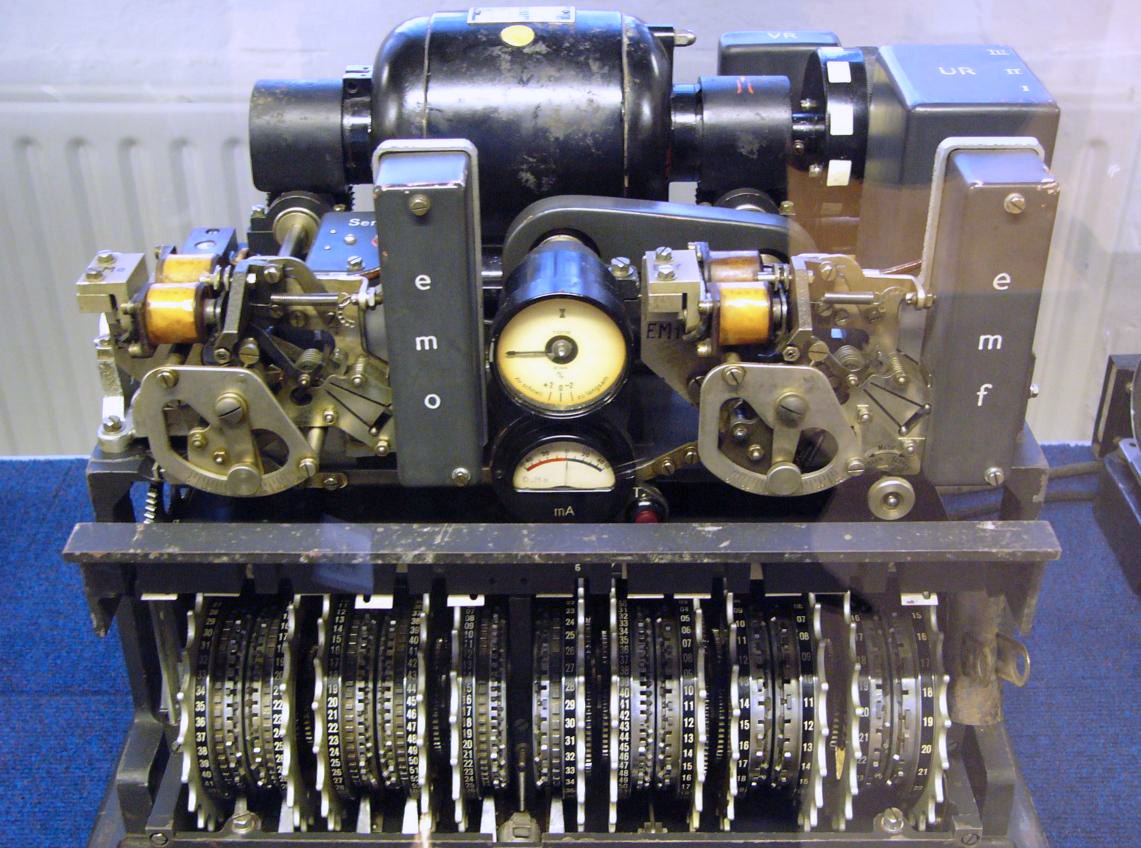
This is the entry point to a fourteen-volume deep dive on Tunny and Colossus: the German Army’s high-level teleprinter cipher of the Second World War, and the British machines and people that broke it. The cipher machine was the Lorenz SZ40/42, a box of twelve pin wheels made by C. Lorenz AG of Berlin that clipped in line with an ordinary teleprinter and enciphered whatever passed through it. The German Army High Command used it on radio links between Berlin and its army groups, from Norway to Greece and from France to the Eastern Front. Bletchley Park called the traffic, and the machine it imagined behind it, Tunny.
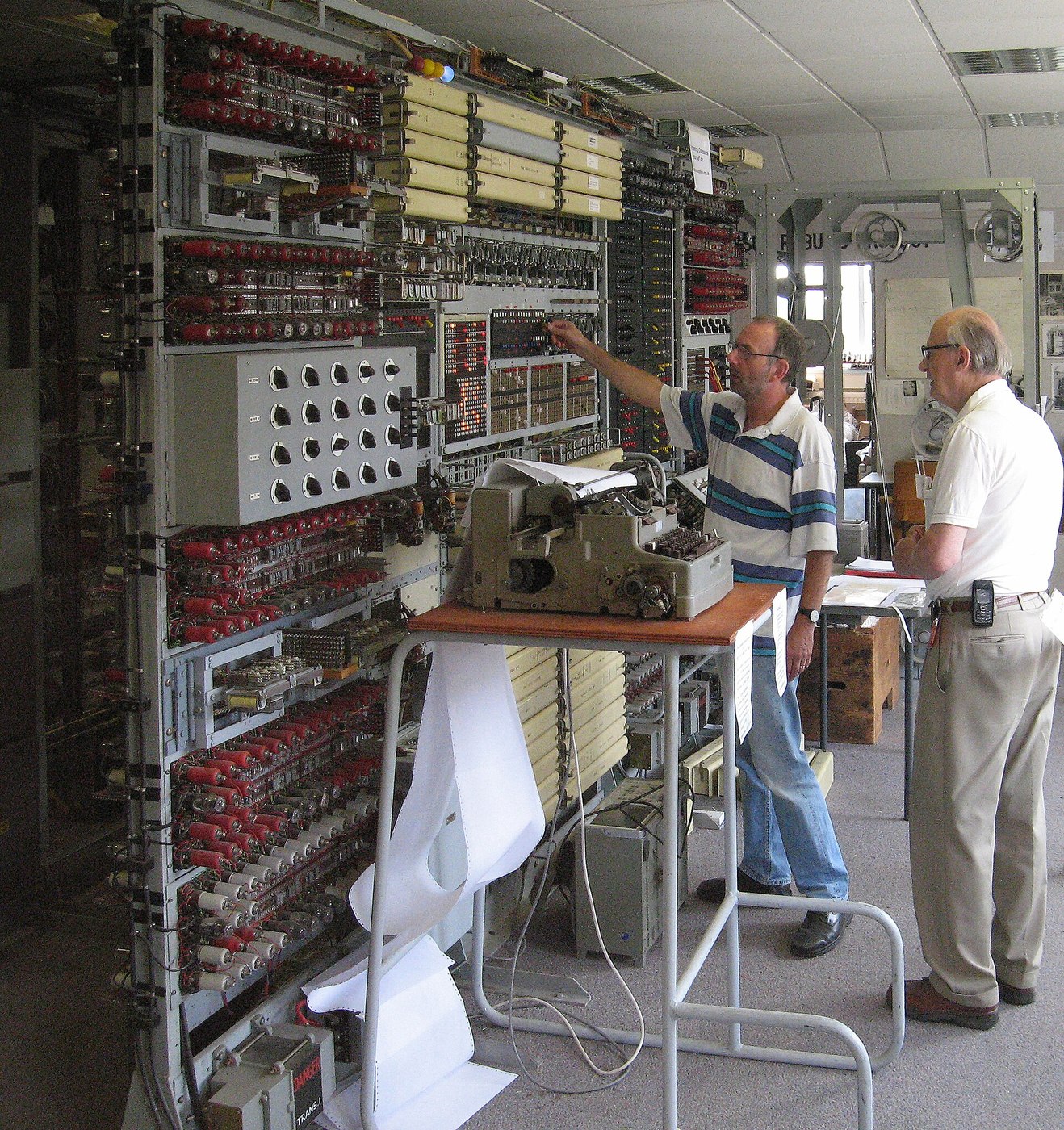
Colossus was the answer. It was a room-sized electronic machine, built by the Post Office engineer Tommy Flowers to run statistical tests devised by the mathematician Bill Tutte, that compared a punched-paper ciphertext tape against electronically generated wheel patterns at 5,000 characters a second. The first was working at Bletchley Park in February 1944; ten were working by the end of the war in Europe. Then almost all of them were broken up, their drawings burned, and the people who built and ran them told never to speak of it. Most never did.
This volume explains in plain terms what Tunny was, why it mattered, how it was broken first by hand and then by machine, what happened to the evidence afterwards, and why the story is so often told as an afterthought to the Enigma story when it may be the more remarkable of the two. It then tours the whole series in miniature. Readers who want the cipher can start at Volumes 2 and 3; readers who want the codebreaking can go to Volumes 4–6; readers who want the machines can go to Volumes 7–9; readers who want to build their own can jump to Volumes 12–14, which design an electronic SZ42 replica and a bench-top Colossus.
1.1.1 The Fourteen-Volume Series
Table 1 — The Fourteen-Volume Series
| Vol | Title | Focus |
|---|---|---|
| 1 | Tunny and Colossus — The Codebreaking Machine Nobody Was Told About (this volume) | Orientation: the machine, the break, the computers, the silence |
| 2 | Teleprinters, Baudot and Vernam — The Cipher That Adds | Five-unit code, the teleprinter, Vernam’s additive cipher and why it is fragile |
| 3 | The Lorenz SZ40/42 — Twelve Wheels, Chi, Psi and Mu | The machine itself: wheels, cams, motor, limitations, operating procedure |
| 4 | The Depth of 30 August 1941 — Tiltman’s Break | The resent message HQIBPEXEZMUG and how John Tiltman read it |
| 5 | Bill Tutte — Deducing a Machine from Its Output | The 41-cycle, the logical structure, and the statistical method |
| 6 | The Testery — Breaking Tunny by Hand | Major Tester’s section, Turingery, cribs and depths, 1942–45 |
| 7 | Max Newman and Heath Robinson | The Newmanry and the first machine for Tutte’s statistics |
| 8 | Tommy Flowers and the Building of Colossus | Dollis Hill, valves, and a computer built in eleven months |
| 9 | How Colossus Worked — Tapes, Valves, Counters and the 1+2 Break-In | Inside the machine and its runs |
| 10 | Fish at War — Tunny Links, Sturgeon and D-Day | The traffic, the network and what it told the Allies |
| 11 | Secrecy, Destruction and the Rebuild — From 1945 to Tony Sale’s Colossus | The thirty-year silence and the reconstruction |
| 12 | Building a Lorenz — The SZ42 Replica, Design | A design-your-own electronic SZ42 |
| 13 | Building a Lorenz — Construction and a Message Sent | Building it and enciphering a real message |
| 14 | A Colossus on the Bench — Running Tutte’s Statistic | A microcontroller Colossus that sets the chi wheels |
1.2 Two Machines, One Story
Most popular accounts of Bletchley Park tell one story: the Enigma machine, its rotors and plugboard, the Polish mathematicians who first broke it, Alan Turing and the Bombe, and the U-boat war in the Atlantic. That story is covered in this collection’s Enigma unit. It is true and important, but it is half the picture.
Enigma was a field cipher. It was carried in a wooden box by army signallers, Luftwaffe ground stations and U-boat radio rooms; it enciphered short messages one letter at a time, by hand, for transmission in Morse. The highest levels of the German command used something else. From 1941 the German Army High Command (Oberkommando des Heeres, OKH) began to send its strategic traffic — situation reports, orders and appreciations between Berlin and the commanders-in-chief in the field — over radio teleprinter links, enciphered automatically by the Lorenz attachment. These were long messages, often thousands of characters each, carrying exactly the kind of material an opposing general most wants to read: what the enemy’s high command thinks is happening and what it intends to do next.
The British first heard this traffic in 1940 as a strange new kind of non-Morse signal, and began intercepting it systematically in June 1941 (Copeland, Rutherford Journal 3, 2010). By the end of the war they were reading a large part of it — in the last months, by one wartime estimate, more than five million characters a month. Between those two dates lies one of the most remarkable pieces of intellectual work of the twentieth century, and the construction of the first large-scale electronic digital computing machines.
1.3 The Machine: A Cipher Attachment for the Teleprinter
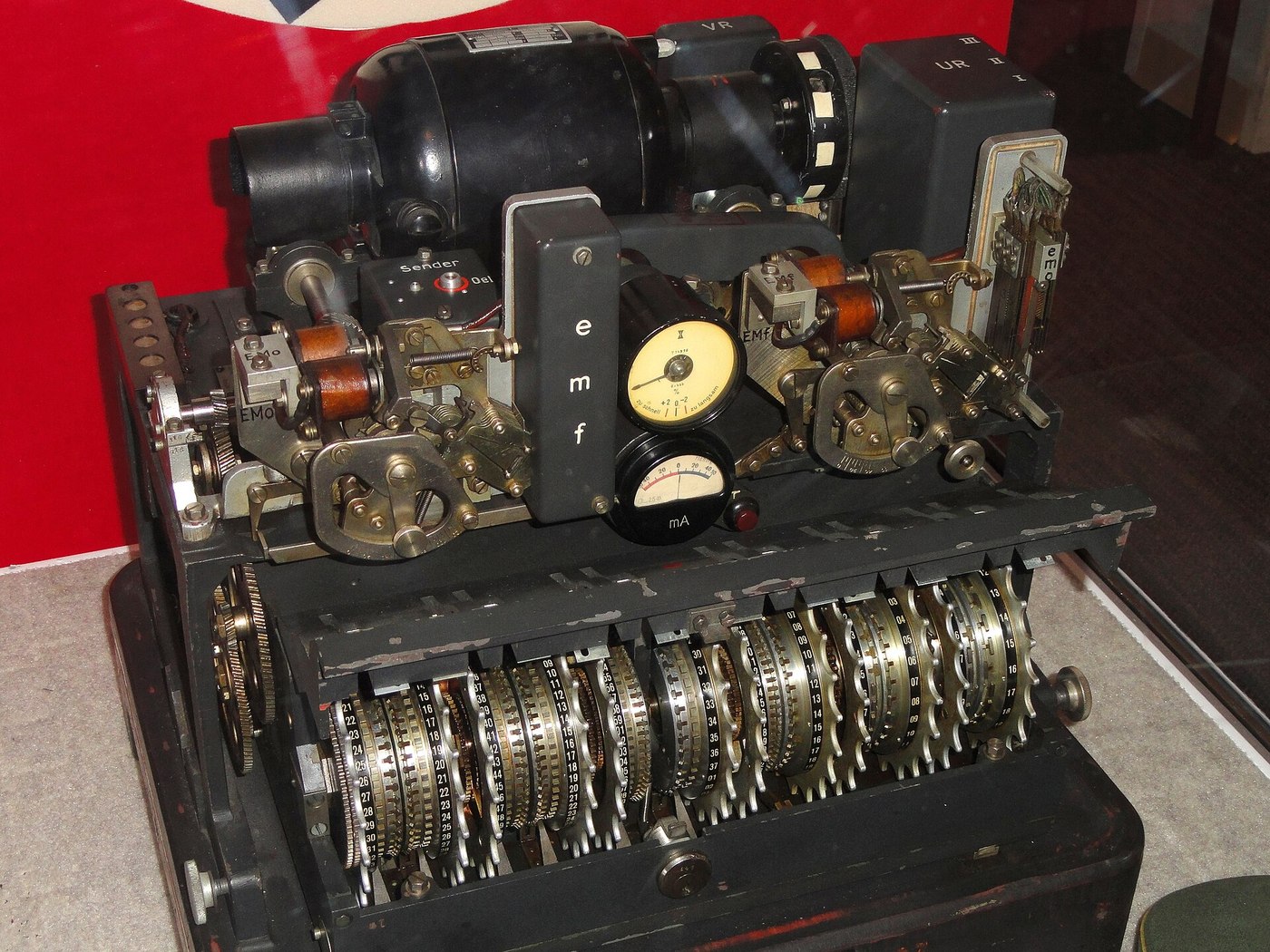
The Lorenz machine’s German name was Schlüsselzusatz, “cipher attachment”, abbreviated SZ. Three main models were used: the SZ40, the first; the SZ42A, in routine use from February 1943; and the SZ42B, from June 1944 (Copeland 2010). Each was a heavy metal box, about 48 × 39 cm at the base and 43 cm high, that sat between a standard teleprinter and the line or radio transmitter. Volume 3 describes it in full; the essentials fit in a paragraph.
A teleprinter sends each character as five on-or-off signals, the five-unit code described in Volume 2. The SZ added to each character a five-unit key character, impulse by impulse, using the rule that two like signals give “off” and two unlike signals give “on”. This is the additive cipher patented in America by Gilbert Vernam in 1919. Its great convenience is that the same operation, with the same key, both enciphers and deciphers: a receiving SZ set up identically simply adds the key again and the plain text comes out.
The key came from twelve wheels with movable cams around their rims. Five of them, which Bletchley named the chi (χ) wheels, had 41, 31, 29, 26 and 23 cams and stepped on one place with every character. Five more, the psi (ψ) wheels, had 43, 47, 51, 53 and 59 cams and stepped irregularly, all together or not at all, under the control of two motor wheels with 61 and 37 cams. Each cam could be set raised or lowered, so each wheel carried a pattern of ones and zeros; the key for each impulse was the sum of one chi wheel and one psi wheel. In all there were 501 cams to set, plus a start position for each of the twelve wheels. The German operators changed the cam patterns periodically — monthly at first, daily by the last year of the war — and the start positions for every message.
1.3.1 Fish, Tunny and Sturgeon
Bletchley Park learned from Enigma decrypts that the Germans called one of their radio teleprinter systems Sägefisch, “sawfish”, and took Fish as the name for all German enciphered teleprinter traffic. The first non-Morse link they studied was named Tunny, and the name stuck to the Lorenz machine and all its traffic; individual Tunny links got fish names of their own, such as Bream for Berlin–Rome and Jellyfish for Berlin–Paris (Wikipedia, “Fish (cryptography)”).
A second, quite different German teleprinter cipher was the Siemens & Halske T52, the Geheimschreiber (“secret writer”), which Bletchley called Sturgeon. It was a complete cipher teleprinter rather than an attachment, used mainly by the Luftwaffe and the Navy, and it scrambled the order of the five impulses as well as adding key. Sturgeon was broken too, but it was read far less, and it is not the subject of this series except where Volume 10 sets it beside Tunny. The two machines are often confused in museums and online: a photograph of a T52 is not a photograph of a Lorenz.
1.4 Hitler’s High Command on the Air
The first Tunny link opened experimentally in June 1941, carrying Army traffic towards Greece; the brigadier who first broke into it, John Tiltman, remembered it as Vienna–Athens, and later histories give it as Berlin to Athens and Salonika. It closed in October 1942 and was replaced by new links. By mid-1943 there were eight; by D-Day, 6 June 1944, Bletchley knew of twenty-six (Copeland 2010; Erskine and Smith, Action This Day, 2001, p. 353, via Wikipedia). They ran from central exchanges near Berlin — Strausberg for the western links and, until July 1944, Königsberg for the east — to army group and theatre headquarters: Paris, Rome, Copenhagen, Oslo, Belgrade, Salonika and the commands on the Russian front.
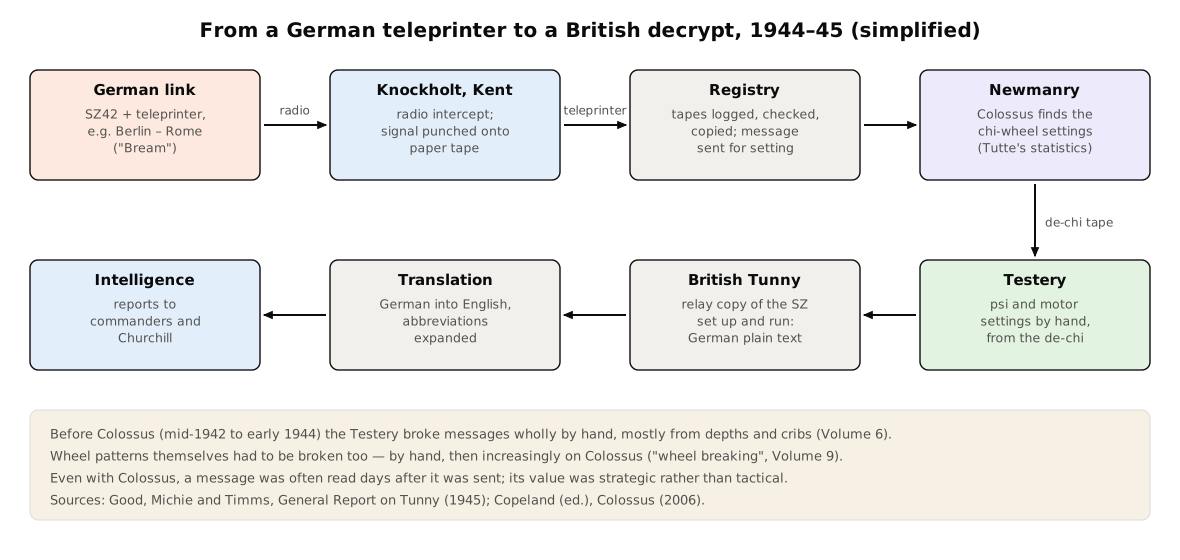
Each link had four SZ machines, a sending and a receiving teleprinter at each end. Long messages were usually punched onto paper tape first and then run through the transmitter at full speed; at the receiving end the plain text was printed on a gummed paper strip and stuck onto message forms. Because the cipher was automatic, no operator on either side ever saw the cipher text. Only the radio — and the British interceptors — did.
The British listened from a purpose-built intercept station at Knockholt in Kent, which grew to about 600 staff. Its operators recorded each Tunny transmission as an ink trace on paper strip (the “undulator” tape), from which “slip-readers” corrected the five-hole tape punched from the signal, and the tapes went by teleprinter line and despatch rider to Bletchley Park. Volume 4 describes the interception in more detail; Volume 10 maps the links and the traffic.
1.5 A Machine Diagnosed from Its Output
The story of how Tunny was broken is told in Volumes 4–6. In outline, it went like this.
A Vernam cipher is very strong if its key never repeats, and very weak if it does. When two different messages are enciphered with exactly the same key, adding the two cipher texts together cancels the key entirely and leaves the sum of the two plain texts — a depth. A skilled codebreaker can then guess a likely word in one message, add it in, and see whether the corresponding letters of the other message make sense. If they do, both texts can be peeled apart a few letters at a time, and the key falls out.
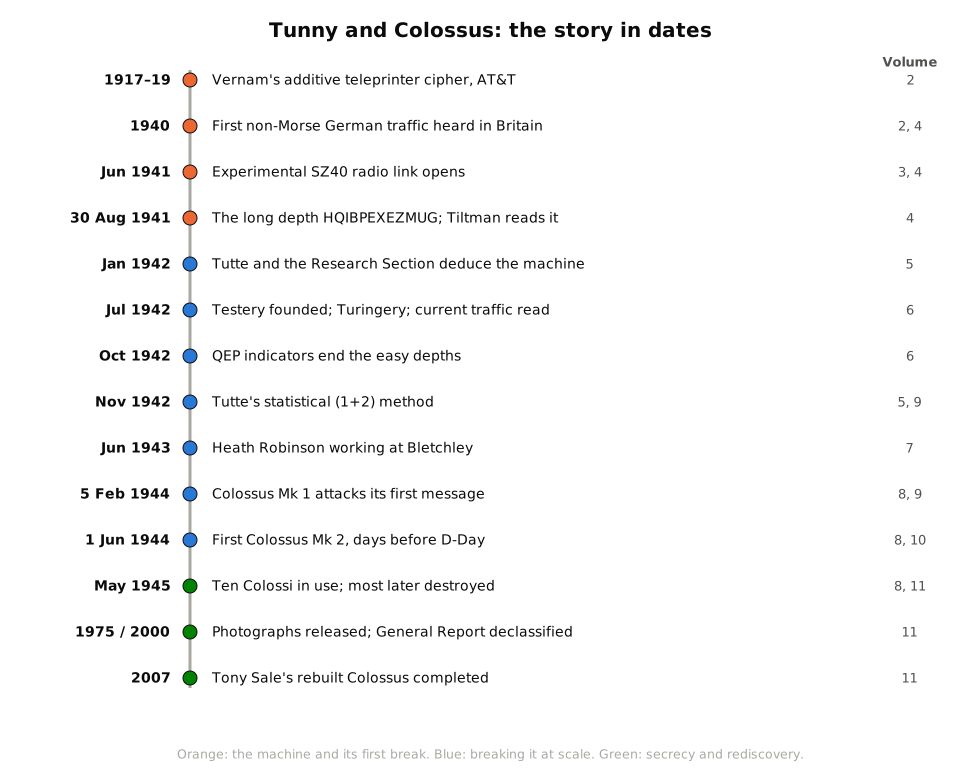
On 30 August 1941, a German operator on the experimental Tunny link sent a message about 4,000 characters long. The receiving operator asked for it again. Both men reset their machines to the same twelve-letter indicator, HQIBPEXEZMUG, and the sender keyed the message a second time — but not identically. He abbreviated words and dropped spaces, so the two plain texts ran out of step a few letters in. That made the depth far more valuable than an exact repeat. The veteran codebreaker John Tiltman spent about ten days separating the two plain texts, and so recovered 3,976 consecutive characters of the key that the Lorenz machine had generated (Tiltman, “The ‘Tunny’ Machine and Its Solution”, NSA, written c. 1961, declassified 2007). Volume 4 tells that story.
Nobody at Bletchley had seen the machine or a manual. For months the key resisted every attempt to find its structure. Then, late in 1941, a young Cambridge chemistry graduate in the Research Section, William Thomas (Bill) Tutte, wrote out the first impulse of the key in rows and noticed repeats at a period of 41. From that thread he and his colleagues unpicked the whole logical structure of the machine — two banks of five wheels, the stepping chi wheels, the stuttering psi wheels, and the motor wheels that controlled them — by January 1942. It was later called one of the greatest intellectual feats of the war. Volume 5 follows the deduction step by step.
1.6 By Hand: The Testery
Knowing how the machine worked was not the same as reading its messages. For that, each message needed both the cam patterns in force and the twelve start positions. In July 1942 a section was formed under Major Ralph Tester, a German-speaking accountant, to break Tunny traffic by hand. The Testery, as it was inevitably called, began with four men and grew by the end of the war to nine codebreakers, 24 women of the Auxiliary Territorial Service and 118 staff in all, working round the clock in three shifts (Wikipedia, “Testery”, citing Roberts in Copeland 2006).
In its first months the Testery lived on depths, cribs (guessed stretches of plain text such as the stereotyped opening Spruchnummer, “message number”) and a pencil-and-paper method invented by Alan Turing in July 1942, known as Turingery, for recovering cam patterns from a stretch of key. Between July and October 1942 it read a high proportion of the traffic. Then the Germans changed their procedures: in October 1942 the twelve-letter indicators that had made depths easy to spot were replaced by numbers from a code book, and the supply of depths dried up. Volume 6 describes the Testery’s methods and people.
1.7 By Machine: Newman, Robinson, Flowers and Colossus
The way out came from Tutte again. In November 1942 he showed that the chi wheels could be set without a depth, by statistics. Add together the first and second impulses of the cipher text after “differencing” them (adding each character to the next); slide the corresponding 1,271-character chi pattern along it; at the right start position the two agree a little more often than chance — perhaps 55 per cent of the time instead of 50. The method worked on a single message. But it required counting, for every message, thousands of characters at each of 1,271 positions, and that was hopeless by hand.
The Cambridge mathematician Max Newman proposed doing the counting by machine. His section, the Newmanry, was given the job in December 1942 and received its first machine, nicknamed Heath Robinson after the cartoonist of absurd contraptions, in mid-1943. Robinson read two paper tapes on a frame of pulleys — the cipher text and a tape carrying the wheel patterns — and counted with electronic circuits, but keeping two tapes in step at speed was its weakness. Volume 7 tells its story.
Tommy Flowers, an engineer at the Post Office Research Station at Dollis Hill in north London, proposed something bolder: generate the wheel patterns electronically, with thermionic valves, so that only the cipher tape needed to run. Colossus Mark 1, with about 1,600 valves, was delivered to Bletchley Park on 18 January 1944 and attacked its first message on 5 February. The improved Mark 2, with about 2,400 valves and five-fold parallel processing, was working on 1 June 1944, five days before D-Day. By May 1945 ten Colossi were in use, with an eleventh being assembled. Volume 8 tells how they were built and Volume 9 how they worked.
Colossus did not decipher messages. It found wheel settings, and later helped to break wheel patterns, by counting. Its output was a few numbers typed on an electric typewriter. The rest — setting the psi and motor wheels, running the cipher text through a relay replica of the Lorenz machine called the British Tunny, translating the German — was still done by people, most of them young women of the Women’s Royal Naval Service. By the end of the war the Newmanry had 26 cryptographers, 28 engineers and 273 Wrens (General Report on Tunny, 1945, §31A, transcribed by Tony Sale).
It is regretted that it is not possible to give an adequate idea of the fascination of a Colossus at work: its sheer bulk and apparent complexity; the fantastic speed of thin paper tape round the glittering pulleys … the uncanny action of the typewriter in printing the correct scores without and beyond human aid …
— General Report on Tunny (1945), §51(j)
1.8 What It Was Worth
Tunny decrypts gave the Allies something Enigma rarely could: the considered views of the German high command and its senior field commanders, often in long, detailed appreciations. Two examples are usually given, and Volume 10 examines both. In spring 1943 Tunny messages on the link to Army Group South revealed German planning for Operation Zitadelle, the summer offensive against the Kursk salient; a warning, with its source disguised, reached the Soviet government at the end of April (Copeland 2010). In 1944, Tunny traffic from the commander-in-chief West showed that the Germans had been taken in by the Allied deception plans for the Normandy landings — that they still expected the main blow in the Pas de Calais.
The intelligence was strategic rather than tactical. Even with Colossus, a message was usually read days after it was sent (Hinsley and Stripp, Codebreakers, 1993, via Wikipedia). Its value lay in showing how the enemy saw the war. How much difference that made to the length of the war is the kind of question historians argue about, and this series reports the arguments rather than settling them.
The volume of work, though, is not in doubt. The American liaison officer Walter Jacobs reported that in March 1945 alone “upward of five million letters” of Tunny were deciphered (Wylie, in Erskine and Smith 2001, via Wikipedia). The National Museum of Computing gives the total for the war as some 63 million characters (TNMOC event notice).
1.9 Silence, and the Long Rediscovery
When the war in Europe ended, the British government ordered most of the Colossi broken up. Two were kept and moved, with GCHQ, first to Eastcote in north-west London and then to Cheltenham; one was dismantled in 1959 and the other around 1960. Most of the drawings and working papers were destroyed with them. Everyone involved had signed the Official Secrets Act, and almost everyone kept silent — for decades, and in many cases for life.
The silence had consequences. When histories of computing were written in the 1950s and 1960s, the first electronic computers were said to be the American ENIAC (1945–46) and the British stored-program machines at Manchester and Cambridge (1948–49). Colossus was not mentioned because nobody who knew about it could say so. Flowers, whose machines had been working for nearly two years before ENIAC was completed, could not use them to win funding or recognition for his ideas. Tutte returned to Cambridge, took a doctorate in mathematics and moved to Canada, where he became one of the founders of modern graph theory; for most of his life almost nobody outside the intelligence world knew what he had done in the war.
The rediscovery came in stages. In October 1975 the British government released a few captioned photographs of Colossus, largely thanks to the persistence of the computer historian Brian Randell. In 1983 Flowers was allowed to publish an account of the hardware. In 2000 the General Report on Tunny, a history of about 500 pages written in 1945 by three Newmanry codebreakers, Jack Good, Donald Michie and Geoffrey Timms, was released to the Public Record Office (Copeland 2010). From the 1990s the engineer Tony Sale led a team that rebuilt a working Colossus Mark 2 at Bletchley Park from the photographs, a few surviving fragments and the memories of the people who had built the originals. It was completed in 2007 and, in a public cipher challenge that November, was beaten to the answer by the German radio amateur Joachim Schüth, whose own program on a laptop found the settings of all twelve wheels in under a minute; the rebuild, slowed by poor radio reception and two blown valves, finished hours later (Computerworld, 2007). Volume 11 tells that story.
1.10 Where to See the Machines Today
Very few Lorenz machines survive. The National Museum of Computing (TNMOC) has put the figure at four, from a production of about 200 (TNMOC, “From encrypt to decrypt – the full Lorenz story”, 2016); that figure comes from the museum and is not independently confirmed here. The examples on public display include:
- Bletchley Park Museum, which shows an SZ42 with its covers removed (the hero photograph at the head of this volume).
- The National Museum of Computing, also on the Bletchley Park estate, whose Tunny gallery holds an SZ42, serial number 1137, used at the German headquarters in Norway at Lillehammer and lent long-term by the Norwegian Armed Forces Museum. It stands beside a rebuilt British Tunny, a working Heath Robinson reconstruction and the rebuilt Colossus, so that a message can be followed from encipherment to decryption in one building. In 2016 the museum added a wartime Lorenz teleprinter that two volunteers had spotted on eBay, listed for £9.50 after it had been rescued from a garden shed in Essex.
- The National Cryptologic Museum at Fort Meade, Maryland, which exhibits its machine as an SZ40.
- The Heinz Nixdorf MuseumsForum in Paderborn and the Deutsches Museum in Munich, which also list examples.
Which model each surviving machine is — SZ40, SZ42A or SZ42B — is not always clear from museum labels, and the differences are internal. Where this series names a model it follows the museum’s own identification. Machines labelled as “Lorenz” in auction listings and on photo-sharing sites are frequently Siemens T52s or ordinary Lorenz teleprinters; the twelve exposed pin wheels in a row across the front are the giveaway.
1.11 Building One
No kit of the Lorenz machine or of Colossus exists. The last three volumes of the series are therefore design-your-own projects, written as designs and procedures that a reader with a soldering iron and a microcontroller could follow.
Volumes 12 and 13 design an electronic SZ42 replica: twelve wheels with their 501 cams held in memory, settable from a front panel or an editor, with a small screen and a knob on each wheel showing its cam pattern and position; five-unit teleprinter code in and out over a USB serial port, and optionally a real current-loop connection to a vintage teleprinter. The design follows the SZ42’s logic exactly, including the motor and the “limitations” that the later models added, so that its output can be checked against published examples. Volume 14 builds a Colossus on the bench: a microcontroller or FPGA that reads a cipher-text tape (from a file, or from a paper-tape reader) and runs Tutte’s 1+2 statistic over all 1,271 chi1/chi2 start positions, printing scores the way Colossus’s typewriter did. Both designs are checked against a pair of simulators written for this series and tested against published material: John Tiltman’s hand-worked example of 1961, enciphered with real wheel patterns from April 1944, and three genuine SZ42 messages from the 2007 Cipher Event at the National Museum of Computing.
1.12 How to Read This Series
The volumes are written to be read in order, but each stands alone. A few conventions recur throughout.
- Dots and crosses. Bletchley wrote the two states of a teleprinter signal as dot (·, no hole in the tape) and cross (×, a hole). Modern readers will think of them as 0 and 1. Both notations appear.
- Adding. ”+” between teleprinter characters means adding impulse by impulse, modulo 2: two dots or two crosses give a dot, a dot and a cross give a cross. It is the same as the exclusive-or (XOR) of modern computing. Adding a character to itself gives all dots.
- Letters. Following the General Report on Tunny, P is plain text, K key, Z cipher text; χ (chi), ψ (psi) and μ (mu) are the three groups of wheels; ψ′ (psi-prime, “extended psi”) is the psi stream with its repeats when the psi wheels stood still; Δ (delta) means a stream added to itself shifted by one character.
- Bletchley’s characters. The 26 letters keep their names. The six other teleprinter characters were written with the signs / 9 3 4 8 +, so that every character could be typed as a single symbol; 9 is the space and / is the “null” character with no holes.
- Dates and places follow the wartime sources. Where sources disagree — on the route of the first Tunny link, for example, or on a date — the disagreement is stated.
Three kinds of figure appear: photographs of machines, people and places; scans and drawings from the period, identified as such; and line diagrams drawn for this series, whose generating scripts are kept with the project.
1.13 The One-Paragraph Version
From 1941 the German Army High Command sent its most important radio traffic through the Lorenz SZ40/42, a twelve-wheeled attachment that added a long, irregular key to teleprinter signals. British interceptors called it Tunny. On 30 August 1941 a German operator sent a 4,000-character message twice on the same settings, with small differences; John Tiltman read both versions and recovered nearly 4,000 characters of key, and from that key Bill Tutte and Bletchley’s Research Section deduced the entire logic of a machine none of them had seen. Major Tester’s Testery then broke messages by hand, using depths, cribs and Turing’s methods, until German procedure changes in late 1942 made that much harder. Tutte’s statistical method showed how to set the wheels by counting, Max Newman’s section mechanised the counting, and Tommy Flowers built Colossus — about 1,600 and then 2,400 valves, 5,000 characters a second — to do it electronically; ten were at work by May 1945. Most were destroyed, the participants kept silent for thirty years, and Colossus was missing from the history of computing until the 1970s; Tony Sale’s team rebuilt one in 2007. The remaining thirteen volumes are the long version, ending with a working electronic Lorenz and a Colossus on the bench.
Next — Volume 2: Teleprinters, Baudot and Vernam — The Cipher That Adds. Before Tunny could be broken it had to be built, and before it could be built there had to be a teleprinter. Émile Baudot’s five-key telegraph of the 1870s, Donald Murray’s typewriter keyboard and punched tape, the international alphabet that let a Berlin machine talk to an Athens one — and an AT&T engineer’s 1917 idea of adding a key tape to the message tape, impulse by impulse, so that the cipher came out automatically. Why that idea is perfect when the key is never reused, and why Lorenz’s twelve wheels made it fatally imperfect.
Comments (0)