Lorenz and Colossus · Volume 11
Lorenz and Colossus — Volume 11 — Secrecy, Destruction and the Rebuild — From 1945 to Tony Sale's Colossus
Machines broken up on Churchill's order, two that ran on in secret until 1960, thirty years of silence, the historian who started asking, and the fourteen-year rebuild that put a working Colossus back in Block H
11.1 About This Volume
The history volumes of this series have so far ended in May 1945, with ten Colossi running around the clock and nine in ten of the selected Tunny messages being broken. This volume is about what happened next, which was almost nothing that anyone outside a small circle was allowed to know for thirty years.
It covers the breaking up of the machines; the two that survived in secret at GCHQ until 1960; the long silence imposed on everyone who had worked on them, and what it cost Flowers in particular; the historian Brian Randell, whose questions in the early 1970s started the slow release of information; the official photographs of 1975, the papers of 1983 and the declassification of the General Report on Tunny in 2000; Tony Sale’s reconstruction of Colossus from 1993 to 2007, and the Cipher Challenge that marked its completion; the museum that now holds the rebuild; the Lorenz machines that survive; and, briefly, the argument over where Colossus stands in the history of the computer.
11.2 Breaking Up
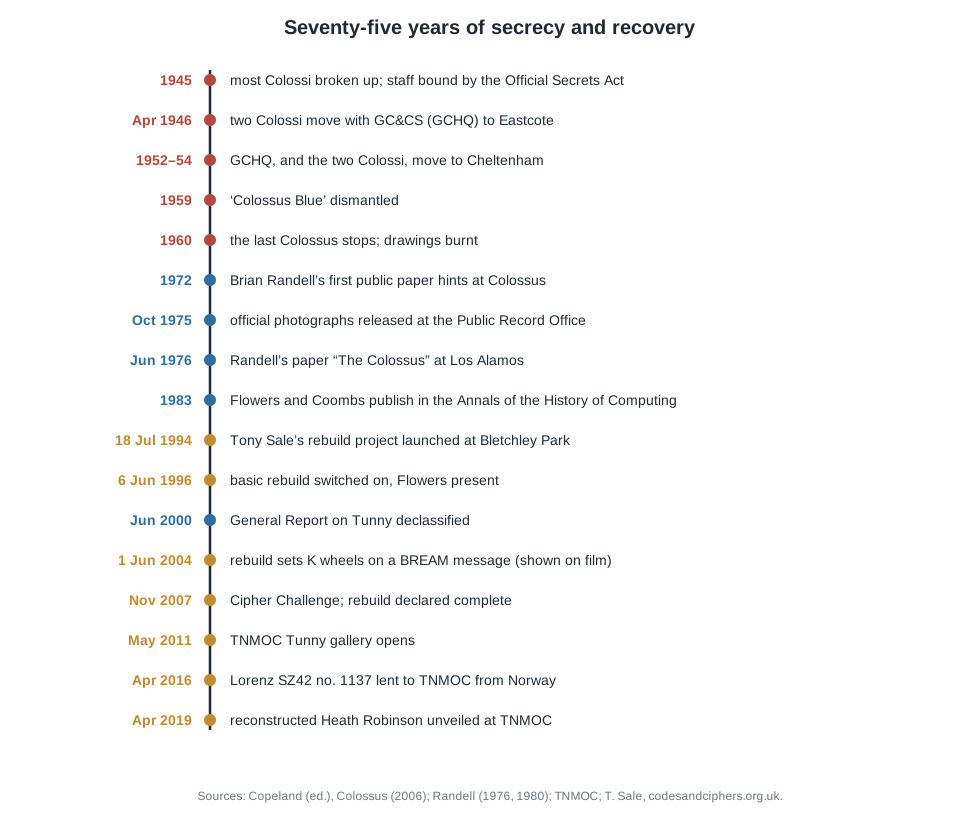
At the end of the war in Europe, Churchill ordered the Colossi to be broken up. Copeland records that everyone involved was bound by the Official Secrets Act and that the very existence of Colossus was to be classified indefinitely (Copeland, colossus-computer.com).
Most of the ten machines were dismantled at Bletchley Park in the months after May 1945. Their parts went back to the Post Office, which reused much of the standard equipment — racks, relays, uniselectors — in the telephone network. Copeland also records that racks of electronic components from the dismantled Colossi were shipped to Max Newman’s new Computing Machine Laboratory at Manchester (Volume 7). Flowers, by his own later account, was ordered to destroy the documentation in his possession, and burned his drawings and plans.
The decision was not only about secrecy for its own sake. The British government had every reason to want the techniques of machine cryptanalysis kept from the Soviet Union, from the defeated Germans, and from any nation that might adopt similar teleprinter ciphers after the war. Captured Lorenz and Siemens machines, and machines like them, remained in use around the world into the 1950s. Telling the world that such machines could be broken by statistical attack on electronic counters would have been a gift to every cipher designer.
11.3 Two That Survived
Not every Colossus was destroyed. In April 1946 the Government Code and Cypher School — soon renamed the Government Communications Headquarters, GCHQ — moved from Bletchley Park to Eastcote in north-west London, and two Colossi went with it, together with two of the British Tunny machines. When GCHQ moved again to Cheltenham between 1952 and 1954, the two Colossi moved too (Wikipedia, “Colossus computer”; Copeland). TNMOC’s account of the Heath Robinson reconstruction adds that one of the Super Robinsons also went to Eastcote and probably remained in use into the 1950s.
What they were used for in peacetime is only partly known. Copeland records that one job was checking the randomness of one-time-pad tapes generated by a noise source nicknamed “Donald Duck” — a natural task for a machine that counted statistical properties of punched tape. They may also have been used against other teleprinter ciphers; GCHQ has not said.
One of the two, known as Colossus Blue, was dismantled in 1959. The other is believed to have stopped running in 1960. Tony Sale’s research found that the original machine drawings were burnt in 1960, presumably when the last Colossus was retired (TNMOC, “The Colossus Rebuild Project”).
11.4 The Silence
For the people who had built and run the Colossi, the end of the war began a long silence. They could not tell their families what they had done, could not list it on a curriculum vitae, and could not use it to argue for funding or promotion.
The cost fell most heavily on Flowers. He had built the largest electronic digital machines yet made, and he could not say so. His £1,000 award did not cover his own outlay (Volume 8). When he sought support to build an electronic computer after the war, he could not explain why anyone should believe he could do it. He went back to telephone engineering at Dollis Hill, where his work on electronic exchanges and on ERNIE was respected but not connected, in anyone’s mind, with the first electronic computers.
Others went on to distinguished careers that drew, invisibly, on what they had learned. Max Newman founded the Manchester computing laboratory (Volume 7). Bill Tutte went to Canada and became one of the founders of modern graph theory. Jack Good became a leading Bayesian statistician; Donald Michie a pioneer of artificial intelligence in Britain. None could say where their ideas had first been tested.
11.4.1 The ENIAC story
Meanwhile the history of the computer was being written without Colossus. In 1946 the US Army publicly unveiled ENIAC, built at the University of Pennsylvania’s Moore School to compute artillery firing tables, with about 18,000 valves. It was presented to the world as the first electronic digital computer, and for a generation that was the received view. When British historians wrote about the origins of the Manchester and Cambridge computers, they assumed — reasonably, on the evidence they had — that the British had learned electronic computing from the Americans. Copeland argues that this inverted the real sequence, at least for Newman and Turing, both of whom had seen large-scale electronic computing work at Bletchley Park two years before ENIAC ran (Copeland).
11.5 Randell Starts Asking
The person most responsible for breaking the silence was Brian Randell, a computer scientist at the University of Newcastle upon Tyne. In the early 1970s, researching the origins of the stored-program computer and Turing’s part in it, he came across hints that Turing had been involved in secret wartime work with electronic machines. His 1972 paper “On Alan Turing and the Origins of Digital Computers” put the hint on record.
Randell pressed the British government for more. In October 1975, after an official silence of more than thirty years, the government released a set of captioned photographs of Colossus to the Public Record Office — the photographs reproduced in this series — together with a brief explanation (Newcastle University Special Collections, BR/3/21/1). Randell has said that the release followed pressure from him, and no doubt from others. With the government’s permission he interviewed several of the engineers and codebreakers, and in June 1976 presented a paper, “The Colossus”, at the International Research Conference on the History of Computing at Los Alamos. An expanded version appeared in 1980 in the conference volume, A History of Computing in the Twentieth Century.
Randell’s work established, in public, that an electronic digital machine with about 1,500 valves had been working at Bletchley Park in early 1944, nearly two years before ENIAC. It did not, and could not yet, explain what the machine had actually done.
11.5.1 The 1983 papers
In 1983 the Annals of the History of Computing published a special issue on Colossus. Flowers was allowed to publish “The Design of Colossus” (volume 5, number 3, pages 239–252), describing the hardware of the first machine, and Allen Coombs “The Making of Colossus”. Both were constrained by what was still classified: they could describe the engineering, but not the cryptanalysis it served.
11.6 Opening the Archives
The cryptanalytic side emerged only in the 1990s and 2000s, and the first full account came from America.
In 1995–96, under the US Freedom of Information Act, the National Security Agency released about 5,000 Second World War documents to the US National Archives. Among them was the report written in December 1944 by Albert Small, an American cryptanalyst attached to the Newmanry, describing the attack on Fish in detail (Sale, codesandciphers.org.uk). Sale obtained a copy in late 1996 and said it was a complete description of Colossus codebreaking; it let the rebuild team work out many circuits and switch functions that had been guesswork.
In 2000 GCHQ released the General Report on Tunny, the 500-page history and technical account written in 1945 by Jack Good, Donald Michie and Geoffrey Timms, to the Public Record Office (now The National Archives, references HW 25/4 and HW 25/5). Accounts differ on the month — June or October. It is the single most important source for how Tunny was broken, and an annotated edition was published in 2015. Other technical documents followed; the IEEE’s history wiki records a technical description by Horwood declassified in August 2003.
11.7 The Rebuild
Tony Sale (30 January 1931 – 28 August 2011) was an electronics engineer who had worked for MI5 under Peter Wright from 1957 to 1963 and later became a senior curator at the Science Museum in London, where he restored early British computers (Crypto Museum, “Tony Sale”). In 1991 he was one of those who campaigned to save Bletchley Park from demolition, and in 1992 a co-founder of the Bletchley Park Trust. He was also a co-founder of the Computer Conservation Society.
11.7.1 Eight photographs and a few fragments
In 1993 Sale decided that Colossus could be rebuilt. “Nobody believed me,” he wrote later (Sale, codesandciphers.org.uk). What he had to work from was meagre:
- eight wartime photographs from 1945, the ones released in 1975;
- fragments of circuit diagrams that some of the engineers had kept, in Sale’s phrase, “quite illegally”;
- the memories of surviving engineers — Harry Fensom, Arnold Lynch, Gil Hayward and others;
- and, from June 1994, Allen Coombs’s wartime notes and circuit diagrams, which Coombs gave to Sale and Fensom when they visited him in Plymouth.
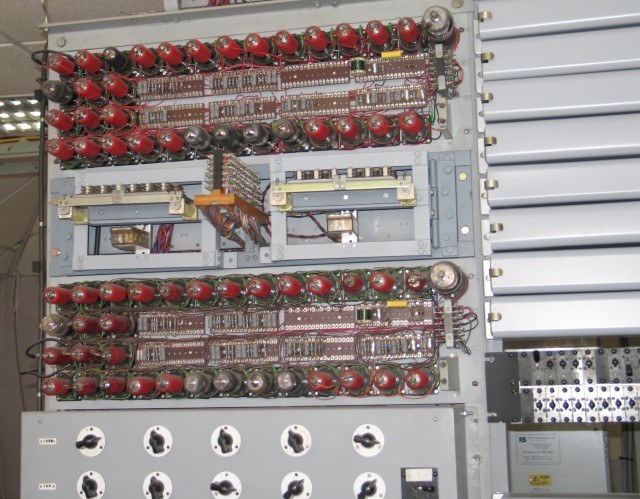
The original machine drawings had been burnt in 1960. Sale and his wife Margaret funded the project themselves at the start: they opened its bank account on 6 July 1994. He began by transferring the details of the photographs into a computer-aided design system, a process that took three months for the frames alone. Lynch, then in his eighties, worked with him to re-engineer the optical tape reader — which appears in none of the photographs — using original Colossus photocells. Valves and Post Office parts came from attics, garages and surplus stocks; Sale noted that sufficient wartime valves were still available.
11.7.2 1994–1996
The Duke of Kent formally opened the Bletchley Park museums and launched the rebuild project on 18 July 1994. The bedstead was working by Christmas 1994. Cliff Horrocks joined the project full time and Paul Bruton part time early in 1995. By early 1996 a basic Colossus was working on two of the five tape channels.
On 6 June 1996 — the fifty-second anniversary of D-Day — the Duke of Kent returned to switch the rebuild on. Tommy Flowers was present, with many wartime staff from Knockholt, the Testery and the Newmanry (TNMOC, “The Colossus Rebuild Project”). Sale chose the year deliberately: 1996 was the fiftieth anniversary of ENIAC’s unveiling, and the switch-on was a public answer to the claim that ENIAC had been the first.
What ran in 1996 was not yet a complete Colossus. It worked at “two-bit level”, on two of the five channels, and the full wiring of the main racks took several more years.
11.7.3 The long middle
The years after 1996 were slow and sometimes difficult. In 1999 the 1996 results were repeated with all five tracks routed through the switch panels. In 2000 a switch panel was built and wired to the wrong logic panels, a mistake discovered only in March 2002 and corrected by David Stanley over nearly six months. From 2001, a dispute with the Bletchley Park Trust kept Sale away from the machine for a time — it was during that interruption that he rebuilt Heath Robinson’s logic in his garage (Volume 7) — until he was allowed back two days a week in March 2002 (Crypto Museum, “Tony Sale”). By early 2003 all five chi rings were working, and in December 2003 the machine gave reliable counts on the chosen algorithms.
The team set itself a target: a working Mark 2 by 1 June 2004, sixty years to the day after Colossus II first ran. On 20 May 2004 Sale filmed the rebuild setting all five chi wheels on a cipher text from the Bream link, and on 1 June the film was shown to 120 people at a commemoration at the Science Museum, more than thirty of them wartime veterans.
11.7.4 The team
TNMOC’s record of the rebuild names Cliff Horrocks, Bob Alexander, Charles Coultas, Phil Hayes, Peter Merriman, John Pether, David Stanley, John Whetter and Rob Dickson as the team, with sponsorship from — among others — Frank Morrell, who had led the Heath Robinson engineering in 1943, Keith Thrower, Quantel Ltd and the Computer Conservation Society. Quantel paid for enough GT1C thyratrons to complete the wheel rings. Gil Hayward, who had designed the Mark 2 Tunny machine in the war, turned some 600 pattern plugs and modified more than 1,000 octal valve bases.
11.8 The Cipher Challenge, November 2007
The rebuild was declared complete in November 2007, and its completion was marked with a public contest. On 15 and 16 November 2007, the Heinz Nixdorf MuseumsForum in Paderborn, Germany, enciphered three messages on an original Lorenz SZ42 and transmitted them by radio. The rebuilt Colossus at Bletchley Park was to break them, and radio amateurs and codebreakers around the world were invited to try too.
Reception at Bletchley Park was poor, and the team did not have a good copy of the signal until 4:30 in the afternoon of the first day. Colossus was loaded with the tape at 9:05 the next morning and had the solution at 1:15 pm, a running time of three hours and thirty-five minutes, not counting forty-five minutes lost to a failed valve (The Register, 16 November 2007).
By then the challenge had already been won. Joachim Schüth, a radio amateur and programmer from Bonn, had written his own codebreaking program in the Ada language after hearing of the challenge in September. He received the transmission, ran it, and submitted the decryption of the hardest message on the afternoon of the first day. His program reproduced the Colossus statistic in software; Wikipedia’s account of the event says his laptop found the settings of all twelve wheels in well under a minute, and that he estimated it was about 240 times faster than Colossus. The Colossus team took it with good grace. The point of the exercise had never been that a 1944 machine could beat a 2007 laptop. It had been to show that the 1944 machine, rebuilt from fragments, still worked.
Schüth’s program and his recordings of the three transmissions were later published, and they are the test data against which this series’ own Lorenz simulator and Colossus counting program are checked (Volumes 9 and 14).
11.9 The National Museum of Computing
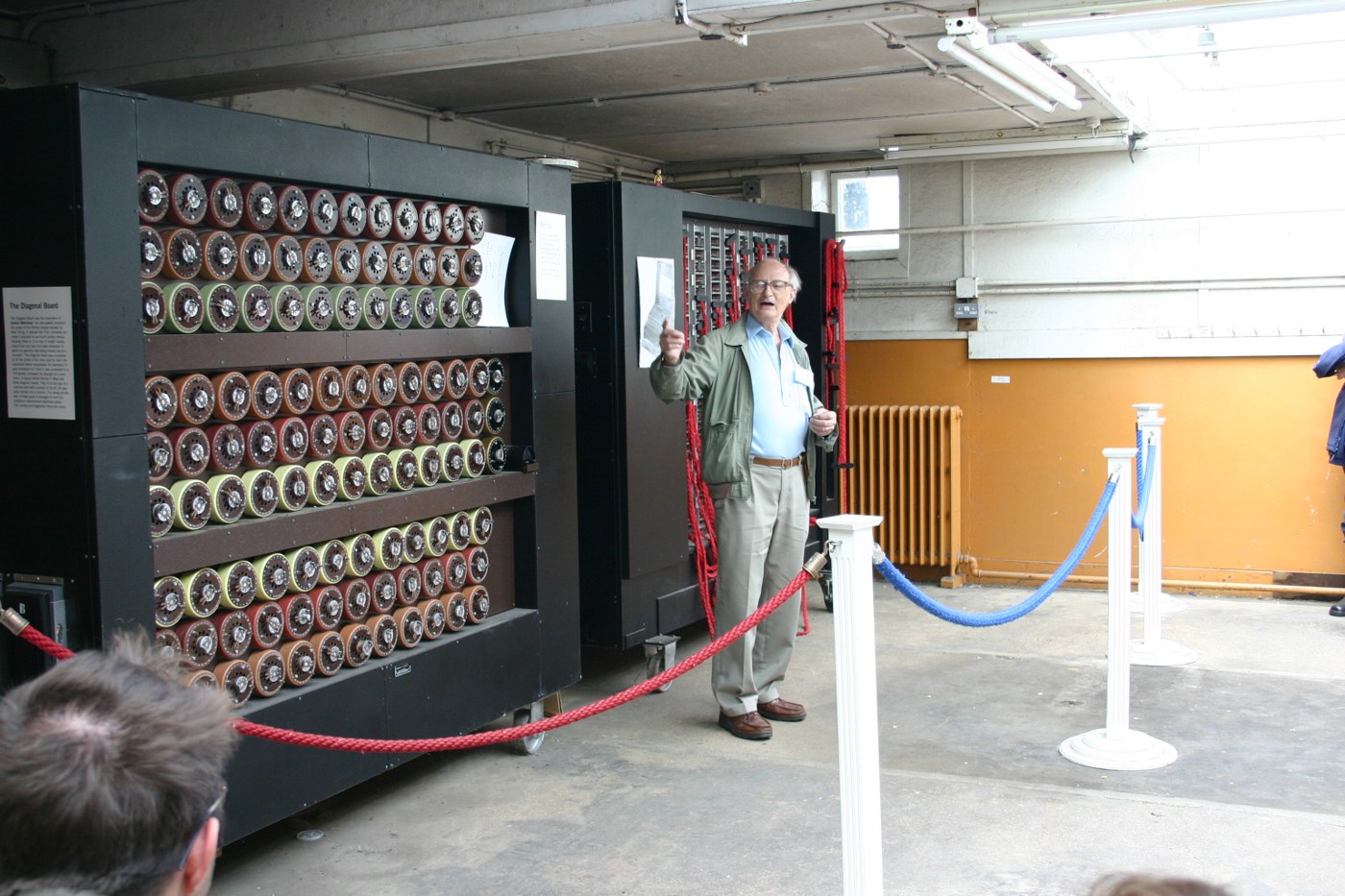
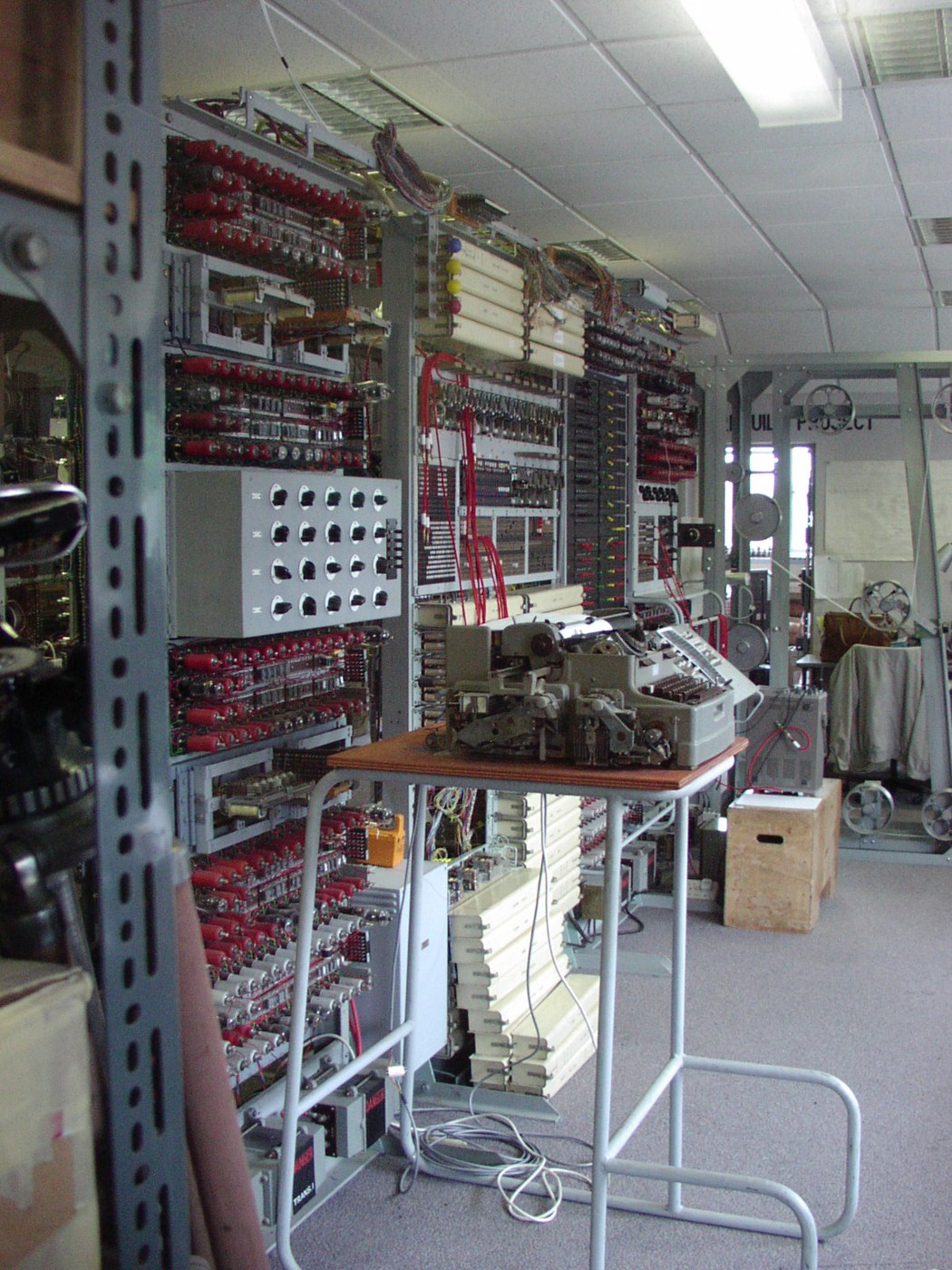
The rebuilt Colossus stands in Block H at Bletchley Park, the building in which several of the wartime Colossi worked, and since 2007 the home of The National Museum of Computing (TNMOC), which Sale co-founded. TNMOC is a separate institution from the Bletchley Park Trust, which runs the rest of the site.
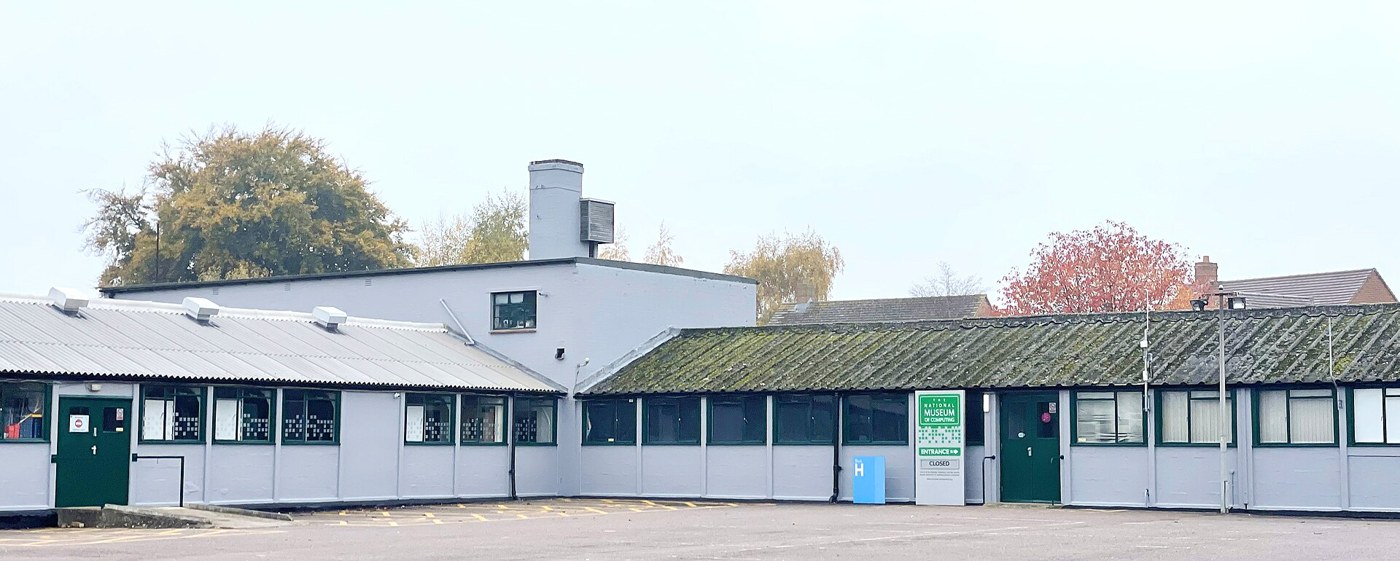
The museum’s Tunny gallery opened on 26 May 2011, in the presence of four wartime veterans: Captain Jerry Roberts of the Testery, Helen Currie, John Croft and Gil Hayward (TNMOC). It holds a reconstruction of part of the Knockholt intercept station, with receivers, undulators and perforators; a working British Tunny machine, rebuilt by a TNMOC volunteer team led by John Pether and John Whetter from a few photographs, partial circuit diagrams and the recollections of former operators; and, since 2019, the reconstructed Heath Robinson. Tony Sale died on 28 August 2011, three months after the gallery opened.
The museum now presents the whole chain: a Lorenz machine to encipher, the intercept equipment that took the signal down, Heath Robinson and Colossus to find the settings, and Tunny to produce the plain text.
11.10 The Surviving Lorenz Machines
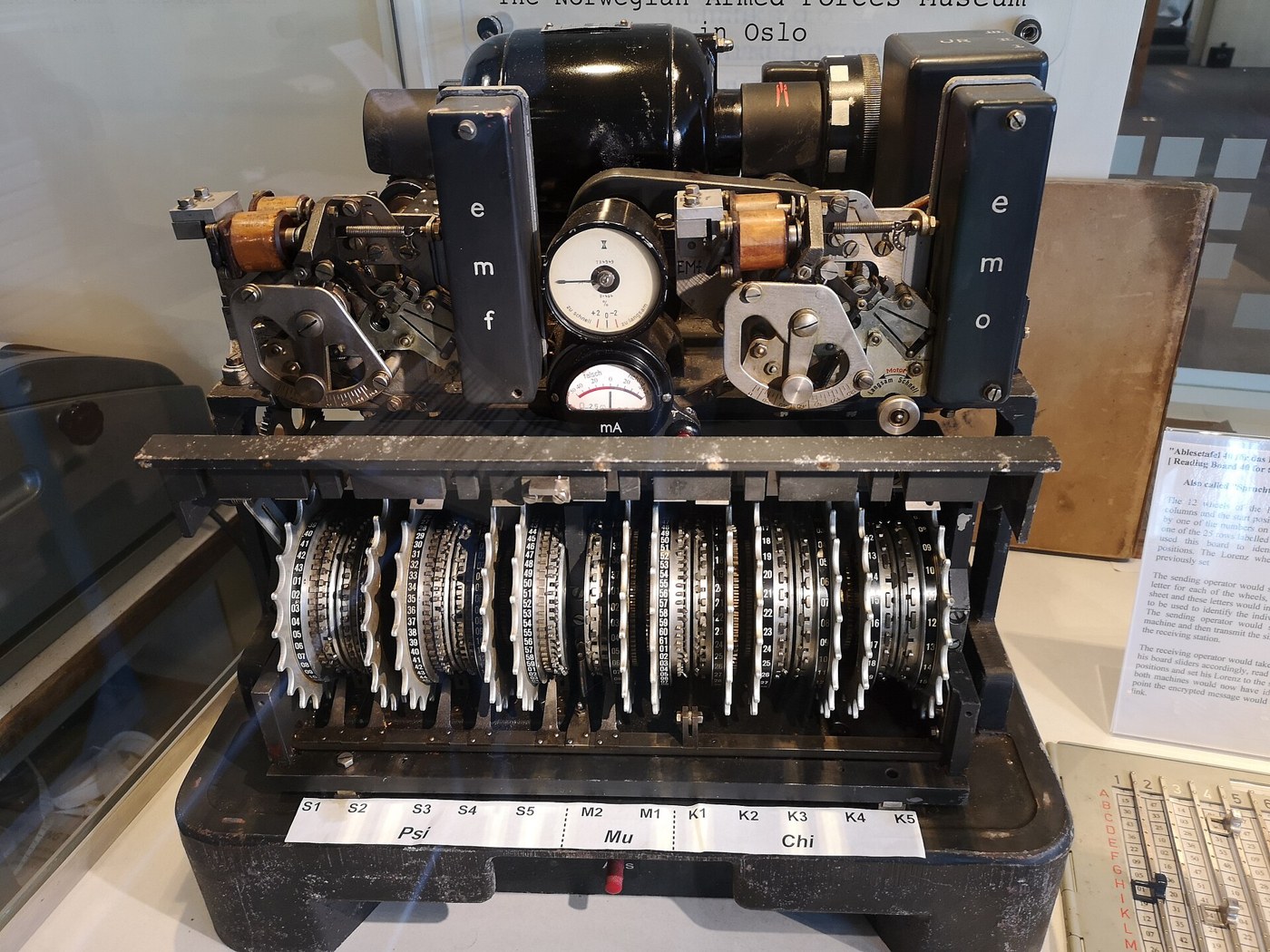
About two hundred Lorenz cipher attachments are thought to have existed during the war. TNMOC states that only four are known to have survived (TNMOC, 7 April 2016); Crypto Museum lists Lorenz machines at five institutions (Crypto Museum, “SZ40”). The difference may be in what is counted — complete machines, incomplete ones, or loans. What is on public display:
- TNMOC, Bletchley Park — a Lorenz SZ42, serial number 1137, used at the German headquarters at Lillehammer in Norway and presented on long-term loan by the Norwegian Armed Forces Museum on 7 April 2016. The museum believes it received the final surrender instruction at midnight on 8 May 1945. It arrived without its drive motor, and the museum appealed for one.
- Bletchley Park Trust museum — a Lorenz SZ42, described by Crypto Museum as having been found in Germany (the machine shown at the start of Volume 10).
- National Cryptologic Museum, Fort Meade, Maryland — a Lorenz machine, displayed near the Siemens T52 “Sturgeon”.
- Heinz Nixdorf MuseumsForum, Paderborn, and the Deutsches Museum, Munich.
The exact model of each (SZ40, SZ42A or SZ42B) is not consistently given in published descriptions, and this series does not assign one where the source does not.
11.10.1 The £9.50 teleprinter
One story attached to the TNMOC display is often garbled. In 2016 TNMOC volunteers noticed a “telegram machine” listed on eBay. John Whetter went to see it and found it on the floor of a shed in Essex, under rubbish. It was bought for £9.50 — the volunteers paid with a £10 note and told the seller to keep the change — and turned out, once cleaned, to be a German military Lorenz teleprinter of the kind used with the SZ42 (KCUR / NPR, 29 May 2016). It now sits beside SZ42 no. 1137. It is not a cipher machine: the eBay find was the teleprinter, not a Lorenz SZ.
11.11 Where Colossus Stands
The release of information since 1975 has reopened the question of what came first in electronic computing, and the answer depends on the definition.
- Colossus (1944) was electronic, digital and programmable by switches and plugs, and it was used in earnest, in numbers, for a real task. It did not store its program in memory and was not general-purpose.
- ENIAC (completed 1945, unveiled 1946) was electronic, digital and general-purpose, and programmed at first by plugging cables; it was not a stored-program machine either, in its original form.
- The Manchester Baby (21 June 1948) was the first electronic computer to run a program stored in its own memory.
- Earlier experimental machines — the Atanasoff–Berry Computer in the United States, Konrad Zuse’s relay machines in Germany — contributed ideas without being large electronic production machines.
Each can be called “first” under some reading. What Colossus can claim without qualification is to have been the first large-scale electronic digital machine put to practical use, and the proof — kept secret for thirty years — that machines with thousands of valves could work reliably for months on end. Copeland argues that its influence on the postwar British computers, through Newman, Turing and the people of the Newmanry, was direct and has been underestimated; others give more weight to the American work. The argument is a historian’s, and this series takes no side beyond the dates.
11.12 Coda
Every original Colossus is gone. What stands in Block H is a reconstruction, made by people who had to reverse-engineer it from photographs, fragments and the recollections of men and women in their seventies and eighties, and it runs. It reads a loop of tape at 5,000 characters a second, generates Lorenz wheel patterns in rings of thyratrons, and counts Tutte’s statistic, exactly as its originals did. It was finished in time to break messages sent from an original Lorenz machine in Germany sixty-three years after the war.
The last three volumes of this series turn from history to the bench: a replica Lorenz SZ42 built from modern parts (Volumes 12 and 13), and a Colossus-style counting machine that runs the same statistic in a microcontroller (Volume 14).
Next — Volume 12: Building a Lorenz — The SZ42 Replica, Design. Twelve wheels and 501 cams in electronics: settable cam patterns, wheel-position displays, the chi-2 and psi-1 limitations, Baudot in and out over USB serial or a real teleprinter loop — the design brief, the block diagram and the parts for a working SZ42 that can encipher a message the way the German high command’s operators did.
Comments (0)