Lorenz and Colossus · Volume 7
Lorenz and Colossus — Volume 7 — Max Newman and Heath Robinson
A Cambridge topologist who had taught Turing logic, a statistical attack that would take years by hand, and the clattering two-tape machine — named after a cartoonist — that proved a machine could do it in hours
7.1 About This Volume
By the end of 1942 Bletchley Park had solved the logical structure of the German Army’s teleprinter cipher machine without ever seeing one (Volumes 4 and 5), and a small section under Major Ralph Tester was reading some of its traffic by hand (Volume 6). Then the Germans tightened their procedures, and the supply of easy openings dried up. What remained was a method Bill Tutte had found in November 1942 that needed no lucky mistakes at all, only an enormous amount of counting. Done with pencil and paper, it was hopeless.
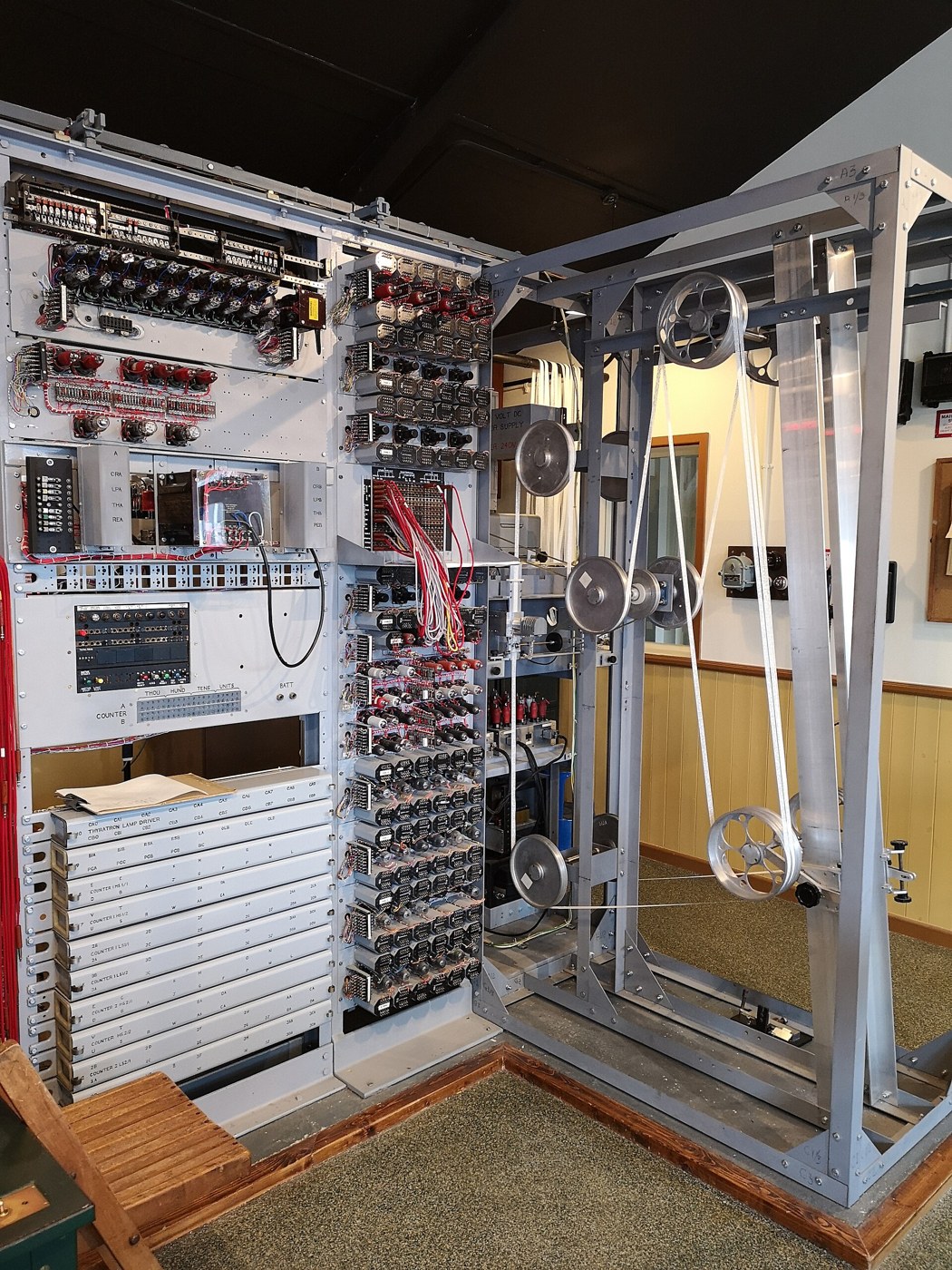
This volume is about the man who decided to hand that counting to a machine, and about the first machine that tried. Max Newman was a Cambridge mathematician of forty-five, a topologist and logician whose lectures had sent the young Alan Turing off to write “On Computable Numbers”. Heath Robinson was the result of his proposal: two loops of punched paper tape running round a steel frame at up to two thousand characters a second, read by photocells, added together by valve circuits and scored by electronic counters. It was slow, fragile, temperamental and named, with Bletchley’s sense of humour, after the cartoonist whose drawings showed absurdly complicated contraptions held together with string. It also worked well enough to prove that statistical codebreaking by machine was possible — and its failures showed Tommy Flowers exactly what to build instead.
The volume covers Newman’s life before the war; the problem Tutte’s method posed; the design and building of Heath Robinson at the Post Office Research Station and the Telecommunications Research Establishment; how it ran and how it went wrong; the growth of the section that came to be called the Newmanry; the later Robinsons; and the reconstruction that now runs at Bletchley Park.
7.2 Maxwell Neumann of Chelsea
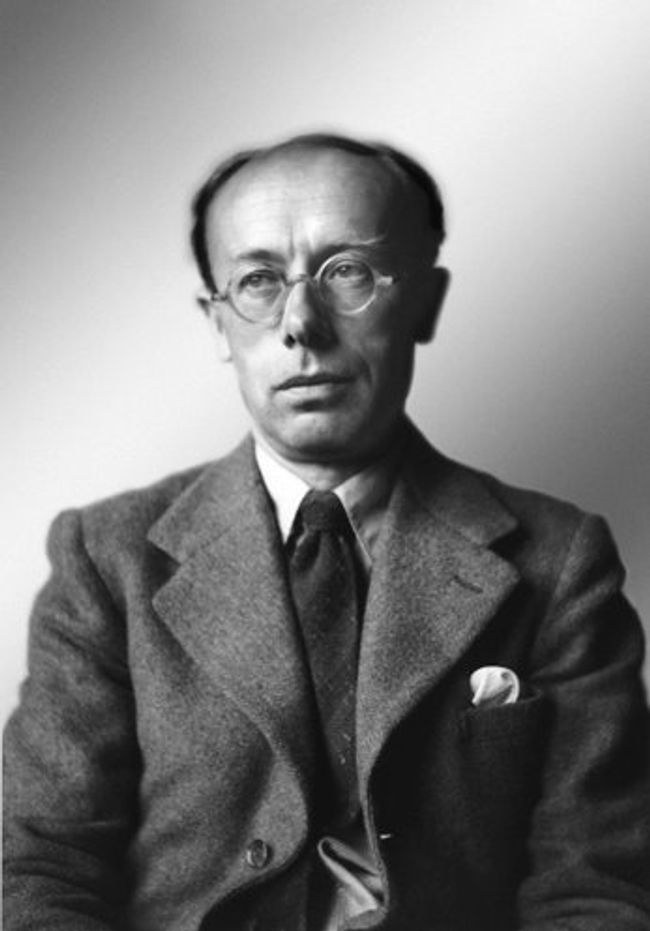
Maxwell Herman Alexander Neumann was born in Chelsea, London, on 7 February 1897. His father, Herman Neumann, had come to London from Bromberg in the German Empire (now Bydgoszcz, Poland) as a teenager; his mother, Sarah Ann Pike, was a schoolteacher. In 1916, with Britain at war with Germany, the family changed its name by deed poll to Newman (Wikipedia, after the Royal Society memoir).
He won a scholarship to St John’s College, Cambridge, in 1915, but the war interrupted his studies. He taught at a school in York and, when called up in 1918, registered as a conscientious objector. Back at Cambridge after the war he graduated as a Wrangler — a first in the Mathematical Tripos — in 1921, became a Fellow of St John’s in 1923 and a university lecturer in 1927. His research field was topology, the mathematics of shape and continuity, and he wrote one of its standard textbooks. He was elected a Fellow of the Royal Society in 1939.
7.2.1 The lectures that started Turing
In 1935 Newman gave a Cambridge lecture course on the foundations of mathematics, ending with Kurt Gödel’s incompleteness theorems and the open question of whether there was a mechanical method — an “effective procedure” — that could decide the truth of any mathematical statement. One of the students was Alan Turing, then a young Fellow of King’s. Turing’s answer, the paper “On Computable Numbers, with an Application to the Entscheidungsproblem” (1936), defined the problem in terms of an imaginary machine reading and writing symbols on a tape, and showed that no such universal decision method could exist. Newman recognised the paper’s importance at once and helped get it into print (Copeland, colossus-computer.com).
The connection mattered later. Newman was one of the very few people in Britain who understood, before the war, the idea of a universal machine that could carry out any procedure given to it as a description. When he came to Bletchley Park he was not an engineer and never became one, but he knew what a machine could in principle be made to do.
7.3 Bletchley Park, August 1942
Newman arrived at Bletchley Park at the end of August 1942 — 31 August by the usual account — recommended by the physicist Patrick Blackett. He was first set to work in the Testery, the section breaking Tunny by hand (Volume 6), and he found he was not much good at it. The Testery’s methods depended on long stretches of patient guesswork, building out from fragments of plaintext. Newman’s gift was for seeing the general shape of a problem.
The timing was important. Through the summer of 1942 the Testery had been reading a good deal of Tunny traffic, because the German operators sent twelve-letter indicators in the clear that told the receiving station the wheel settings, and because they sometimes sent two messages on the same setting — a depth, the opening that John Tiltman had exploited in August 1941 (Volume 4). In October 1942 the Germans replaced the twelve-letter indicators with settings taken from a printed list (the QEP books, after the prefix used for them), and the depths became much rarer. Copeland’s account says that broken messages fell to “a trickle” during 1943 (Copeland, Rutherford Journal 3).
7.3.1 Tutte’s statistical method
What survived the change was a method Bill Tutte had found in November 1942 (Volume 5). It needed no depths and no indicators. It needed only a long message and a good deal of arithmetic.
The idea, in outline, was this. Each character of Tunny cipher text was the sum (bit by bit, modulo two) of the plaintext character and two key characters: one from the five regularly stepping chi wheels, and one from the five irregularly stepping psi wheels (Volume 3). Tutte noticed that if you took the difference between each character and the next — the delta — the psi contribution very often vanished, because the psi wheels frequently stood still between one character and the next. German plaintext, too, had a slight tendency for the first two bits of consecutive characters to change together. Put those two weak biases together, and something useful happened: if you added together the deltas of the first two bits of the cipher text and the deltas of the first two chi wheels set at their correct starting positions, the result came out as a “dot” (zero) a little more often than half the time — about 55 per cent. At a wrong setting it came out at about 50 per cent (Wikipedia, “Cryptanalysis of the Lorenz cipher”).
The first chi wheel had 41 positions and the second 31, so there were 41 × 31 = 1,271 possible pairs of starting positions. For each pair, the method required running through the whole message — several thousand characters — computing the sum at every position and counting the dots. Then the pair with the highest count was, probably, the right one. A message of 4,000 characters tested against all 1,271 settings meant more than five million separate operations, and then the same again, in shorter runs, for the other three chi wheels. Volume 9 works through the arithmetic in detail.
Newman’s estimate, as reported by Copeland, was that a single long message attacked this way by hand would take several hundred years. Tutte’s method was correct and useless at the same time.
7.3.2 Newman’s proposal
Newman’s contribution was to see that the method was perfectly suited to a machine. It was nothing but a long, repetitive sequence of additions and comparisons — the kind of thing a machine does without fatigue and a person does with mounting error. He also knew that high-speed electronic counters already existed: physicists had been using valve circuits to count particles from radioactive sources since the early 1930s.
Newman put the idea to Bletchley Park’s senior staff and persuaded them. In December 1942 he was given the task of developing a machine to carry out Tutte’s method, and the small section he formed to do it — formally the statistical section, universally the Newmanry — began work. Construction of the machine began in January 1943.
7.4 Building Heath Robinson
Heath Robinson was the product of two research establishments that were, by 1943, accustomed to doing secret electronic work in a hurry.
The first was the Post Office Research Station at Dollis Hill in north-west London, where the General Post Office developed telephone exchange and line equipment. Its engineering design team for the new machine was led by Frank Morrell. The second was the Telecommunications Research Establishment (TRE), the radar research centre then at Malvern, where C. E. Wynn-Williams — a Cavendish Laboratory physicist who before the war had invented the scale-of-two and ring counters used to count nuclear particles — designed the counting circuits. Newman wrote the functional specification (Wikipedia, “Heath Robinson”).
7.4.1 The three parts
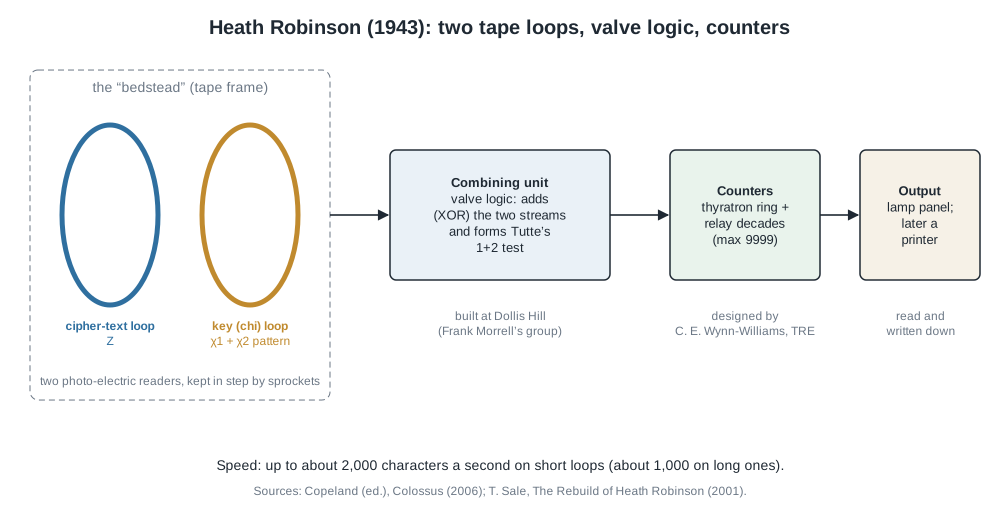
As Tony Sale reconstructed it from the surviving fragments, the machine came in three physical parts (Sale, codesandciphers.org.uk):
- The bedstead — a tall open steel frame carrying pulleys round which two long loops of five-hole teleprinter tape ran side by side, past an optical reader. Its nickname came from its appearance. It was designed by Arnold Lynch and Eric Speight of Dollis Hill.
- A tall rack of valve logic, built at Dollis Hill, which combined the signals read from the two tapes, plus a jack field on which the logical test could be set up with plugs.
- A short, wide rack of counters, built at TRE, with a lamp panel to display the result.
The cover name on the drawings was “Apparatus Telegraph Transmitting”, case number 11951.
7.4.2 Two tapes
One tape carried the cipher text: the intercepted message, punched by Bletchley’s own staff, at least a couple of thousand characters long, its two ends glued together to make an endless loop. The other carried the key: the patterns of the first two chi wheels, punched out as a long stream. Because the chi wheel patterns were usually known — broken by hand in the Testery from earlier traffic — this tape could be prepared in advance.
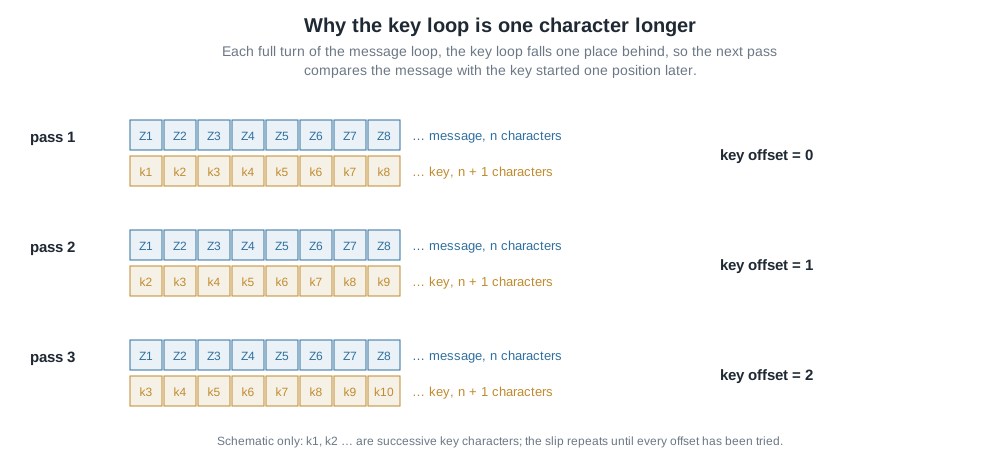
The key tape was made one character longer than the cipher tape. On each full revolution of the message loop, the key loop came round one character later relative to it, so each pass compared the message with the key started one place further on. Pass after pass, the machine tried the message against successive relative starting positions until all had been tried, adding up a count on each pass. Wartime and modern accounts describe the process in slightly different ways, but the principle is that shown below.
7.4.3 Reading at two thousand characters a second
The tapes were read optically: light shone through the punched holes on to photocells, one for each of the five data tracks on each tape, with further cells for the small sprocket holes and for hand-punched start and stop marks. The sprocket holes, which every teleprinter tape carries along its length to drive it through a reader, also provided the timing — the moment at which each character was sampled.
Speeds reached about 2,000 characters per second on the shorter loops and about 1,000 on the longer ones, which could run to 11,000 characters. That was far faster than any mechanical teleprinter reader, and it was the source of most of the machine’s troubles. At first the two tapes were driven by a pair of sprocket wheels on a common axle; this tore the tape, and the drive was changed to friction pulleys, with the sprocket wheels left idling to keep the loops in step.
7.4.4 Logic by phase
The combining unit had to do one thing very fast: add two binary signals modulo two — what is now called an exclusive-or — and do it for several channels at once. According to Sale’s reconstruction, Wynn-Williams’s design did this in an unusual way. A master oscillator generated a 25 kHz carrier, and each binary signal was represented by the phase of that carrier: 0 degrees for one value, 180 degrees for the other. Passing the carrier through a diode-bridge “ring modulator” shifted its phase by 180 degrees whenever the controlling bit was a 1. Two such shifts cancel. A chain of bridges therefore produced, at the output, a phase that encoded the sum of all the inputs; a detector compared the output phase with the original, and a pulse from the sprocket track sampled the result. Each bridge had a small triode amplifier to make up its losses (Sale, “The Wynn-Williams proposal”).
Sources disagree about who should be credited with the combining unit. Some accounts attribute it to Tommy Flowers; Sale’s reconstruction pages describe Wynn-Williams’s design built by Morrell’s group at Dollis Hill, with Flowers in an advisory role. One story Sale recorded makes the point: when more than six of the bridge circuits were chained together, stray phase shifts accumulated and the logic failed. Allen Coombs, one of the Dollis Hill engineers, took the problem to Flowers, who told him to change the oscillator frequency. Coombs did, and the circuit worked — though, by Sale’s account, neither man could say why.
7.4.5 Counting
The counters were Wynn-Williams’s own territory. Each counter was four decimal decades in series, so it could count to 9,999. The units decade, which had to keep up with the tape, was a ring of ten thyratrons — gas-filled valves that, once fired, stay conducting until they are deliberately switched off, so that a ring of them can pass a single “on” state round like a baton. The tens and hundreds decades used high-speed relays, and the thousands a slower relay. There were four counters: two counting the result of the logical test, alternating from one pass to the next, and two counting sprocket holes so that the operators knew where they were on the tape.
At first the counts were read off a lamp panel and written down by hand. Sale called this “a great source of error”. A printer was added later; by his account it was not much better.
7.5 Heath Robinson at Bletchley Park
The prototype was delivered to Bletchley Park in June 1943 and installed in Hut 11, which had previously housed Bombes (Sale, codesandciphers.org.uk). Copeland’s account records that its first switch-on produced smoke, when a large resistor overloaded. Two Post Office engineers, Harry Fensom and Alan Bruce, came with it to keep it running. Two Wrens operated it at a time. The cryptanalysts were Newman’s first two recruits to the new section, Jack Good and Donald Michie.
7.5.1 Why it was called Heath Robinson
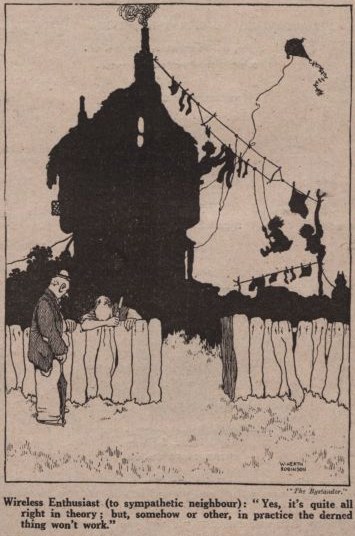
William Heath Robinson (1872–1944) was an illustrator whose cartoons for magazines such as The Sketch, The Bystander and the Radio Times showed earnest men operating ludicrously complicated machines to do simple things, their parts held together with knotted string and pulleys. By the 1930s “Heath Robinson” was an ordinary English adjective for any improvised, over-elaborate contraption. The Wrens and codebreakers who watched two paper tapes whirring round a frame of pulleys did not have to look far for a name. The cartoonist died in September 1944, never knowing that a secret machine bore his name.
7.5.2 What went wrong
Heath Robinson proved the principle. Run on a real message, it produced a count that stood out at the right chi setting, as Tutte’s theory predicted. But it was not a dependable production machine, and the reasons were almost all to do with paper:
- Synchronisation. The method depended on the two tapes staying exactly in step for thousands of characters at a time. Paper stretches, especially when it is pulled round pulleys at speed, and two loops of different lengths stretch differently. Once they drifted apart by even a fraction of a character, every count from then on was meaningless.
- Tape wear and breakage. The loops broke, and had to be repaired and rejoined. Irene Dixon, one of the Wren operators, recalled in 2019 that the machine gave good results but that its tapes broke so often that repairing them was a major and tedious job (i-programmer, 13 April 2019).
- Tape preparation. Both tapes had to be punched accurately; a single error in the key tape corrupted every pass. Long runs of all-holes or no-holes characters also confused the optical reader, and the texts had to be adjusted to avoid them.
- Inconsistent results. Copeland’s account notes that the machine took several hours to process a single message and sometimes gave different results for the same problem.
- Hand recording. Until the printer arrived, every result passed through a human hand.
None of this made the machine useless. Over the second half of 1943 the Newmanry used it, and its successors, on current traffic, and the combination of machine counting and hand methods in the Testery did break messages. But it was clear by the autumn that a machine reading two synchronised tapes at high speed was always going to be fighting its own paper.
7.5.3 The Robinson family
Improved machines followed. The prototype’s shortcomings were mostly overcome in a developed version known as Old Robinson, though one limitation — the inability to “span”, that is, to restrict the count to a chosen section of the tape — remained. Two further machines were called Peter Robinson and Robinson and Cleaver, after London department stores. A larger machine designed by Flowers, Super Robinson, had four bedsteads to run four tapes at once and was used for running depths and cribs — testing guessed plaintext against cipher text — rather than for Tutte’s statistical runs (Wikipedia, “Heath Robinson”). TNMOC’s 2019 account says that by the end of the war two Super Robinsons were working and two more in development, and that one went to the codebreakers’ postwar home at Eastcote, where it probably ran into the 1950s.
The Robinsons were not replaced by Colossus everywhere. They remained in use for the jobs that genuinely needed two tapes, and the Newmanry’s end-of-war inventory, as given in the General Report on Tunny, lists three Robinsons alongside the ten Colossi.
7.6 The Newmanry
The section Newman built around these machines grew from almost nothing into one of the most unusual organisations at Bletchley Park.
In June 1943, when Heath Robinson arrived, it consisted of Newman, Good, Michie, two engineers and sixteen Wrens in a small hut (Wikipedia, “Newmanry”, citing the General Report on Tunny). By the end of the war it had 26 cryptographers, 28 engineers and well over 250 Wrens — accounts give 272, 273 or 275 — running ten Colossi, three Robinsons and a number of smaller machines around the clock.
Newman ran it in a way unusual for a wartime intelligence section. The cryptanalysts were young — Good and Michie were in their twenties — and Newman treated them as research colleagues. Problems were discussed openly, ideas written up and argued over, and the section’s working notes later became the basis of the General Report on Tunny, written in 1945 by Good, Michie and Geoffrey Timms. It is, among other things, a record of how a group of mathematicians learned to use machines as instruments of statistical inference.
The Wrens — members of the Women’s Royal Naval Service — did most of the machine work: punching and joining tapes, setting up runs, threading loops on the bedstead, reading and recording counts, and keeping the machines going on three shifts. Their role grew larger, not smaller, as the machines improved; by 1945 they were sometimes given written decision procedures that let them choose the next run themselves on the basis of the last result.
7.6.1 Relations with the Testery
The Newmanry did not break messages on its own. Its machines produced settings of the chi wheels, which were half the key. The rest of the work — setting the psi and motor wheels, and producing the plaintext — was done by hand in the Testery, and the two sections passed tapes and settings back and forth constantly. Some cryptanalysts held posts in both. Volume 6 describes the Testery’s side; Volume 10 follows the decrypts out of Bletchley Park.
7.7 From Heath Robinson to Colossus
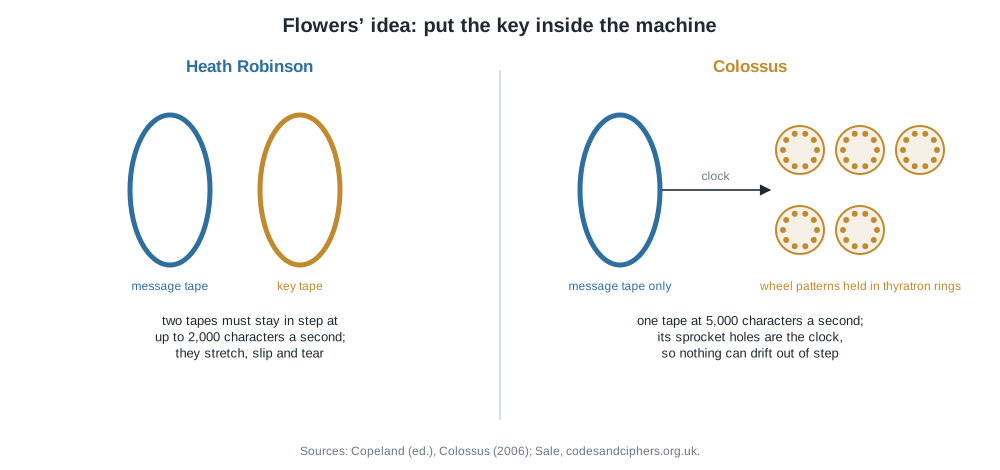
Among the engineers consulted about Heath Robinson was Tommy Flowers of Dollis Hill, introduced to Newman by Turing in February 1943. Flowers looked at the design and saw the two-tape problem at once. His proposal, made to Newman that month, was radical: do away with the key tape altogether. Instead of reading the chi patterns off a second loop of paper, generate them electronically inside the machine, using rings of valves set up to imitate the wheels. There would then be only one tape, and nothing for it to fall out of step with. The tape’s own sprocket holes could drive the whole machine’s timing.
The objection, from Bletchley Park and from TRE, was the number of valves such a machine would need. Valves were thought unreliable in large numbers; a machine with one or two thousand of them, the argument went, would spend more time broken than working. Flowers, who had built telephone switching equipment with thousands of valves before the war, thought otherwise. Bletchley Park did not order the machine. Flowers built it anyway. That story is Volume 8.
7.8 After the War: Newman at Manchester
Newman left Bletchley Park in 1945 for the University of Manchester, where he became Fielden Professor of Pure Mathematics in September of that year. He came with a clear idea, formed during the war, of building an electronic computer on the lines of Turing’s universal machine. In a letter to John von Neumann in February 1946 he wrote that he had “got very interested in electronic devices of this kind during the last two or three years” (Copeland, colossus-computer.com).
He obtained a Royal Society grant for a Computing Machine Laboratory, approved in July 1946, and, according to Copeland, racks of components from dismantled Colossi were shipped from Bletchley Park to Manchester. The engineers Frederic Williams and Tom Kilburn, who had come to Manchester from TRE, built the Manchester “Baby”, which ran its first stored program on 21 June 1948 — the first electronic stored-program computer to work. Turing joined the laboratory that year. How much the Baby owed to Colossus is argued: its memory and architecture were new, but the people, the confidence that large electronic machines could be made to work, and some of the hardware came directly out of the Newmanry.
Newman declined an OBE in 1946, reportedly regarding it as derisory in the light of how Turing had been treated. He was president of the London Mathematical Society from 1949 to 1951, received the Royal Society’s Sylvester Medal in 1958, and died in Cambridge on 22 February 1984, by which time his wartime work was only beginning to be publicly known.
7.9 The Heath Robinson Reconstruction
Nothing of the original Heath Robinson survives. Like Colossus, it was broken up after the war, and its drawings were destroyed.
The first attempt at a reconstruction was Tony Sale’s. In 2000 and 2001, while his work on the Colossus rebuild at Bletchley Park was interrupted, he began reconstructing Heath Robinson’s logic in his own garage, starting from a single A3 circuit diagram that had survived among Allen Coombs’s papers and from the recollections of Harry Fensom, Arnold Lynch and Gil Hayward. He rebuilt the 25 kHz oscillator and bridge logic, rewound transformers from Post Office amplifier units to work at the right frequency, built thyratron ring counters from Wynn-Williams’s prewar papers in the Proceedings of the Royal Society, and drove the logic from a PC that simulated the tape. By his account, the double-delta results from his reconstructed logic matched those of the Colossus rebuild exactly (Sale, “The Rebuild of Heath Robinson”). He also installed one of its amplifier chassis in the Colossus rebuild, where it improved the tape signals.
A full working reconstruction, with a bedstead, was completed by a volunteer team at The National Museum of Computing after about seven years’ work and unveiled on 6 April 2019 by Irene Dixon, who had operated Colossus as a Wren, in the presence of Peter Higginson, the cartoonist’s great-nephew (i-programmer, 13 April 2019). It stands in Block H, a few metres from the Colossus rebuild — the first-ever Tunny-breaking machine next to its successor, as they never stood in the war.
7.10 Why Heath Robinson Matters
It would be easy to treat Heath Robinson as a false start, the prototype that Colossus made obsolete within a year. That misreads it in three ways.
First, it established the method. Before Heath Robinson, nobody had tried to break a high-grade cipher by having a machine run a statistical test over a long text and pick out the setting that scored best. Heath Robinson showed that Tutte’s statistic, counted by machine, did stand out at the right setting in real traffic, and that a team of mathematicians, engineers and operators could turn that into a routine. Colossus did the same job much faster and more reliably, but it did the same job.
Second, it established the architecture: a tape read photo-electrically at high speed, a programmable logic unit that formed a Boolean function of the bits read, and electronic counters to total the result — with the timing taken from the tape itself. Every one of those features carried straight into Colossus.
Third, it established the organisation. The Newmanry’s mixture of mathematicians, Post Office engineers and Wren operators, working in shifts around a machine and deciding what to run next on the strength of the last result, was built around Heath Robinson in the second half of 1943. When Colossus arrived in January 1944, it arrived into a section that already knew what to do with it.
Next — Volume 8: Tommy Flowers and the Building of Colossus. A bricklayer’s son from the East End who had spent the 1930s putting valves into telephone exchanges; a proposal that Bletchley Park thought would never work; eleven months of building at Dollis Hill, partly at his own expense; a machine delivered on 18 January 1944 that did its first job on 5 February — and the order for a dozen more, the first of them wanted by the first of June.
Comments (0)