PURPLE · Volume 9
PURPLE — Volume 9 — What Survived — The Berlin Fragment, CORAL, JADE and the Legacy
What is left of a machine its owners smashed: the stepping-switch assembly dug out of the Japanese embassy in Berlin, the captured JADE from Saipan, the American analogs that outlived the original, PURPLE's naval cousins CORAL and JADE and how they were broken, and the long road from a 1940 break to public knowledge, published reconstructions and working simulators
9.1 About This Volume
Japan issued its Type 97 diplomatic cipher machine to its most important embassies, and by 1945 it had destroyed them. What survives of the machine the Americans called PURPLE is a single assembly of three stepping switches about the size of a shoebox, recovered from the ruins of the Japanese embassy in Berlin, and two smaller pieces that are rarely mentioned. The machine is better represented by its copies: the analogs the U.S. Army built without ever having seen one, some of which are still in museum cases.
This volume describes what survived and where it is, the two other machines of the same generation — the naval attachés’ CORAL and the Navy’s JADE — and how they were broken, how the secret of PURPLE came out, and what the 1940 break left behind: an institution, a body of technique, and in recent decades a published reconstruction precise enough to decipher the original intercepts again. It closes the history volumes of the series. Volumes 10 to 12 turn to building a working PURPLE.
9.2 Smashed and Buried
The Japanese took the destruction of cipher machines seriously, and the record shows them doing it. On the morning of 7 December 1941 Tokyo ordered its Washington embassy, “after deciphering part 14 of my #902 … please destroy at once the remaining cipher machine and all machine codes” (Volume 7). Similar orders had gone to London, Hong Kong, Singapore and Manila in the first days of December.
Berlin’s machine survived until the last weeks of the Reich. The NSA’s account, which follows Carl Boyd’s study of Ambassador Ōshima, describes its end:
“The PURPLE machine on which Oshima’s reports were encrypted did not survive the war intact; the Japanese staff broke it up and buried the largest remaining chunks in the underground air raid shelter associated with the Berlin embassy. These pieces were unearthed by the Americans after the war — the only remnants of the system which had proved so valuable to the Allies.” — NSA Center for Cryptologic History, Cryptologic Almanac, “Baron Oshima’s Contributions” (1998)
The machines in Tokyo, and at the other embassies that held them, seem to have been destroyed under the same orders. Wes Freeman, Geoff Sullivan and Frode Weierud, whose 2003 Cryptologia paper is the standard technical account, put it plainly: the SIS cryptanalysts “never actually saw the Japanese machine, and, as far as has been revealed in the literature, only a few parts of one machine were ever recovered at the end of World War 2” (Freeman, Sullivan & Weierud, “PURPLE Revealed”, 2003, p. 2). No complete Type 97 is known to exist.
9.3 The Berlin Fragment
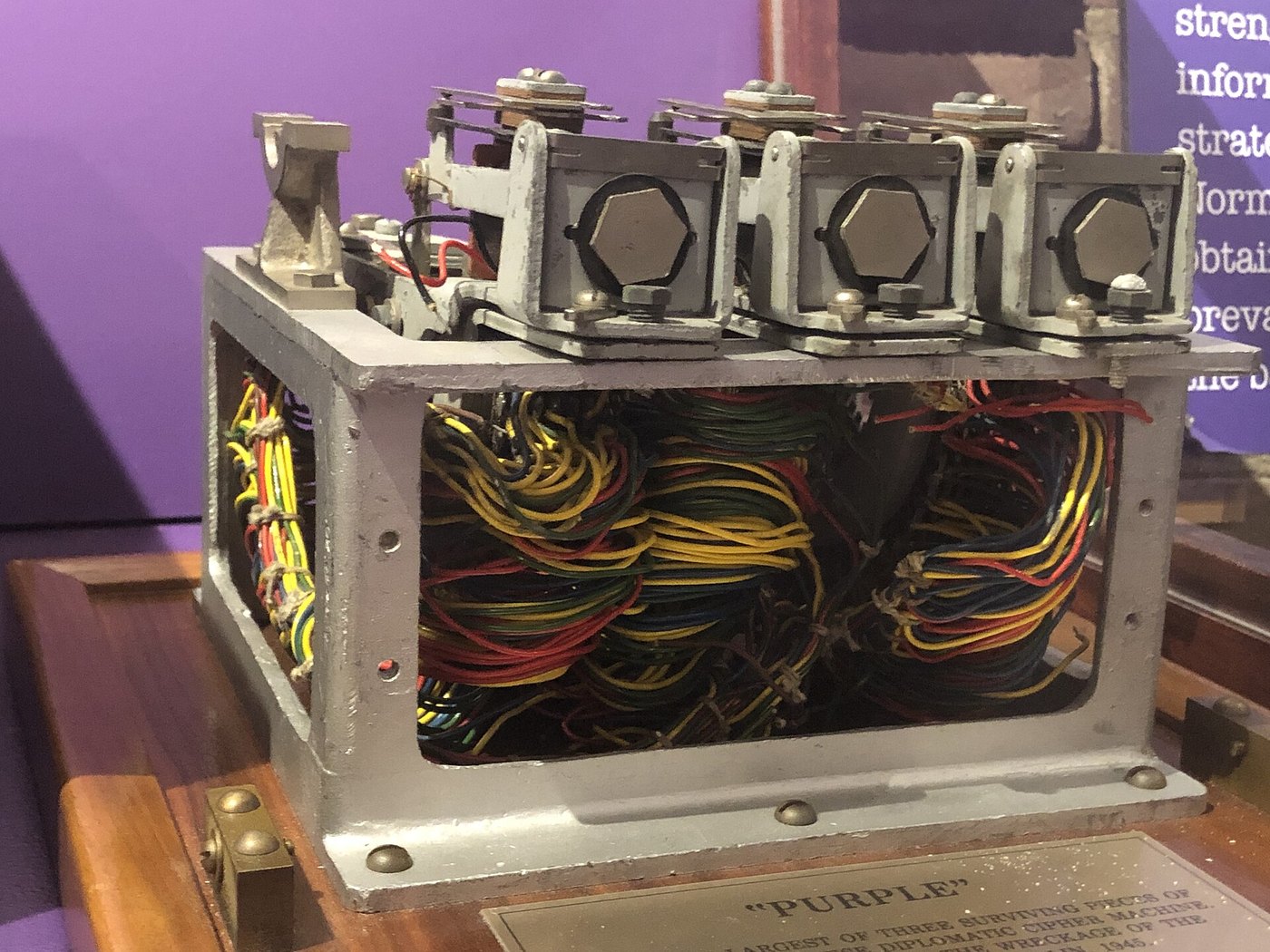
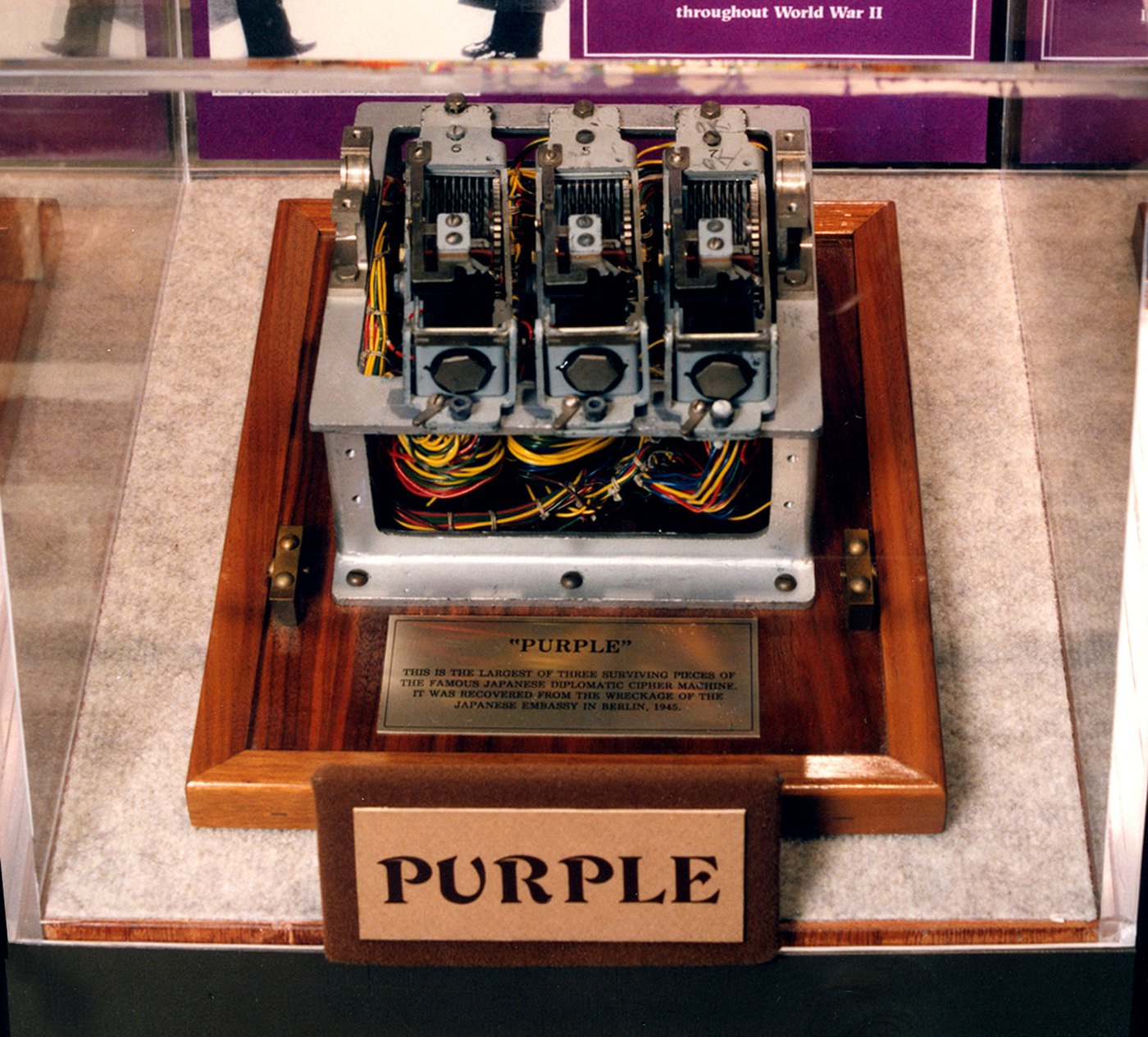
The largest of the Berlin pieces is a cast-metal frame carrying three 25-position stepping switches mounted side by side. Above the frame each switch shows its contact bank, its wiper assembly and its ratchet; each has its own stepping magnet. Below, the frame is filled with a dense harness of colour-coded wire. A small wooden plinth and an engraved plaque complete the museum display.
The assembly is one stage of the “twenties”. Volume 4 explained the principle. PURPLE split the alphabet into six letters (the “sixes”) and twenty (the “twenties”), and enciphered the twenties through three stages of stepping switches in series. Each stage had to switch twenty wires at once, one for each letter, through 25 positions, which needed at least twenty contact levels moving together. One stepping switch of that era did not carry twenty levels, so the Japanese ganged several together on a common drive.
The fragment shows how. Its switches each carry seven levels of contacts, and three of them together give 21 — the twenty the cipher needed plus one, which the writer Arnold Reinhold has suggested was used for control. The seven-level count is visible in close photographs and is noted in the Wikimedia Commons descriptions of the museum photographs; Reinhold raised it in a 2019 post to the Cryptography mailing list, pointing out that the Japanese switches are therefore not identical to those the American team chose, as many popular accounts say. The U.S. Army’s analogs reached the same logical result with switches of their own.
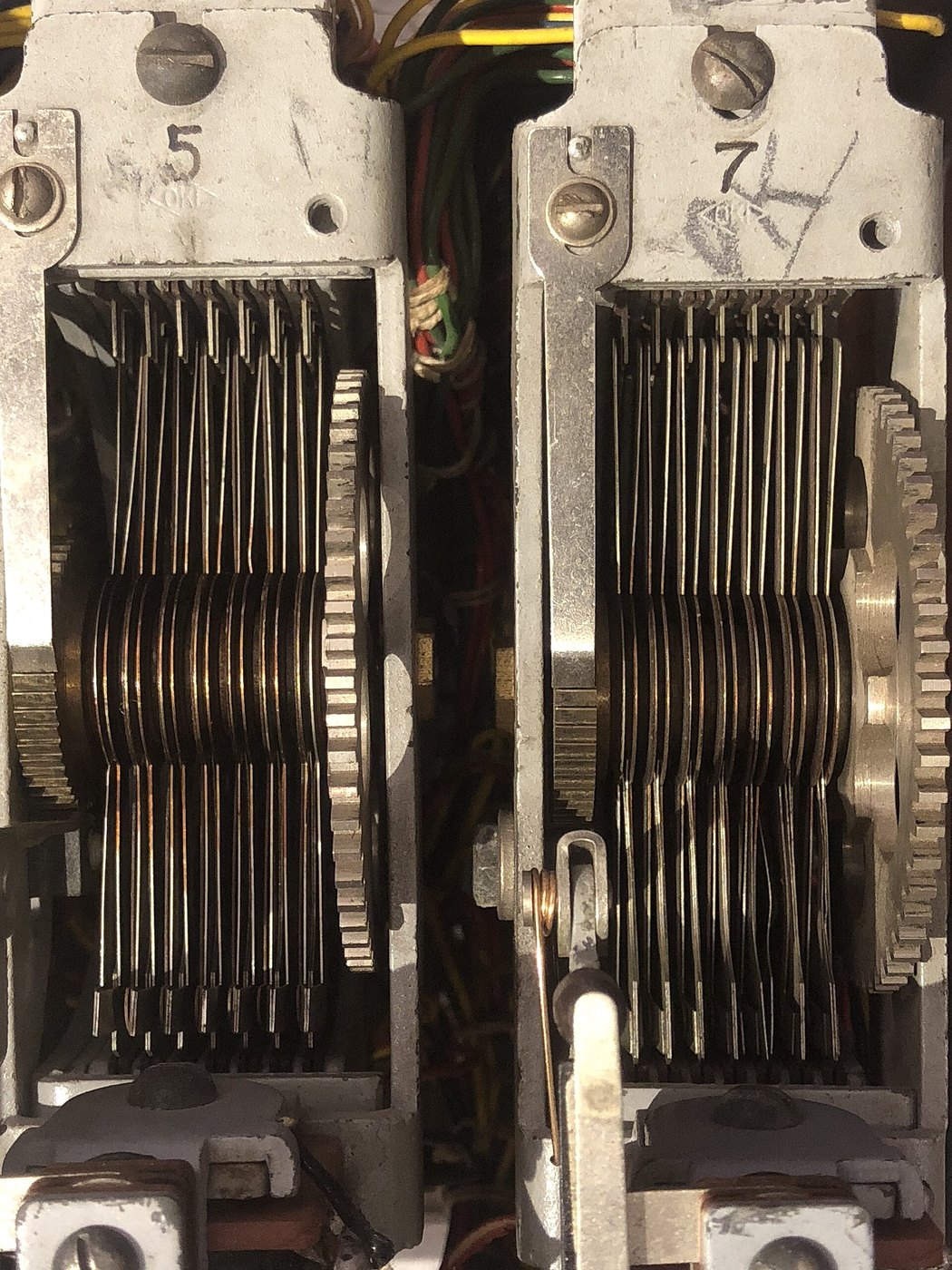
The frames are stamped with numbers (5, 6 and 7 can be read in published photographs), and pencilled marks appear on some of them. Reinhold suggested the numbers might identify which stage the assembly was — he thought the middle one — and proposed checking its wiring against the published tables. As far as can be found, no tracing of the fragment’s wiring against the SIS tables has been published. Freeman, Sullivan and Weierud took their wiring from wartime U.S. Navy documents describing the American reconstruction, not from the fragment.
9.3.1 Where it is, and seeing it
The fragment belongs to the National Cryptologic Museum (NCM), the NSA’s public museum at 8290 Colony Seven Road, Annapolis Junction, Maryland, beside Fort George G. Meade. Admission is free. The fragment has been photographed in the museum’s galleries for many years: the public-domain photograph at the head of this volume, Daderot’s photographs of 2013 and Reinhold’s of 2019 all show it on display. The NSA has also featured it in a museum “Artifact Spotlight” as “the largest of three surviving pieces” of the machine (NSA photo gallery).
The museum has changed a great deal in recent years. It closed in 2020, reopened after a renovation in October 2022, and posted a further temporary closure from March 2026. Whether the fragment is in the current galleries could not be confirmed from public sources as of October 2026. The NSA’s own pages say only that the fragment and the analogs are “at” or “in the collection of” the museum. The evidence that the fragment is shown to the public is good up to 2019 (Reinhold’s gallery photographs) and fair after the 2022 reopening (a 2023 press account describes the museum as having the Berlin remnant, without saying it is on view). Beyond that it is unknown. The same is true of the analogs. Visitors who want to see a particular object should ask the museum before travelling.
9.3.2 The other two pieces
The plaque’s “three surviving pieces” invites the question of where the other two are. Public sources do not say. The NSA’s account speaks of “the largest remaining chunks” being dug up in Berlin, which suggests that all three came from the same machine and the same shelter. Their present location and their nature are unconfirmed, and nothing here should be read as a claim about them.
9.4 The Analogs That Outlived the Machine
The SIS built its first PURPLE analog in 1940, and more followed as the Army and Navy expanded the work (Volume 6). How many were built is less certain than popular accounts suggest. Some lists give six or more, including a second machine for Britain and one sent on to Singapore and India. Only the first machine delivered to Britain in early 1941 is firmly documented in the sources consulted for this series; the others are unverified. Several American machines survive.
- PURPLE Analog No. 1 is held by the National Cryptologic Museum. Freeman, Sullivan and Weierud described it as “on display” at the museum in 2003 and noted that it had only one physical plugboard, because Japanese practice was to plug the input and output boards identically. It was lent to the International Spy Museum in Washington for a temporary exhibition of NSA artefacts in 2021.
- An improved analog, built later in the war, is also at the NCM, and has been photographed there in detail, including its plugboard and wiring.
- The U.S. Air Force’s Dr. Dennis F. Casey Heritage Center at Joint Base San Antonio–Lackland, Texas, unveiled a World War II PURPLE analog with a specially configured input keyboard in an exhibit on 21 December. The Air Force caption gives no year; the photograph’s metadata suggests December 2016 (ACC photo).
So the copies outnumber the original. Every surviving piece of a PURPLE that actually worked is American.
9.5 PURPLE’s Cousins: The 1937 Generation
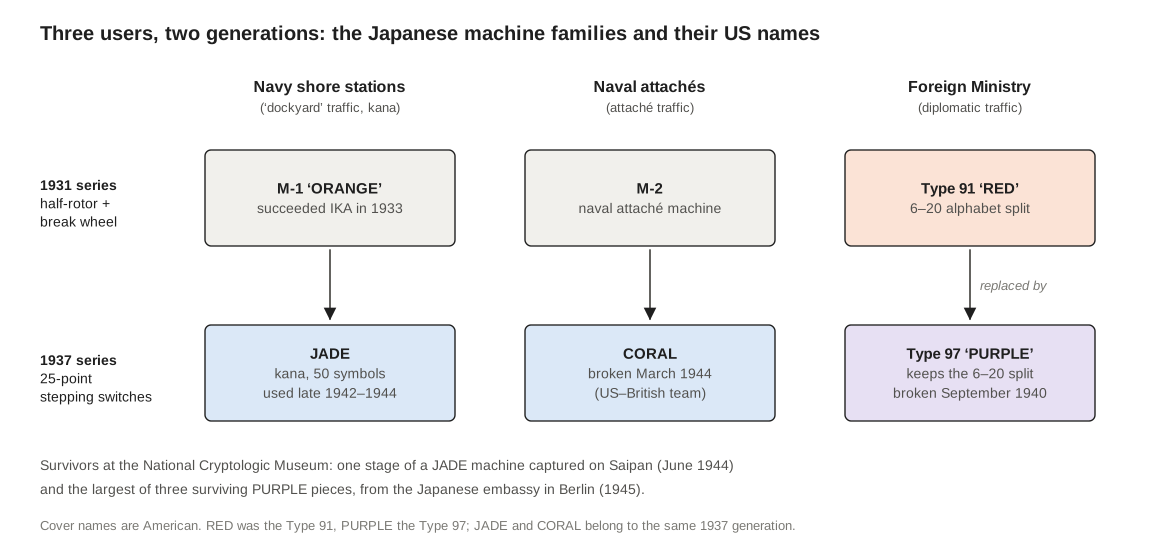
PURPLE was not a one-off. Chris Christensen’s study of the earliest Japanese naval machine sets out a family tree that the American codebreakers came to know well. Through the 1930s three Japanese users each had a machine: the Navy for administrative traffic between shore stations (the “dockyard ciphers”, in kana), the naval attachés abroad, and the Foreign Ministry. The 1931 series — the Navy’s M-1 (called ORANGE by the Americans), the attachés’ M-2, and the Foreign Ministry’s Type 91, RED — was built around the Damm half-rotor and a break wheel that staggered its motion. The 1937 series replaced all three with machines built from 25-point telephone stepping switches: JADE for the Navy, CORAL for the attachés and PURPLE for the Foreign Ministry (Christensen, HistoCrypt 2019).
Freeman, Sullivan and Weierud single out what the three had in common:
“PURPLE and its naval cousins, CORAL and JADE, were unique in that they were the first, and perhaps the only, known cryptographs to use stepping switches to permute the plaintext.” — “PURPLE Revealed”, p. 16
The difference that mattered most was one PURPLE alone kept. It inherited from RED the split of the alphabet into six and twenty letters, and that split is what let the SIS read the sixes first and then attack the twenties (Volume 5). The naval machines did not divide their alphabets that way, and they were correspondingly harder.
9.5.1 JADE
JADE was the Imperial Japanese Navy’s machine for kana traffic, with an alphabet of about fifty symbols. According to the NSA’s Center for Cryptologic History, it was in use from late 1942 until 1944; after an initial high volume of traffic it was used much less, and it “did not stand up to heavy usage in the field” (as quoted in Wikipedia’s article on JADE, citing the NSA’s “Early Japanese Systems”). It was broken by an OP-20-G team in which Francis A. Raven, later a senior NSA official, played the leading part; the exact date of the break is not given in the public sources consulted here.
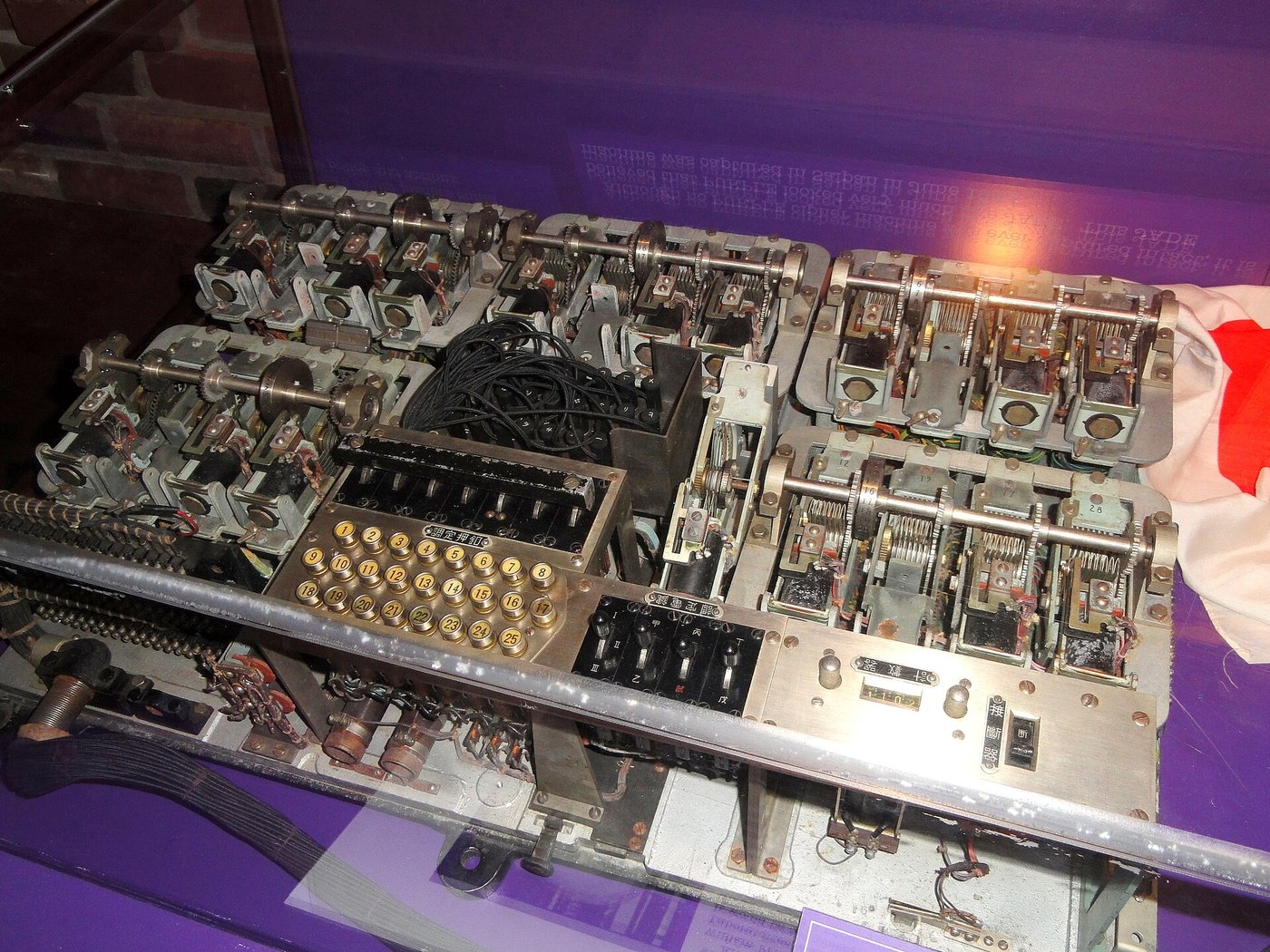
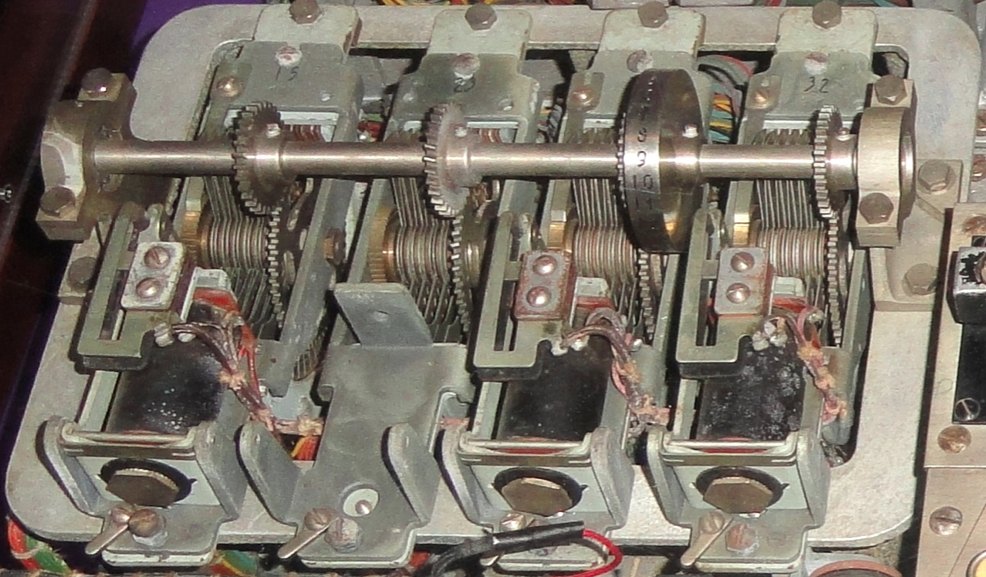
JADE is the only machine of the three that survives in substantial form. The National Cryptologic Museum displays one captured on Saipan in June 1944, during the American invasion of the island. Its construction is the best guide there is to how the Japanese built PURPLE. Each permutation stage is a block of four seven-level stepping switches on a common shaft — 28 levels, enough for a large kana alphabet — of the same mechanical design as the three-switch block from Berlin, down to the bushings that carry the shaft.
9.5.2 CORAL
CORAL was the naval attachés’ machine. Its traffic was light, which made it hard to attack: few messages meant few overlaps and few cribs. It fell in March 1944 to a combined American and British effort. GCHQ’s history records that Hugh Foss, a British codebreaker born in Japan who headed Bletchley Park’s Japanese naval section, was sent to Washington from January to July 1944 to help the OP-20-G team, and that with Hugh Alexander he “made a major contribution to the US team tackling the Japanese Naval Attaché machine, known as CORAL, which was broken in March 1944” (GCHQ, “Hugh Foss”). Raven and the American cryptanalyst Prescott Currier also worked on CORAL. One British heritage source dates the break to 1943; GCHQ’s own account is preferred here.
CORAL’s value was out of proportion to its volume, and for the same reason as Ōshima’s PURPLE traffic (Volume 8). One of its users was Vice Admiral Katsuo Abe, Japan’s naval representative to an Axis war-planning council in Berlin. In the NSA’s account, Abe passed considerable information about German deployments in CORAL, which made a Japanese naval system essential to Allied decisions in the European theatre. The Americans nicknamed him “Honest Abe.”
9.6 How the Secret Came Out
The fact that the United States had read Japan’s diplomatic cipher became public in stages.
- 1944. General Marshall persuaded Governor Dewey not to raise it in the presidential campaign (Volume 8).
- 1945–46. The Joint Congressional Committee on the Pearl Harbor attack published the MAGIC intercepts of July–December 1941 as its Exhibit No. 1. From then on the reading of the Tokyo–Washington traffic was public, and the cover name PURPLE entered the history books. How much more had been read was not disclosed.
- 1946–48. Intercepted Japanese diplomatic telegrams were printed in the Nuremberg documentation and entered as evidence at the Tokyo war crimes trial (Volume 8).
- 1977. The Department of Defense released The “Magic” Background of Pearl Harbor, a multi-part compilation of the 1941 intercepts originally prepared in 1944.
- From the late 1970s. The National Archives opened the NSA’s historical cryptologic collection (Record Group 457), including the technical papers on PURPLE. The NSA released William Friedman’s collection, including working copies of the Pearl Harbor intercepts, with release stamps from 2013.
Ōshima himself, Boyd wrote, died in 1975 “never knowing that his mail had been read in Washington and London the whole time he was in Berlin.” The scale of the Berlin reading only became widely known with Boyd’s own book in 1993.
9.7 Reconstructions and Simulators
Because the Japanese machine is gone, everything known about how PURPLE enciphered comes from the American reconstruction and the documents that describe it. The decisive modern work is Freeman, Sullivan and Weierud’s “PURPLE Revealed: Simulation and Computer-Aided Cryptanalysis of Angooki Taipu B”, published in Cryptologia in January 2003. Working from National Archives records, the authors published:
- the complete wiring tables of the sixes and the three twenties switches, taken from U.S. Navy technical documents;
- the stepping logic and the six possible switch motions;
- the keying system, including the list of starting positions, the monthly additive and the disguised indicators;
- a software simulator, demonstrated by deciphering Part 1 of the fourteen-part message of 6 December 1941;
- a hill-climbing attack that recovers PURPLE settings from ciphertext alone, a modern counterpart to the SIS’s 1940 work.
Their tables made PURPLE reproducible by anyone. Open implementations followed, among them Brian Neal’s purple Python package, whose test suite deciphers all 1,285 transcribed letters of Part 1. This series has its own simulator, 03-outputs/tools/purple_sim.py, which uses the published tables and passes fifteen self-test checks against the published vectors, including that full Part 1 decipherment. It produced the worked example in Volume 7 and drives the build in Volumes 10–12.
The stepping switch itself is still easy to find. The 25-point switches the Japanese used were standard telephone-exchange parts of their day, and the same family of electromechanical switch ran the automatic telephone exchanges of the twentieth century. The history and working of the Strowger switch are covered on this site’s Telephones pages. Volume 10 surveys the switches a builder can still obtain.
9.8 The Legacy
What did the 1940 break leave behind?
An institution. The handful of people who broke PURPLE under William Friedman — Frank Rowlett, Solomon Kullback, Abraham Sinkov, Genevieve Grotjan, Leo Rosen and their colleagues (Volume 5) — were the core of an organisation that grew into the Signal Security Agency at Arlington Hall, then the Army Security Agency, then the Armed Forces Security Agency in 1949 and the National Security Agency in 1952. Several of them, and Raven from the Navy side, held senior posts in it. The museum that now holds the Berlin fragment is that agency’s own.
A method. PURPLE was broken by reconstructing a machine from its output alone and then building a copy that worked. It was not the first such reconstruction — the Polish Cipher Bureau had rebuilt the Enigma from its traffic in 1932 — but it was the first by American codebreakers, against a machine of a kind nobody had met before, and it set the pattern for much that followed. The first analog, built in 1940 by people who had never seen the original, matched it so closely that the SIS’s reading of Japanese diplomatic traffic was, by the later war years, little slower than the Japanese recipients’ own.
An alliance. The PURPLE analog that went to Britain early in 1941, ten months before the United States entered the war, was one of the first exchanges of cryptologic secrets between the two countries (Volume 6). The CORAL break of 1944, with Foss and Alexander working alongside OP-20-G in Washington, showed what the partnership had become.
A lesson about intelligence. The Pearl Harbor investigations (Volume 7) taught that reading the enemy’s mail is not the same as knowing his intentions, and that a decrypt nobody evaluates or delivers is worth little. The Berlin traffic (Volume 8) showed the opposite case: a single well-placed source, read continuously and believed, could inform strategy at the highest level for four years.
A machine nobody saw. Volume 1 took that phrase as its title, and it still holds. The surviving original is three stepping switches in a glass case. The PURPLE that actually ran is known from American wiring diagrams, American analogs and the intercepts the Americans read with them. Its fullest surviving description is the one written by its enemies.
9.8.1 Where to see PURPLE and its relatives
Table 1 — Where to see PURPLE and its relatives
| Object | Where | Notes |
|---|---|---|
| PURPLE fragment from Berlin (three-switch stage) | National Cryptologic Museum, Annapolis Junction, Maryland | ”Largest of three surviving pieces”; check display status before visiting |
| PURPLE Analog No. 1 | National Cryptologic Museum | SIS-built; lent to the International Spy Museum, 2021 |
| Improved PURPLE analog | National Cryptologic Museum | Later wartime analog |
| PURPLE analog | Dr. Dennis F. Casey Heritage Center, 25th Air Force (now Sixteenth Air Force), JBSA-Lackland, Texas | Unveiled 21 December (probably 2016) |
| JADE, captured on Saipan, June 1944 | National Cryptologic Museum | The most complete 1937-series machine on public display |
Next — Volume 10: Building a PURPLE — Design. No kit exists, so the series ends by designing one: a working PURPLE analog built from real 25-position telephone stepping switches, a sixes stage and three twenties stages wired to the published tables, input and output plugboards, a keyboard in and a printer out, and a small controller to run the stepping logic — with an all-electronic fallback for builders who cannot find the switches.
Comments (0)