PURPLE · Volume 8
PURPLE — Volume 8 — Oshima's Window — Reading Berlin from Washington
How the Japanese ambassador to Nazi Germany, a general who had known Hitler since 1935, became through his PURPLE telegrams the Allies' best informant on the Third Reich: Barbarossa, Ribbentrop's promise, the Atlantic Wall, the run-up to D-Day and the collapse of 1945 — and what became of him
8.1 About This Volume
PURPLE was built to protect Japan’s diplomacy, and Volume 7 showed what it gave away about Japan. This volume is about something its designers can never have intended: for four years it was one of the best sources the Allies had on Nazi Germany.
The reason was one man. General Hiroshi Ōshima, Japan’s ambassador in Berlin, was a professional soldier with an unusual degree of access to Hitler, Ribbentrop and the German high command, and he reported what he learned in long, careful telegrams. They went to Tokyo by radio, enciphered on the embassy’s PURPLE machine. The U.S. Army’s codebreakers, and from 1941 their British partners, read them. The German Army’s Enigma traffic told the Allies what German units were doing; Ōshima’s telegrams told them what Germany’s leaders said they intended, in their own words, to an ally they trusted.
The volume follows the traffic from the warning about American codebreaking that Ōshima himself passed to Tokyo in May 1941, through Barbarossa, the eve of Pearl Harbor and the Atlantic Wall tour of 1943, to the end of the Reich and Ōshima’s trial in Tokyo. The main sources are the NSA’s histories, the U.S. Army intelligence historians’ accounts of individual intercepts, the decrypts themselves as released by the NSA and printed in the Nuremberg and Pearl Harbor records, and Carl Boyd’s Hitler’s Japanese Confidant: General Ōshima Hiroshi and MAGIC Intelligence, 1941–1945 (University Press of Kansas, 1993), still the standard study.
8.2 The General in Berlin
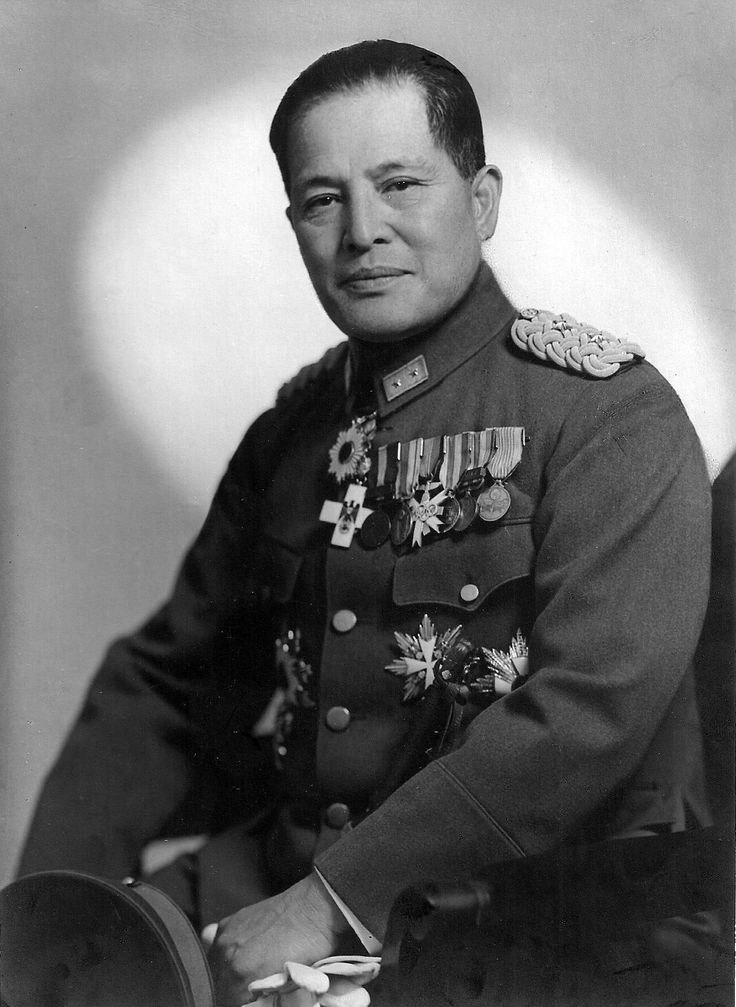
Ōshima was born in 1886 in Nagoya, the son of Ken’ichi Ōshima, Army Minister from 1916 to 1918. He was an artillery officer and a graduate of the Army War College, and he had served as military attaché in Vienna and Budapest in the 1920s. He arrived in Berlin as military attaché in 1934, spoke fluent German, and within a year had met Hitler privately through Joachim von Ribbentrop, then Hitler’s foreign-policy adviser outside the Foreign Office. He was one of the architects of the Anti-Comintern Pact of November 1936 and, as ambassador from October 1938, an advocate of a full military alliance.
The Molotov–Ribbentrop Pact of August 1939 embarrassed him badly — Germany had made a treaty with Japan’s chief enemy without telling him — and he was recalled. After the Tripartite Pact of September 1940 the Germans asked for him back, and he returned to Berlin as ambassador in February 1941. He stayed until the Reich collapsed (Wikipedia summary of Boyd and others).
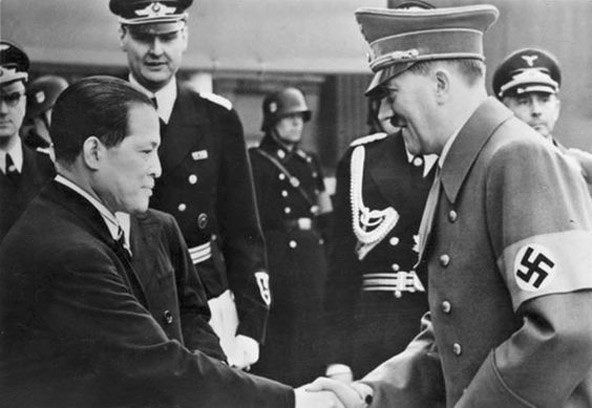
The NSA’s short history of his reporting sums up what made him valuable:
“Japan’s ambassador to Germany, Baron Oshima Hiroshi, concurrently a lieutenant general in the Japanese Imperial Army, had been an early supporter of the Nazi Party and enjoyed good access to Adolf Hitler and other high-ranking German civil and military officials. He wrote regular and detailed reports on what he learned from his contacts; he had the reports encrypted in PURPLE and broadcast to Tokyo.” — NSA Center for Cryptologic History, Cryptologic Almanac, “Baron Oshima’s Contributions” (1998)
He was a soldier reporting to soldiers as much as to diplomats. When he toured a front or a fortification, he described what he saw in the terms of a general staff officer: units, calibres, reserves, concrete thickness, the commander’s concept of the battle.
8.3 The Berlin Circuit
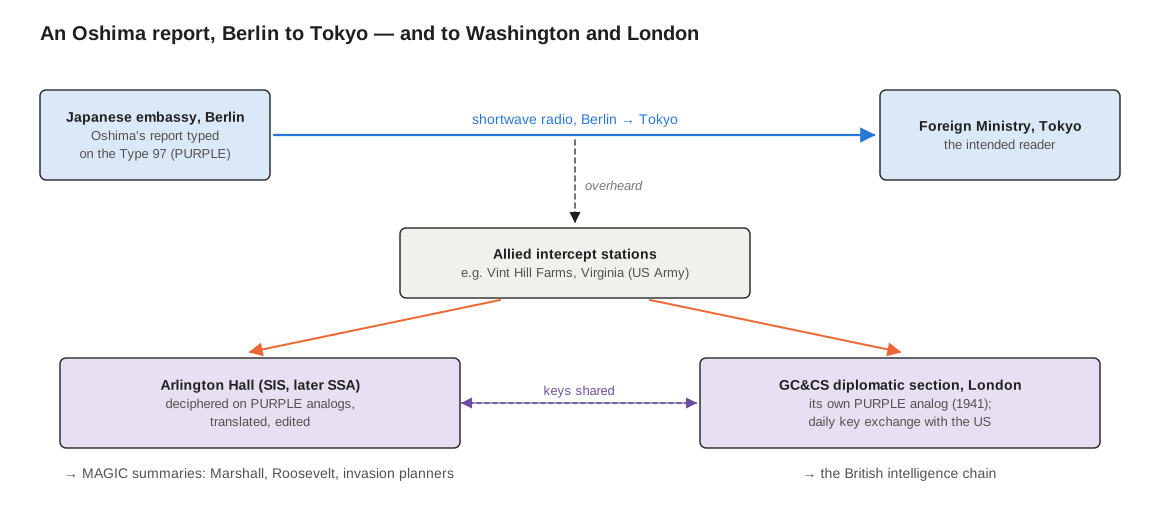
Berlin was one of the important embassies issued a PURPLE machine (Parker, Pearl Harbor Revisited, p. 23). The Tokyo–Berlin circuit carried the business of the alliance: Ōshima’s reports, Tokyo’s instructions and the exchange of military information.
The Japanese did change the procedure for their most sensitive Berlin traffic. Freeman, Sullivan and Weierud found that messages marked HIKAL, used on the Tokyo–Berlin link, derived their switch settings from the usual list of starting positions but read it in a different way — down a column instead of across a row, for example. By July 1943 the Allies distinguished four PURPLE procedures with their own short titles: JAA for regular traffic, JAB for “super secret messages of state”, JAC for code and cipher instructions, and JAD for the HIKAL traffic from Berlin to Tokyo. All four used the same machine, and all four were broken. As the authors observe, new keying rules were themselves sent in PURPLE, so “the new keys were compromised as soon as they were transmitted” (Freeman, Sullivan & Weierud, “PURPLE Revealed”, Cryptologia 27 (2003), p. 31).
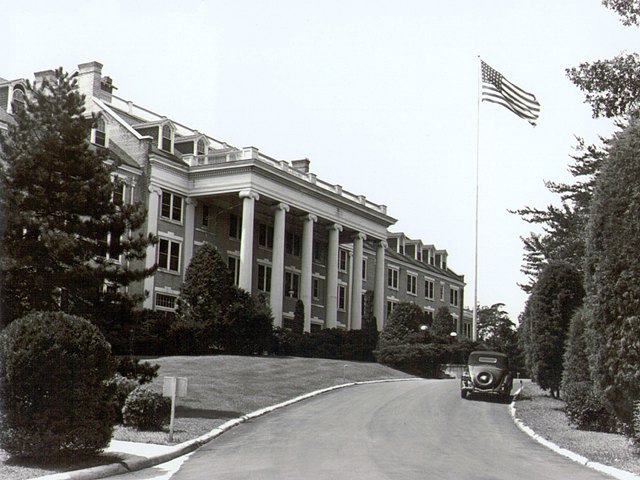
The British were reading this traffic too. An SIS PURPLE analog went to Britain in early 1941 (Volume 6), and the two services settled into “a daily exchange of keys with the Japanese Diplomatic Section of GC&CS, Berkeley Street, London” (ibid.). From mid-1942 the American work was done at Arlington Hall, a former girls’ junior college in Arlington, Virginia, taken over by the Army for its expanding Signal Intelligence Service (renamed the Signal Security Agency in 1943). Much of the intercept came from Vint Hill Farms Station in northern Virginia.
8.4 A Warning About the Warnings: May 1941
The most curious Ōshima telegram of all is one in which he warned Tokyo that PURPLE might be broken — and the warning was itself read on PURPLE.
On 3 May 1941 Heinrich Georg Stahmer, the Ribbentrop envoy who had negotiated the Tripartite Pact in Tokyo, called on Ōshima. Ōshima reported to Foreign Minister Yōsuke Matsuoka in telegram No. 482, which the Americans decrypted and filed under “Purple–CA”:
“[Stahmer] called on me this day … and stating that this request was to be kept strictly secret, he said that Germany maintains a fairly reliable intelligence organization abroad, and according to information obtained from the above mentioned organization it is quite reliably established that the U.S. government is reading Ambassador Nomura’s code messages, and then asked that drastic steps should be taken regarding this matter.” — Berlin to Tokyo No. 482, 3 May 1941, NSA release, Friedman collection, REF ID A487643 (the surviving American copy is incomplete)
Matsuoka passed the warning to Ambassador Nomura in Washington. Nomura asked what it was based on, and on 7 May Tokyo replied (No. 198) that the Germans had refused to divulge their basis. On 20 May Nomura reported, in a PURPLE telegram the Americans translated the next day:
“Though I do not know which ones, I have discovered that the United States is reading some of our codes. As for how I got the intelligence, I will inform you by courier or another safe way.” — Washington to Tokyo No. 327, 20 May 1941, NSA release, REF ID A487614
The source of the German information has never been firmly established. The warning did not lead Tokyo to replace the machine. The Foreign Ministry appears to have concluded that some lesser system had been compromised, not the Type 97; PURPLE stayed in service, the Berlin circuit with it, until the end of the war.
8.5 Barbarossa
Ōshima’s first great service to his enemies came within weeks. In early June 1941 Hitler and Ribbentrop received him and made clear that war with the Soviet Union was coming; Ōshima reported it to Tokyo, and according to Boyd his telegram was read by the Americans and the British before the invasion began on 22 June. The fullest scholarly account is Alvin D. Coox, “Japanese Foreknowledge of the Soviet-German War, 1941,” Soviet Studies 23 (1972), with Boyd’s book. The exact date of the conversation and of the telegram are given differently in different summaries; Wikipedia’s article dates Ōshima’s warning to Tokyo to 6 June.
What the decrypt added was not the bare fact of German preparations, which the British were already seeing in Enigma traffic, but Hitler’s own statement of intent to an ally. Stalin, who received warnings from many quarters, discounted all of them. Once the invasion had begun, Ōshima’s reports became something even rarer. The NSA’s verdict is that they “gave the United States its only authentic information about combat on the Russo-German front,” because the Germans briefed him on a campaign that no Western observer could watch.
8.6 November 1941: Ribbentrop’s Promise
The Berlin circuit matters to the Pearl Harbor story of Volume 7 in one specific way: it showed Washington what Germany would do if Japan went to war with the United States.
On the night of 28 November 1941, after a long conference at the Chancellery, Ribbentrop received Ōshima at 10:30 p.m. Ōshima’s report, sent on the 29th in three parts as No. 1393, quoted him:
“Should Japan become engaged in a war against the United States, Germany, of course, would join the war immediately. There is absolutely no possibility of Germany’s entering into a separate peace with the United States under such circumstances. The Fuehrer is determined on that point.” — Berlin to Tokyo No. 1393, 29 November 1941, Navy translation; printed as Nuremberg document D-656 (Harvard Law School Nuremberg Trials Project)
The Tripartite Pact did not require Germany to join a war that Japan started, and the promise was the more significant for being voluntary. The decrypt was later entered as evidence of German aggression at Nuremberg. The next day Tokyo told Ōshima to warn Hitler and Ribbentrop “very secretly” that war “may come quicker than anyone dreams.” Four days after Pearl Harbor, on 11 December, Germany declared war on the United States.
8.7 Inside the Axis, 1942–1943
Through 1942 and 1943 the volume of Ōshima’s reporting grew with his access. His reports covered the German Army’s view of the Eastern Front, German armament production, German jet aircraft and rocket experiments, and Japan’s interest in uranium, according to the U.S. Army Intelligence Center of Excellence’s account (Stewart, “MAGIC Contributes to D-Day Success”, 2024). Ōshima also carried Tokyo’s side of the strategic argument. In March 1943 he delivered to Ribbentrop Japan’s refusal to join the war against the Soviet Union, and decrypts of that kind showed the Allies the limits of Axis cooperation as clearly as its substance.
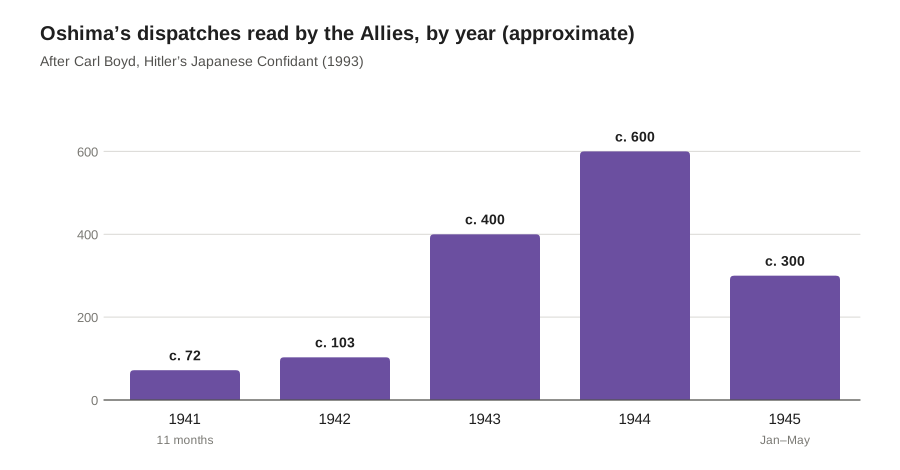
Boyd’s figures for the dispatches read run from about 72 in the last eleven months of 1941 and about 103 in 1942 to about 400 in 1943, about 600 in 1944 and about 300 in the four months of 1945 — roughly 1,500 in all. The increase follows Ōshima’s growing access, the importance of what he could describe, and the codebreakers’ growing capacity to read everything on the circuit quickly.
8.8 The Atlantic Wall Tour
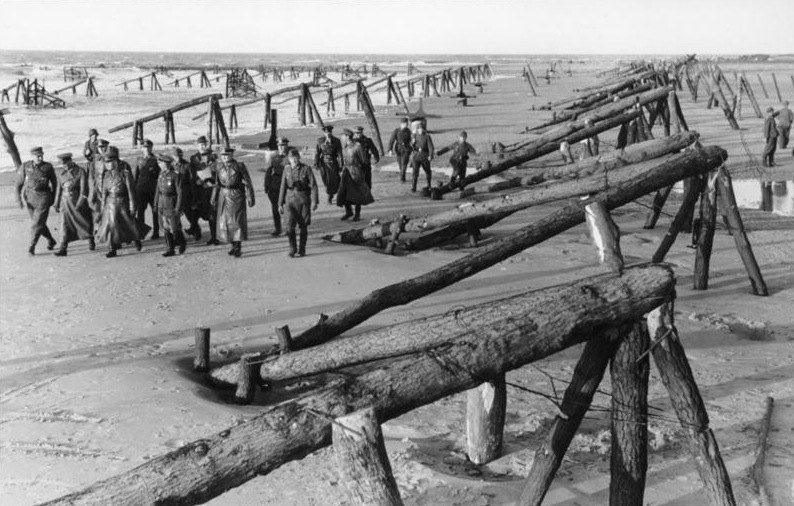
The best-known Ōshima intercepts are the reports of his inspection of the German coastal defences in France in the autumn of 1943. The account here follows two U.S. Army intelligence historians: Michael E. Bigelow, INSCOM command historian (“SSA Sends Trip Report to FDR”, 2023), and Lori S. Stewart, USAICoE command historian (2024).
The Germans took Ōshima on a tour of the Atlantic Wall from 24 October to 1 November 1943, from Paris to the coast between Brest and Bordeaux. Early in November he sent Tokyo his report in three messages. At Vint Hill Farms, Private Leonard Mudloff picked up the start of the transmission around lunchtime on 10 November 1943, under an “urgent” header; successive shifts copied the rest over the following days and passed it to Arlington Hall, where the intercepts began arriving on the evening of 11 November.
What they described was close to a staff study of the defences the Allies would have to break:
- the composition and dispositions of the German divisions in France, with their numbers, condition and reserves, including the news that some reserve units had been sent to the Russian front and the rest were under strength;
- the layout of the fortifications, the calibres of the guns, the construction materials and the arrangement of strongpoints;
- the German concept of the battle, to meet the invasion as close to the water as possible, with crossfire from mutually supporting positions;
- the priority given to the Pas-de-Calais, about 200 miles from Normandy, which the Germans regarded as the most likely landing area. Stewart’s account adds that Hitler considered a landing elsewhere a feint, so that no troops would be moved from the Pas-de-Calais to reinforce other beaches.
The Signal Security Agency identified the German generals by their full names — its translators had to turn phonetic renderings such as “Tsuootenshutain” back into “von Sodenstern” — and edited the translation for clarity. On 14 December 1943 Lieutenant Colonel Earle F. Cook sent it up the chain, and it reached President Roosevelt on 16 December. It went to the OVERLORD planners, who used it to revise their estimates of the defences. Bigelow quotes one historian’s description of the report as “the blueprint to Hitler’s fortifications along the northern French coast”; Stewart records that Eisenhower later credited the message in part for the success of D-Day.
8.9 1944: D-Day and After
In the first half of 1944 the Allied commanders had a pressing question that only the enemy could answer: was the deception plan working? Operation FORTITUDE was built to persuade the Germans that the main invasion would come in the Pas-de-Calais, with any landing in Normandy a diversion. Stewart’s account records that monitoring of the message traffic “through the first six months of 1944 indicated Germany had not discovered” FORTITUDE. Ōshima’s reports were part of that traffic, because what Hitler and his generals told their ally about where the blow would fall was what they believed.
Ōshima met Hitler at the end of May 1944, days before the invasion. Accounts drawn from the decrypts describe Hitler as expecting diversionary operations elsewhere followed by the main assault across the Strait of Dover. The exact date of the meeting (27 or 29 May) and the wording of the report could not be checked against a primary source for this volume, and the point is offered with that caveat.
After the landings Ōshima reported the German view of the Normandy battle and the breakout at Avranches, the aftermath of the 20 July plot, and the gloomier tone in which German leaders spoke to him as the year went on. In early September Hitler talked to him of a coming offensive in the west. Whether that and later reports should have warned the Allies of the Ardennes offensive in December has been debated since; a 1977 U.S. Army study by Lieutenant Colonel Harry L. Dull Jr. is among the works that examined the question.
8.9.1 Marshall’s letter
In September 1944, during the presidential campaign, General Marshall wrote personally to Governor Thomas E. Dewey, the Republican candidate, who was preparing to make an issue of what Washington had known before Pearl Harbor. Marshall’s letter explained that the United States was still reading Japanese codes, that the victories at the Coral Sea and Midway had depended on it, and that disclosure would end it. On Ōshima’s traffic he wrote, in the words quoted by the Army’s intelligence historians:
“Our main basis of information regarding Hitler’s intentions in Europe is obtained from Baron Oshima’s messages from Berlin reporting his interviews with Hitler and other officials to the Japanese Government.” — General George C. Marshall to Governor Thomas E. Dewey, September 1944, as quoted by Stewart (USAICoE, 2024)
Dewey kept the secret. The NSA notes that the Berlin reports were first given the codeword MAGIC and later ULTRA, when the United States and Britain standardised their terminology. Marshall’s sentence is the most authoritative judgement there is of what the Berlin circuit was worth: the Army Chief of Staff, with ULTRA from Bletchley Park on his desk, named a Japanese diplomat’s telegrams as his main source on Hitler’s intentions.
8.10 The End in Bad Gastein
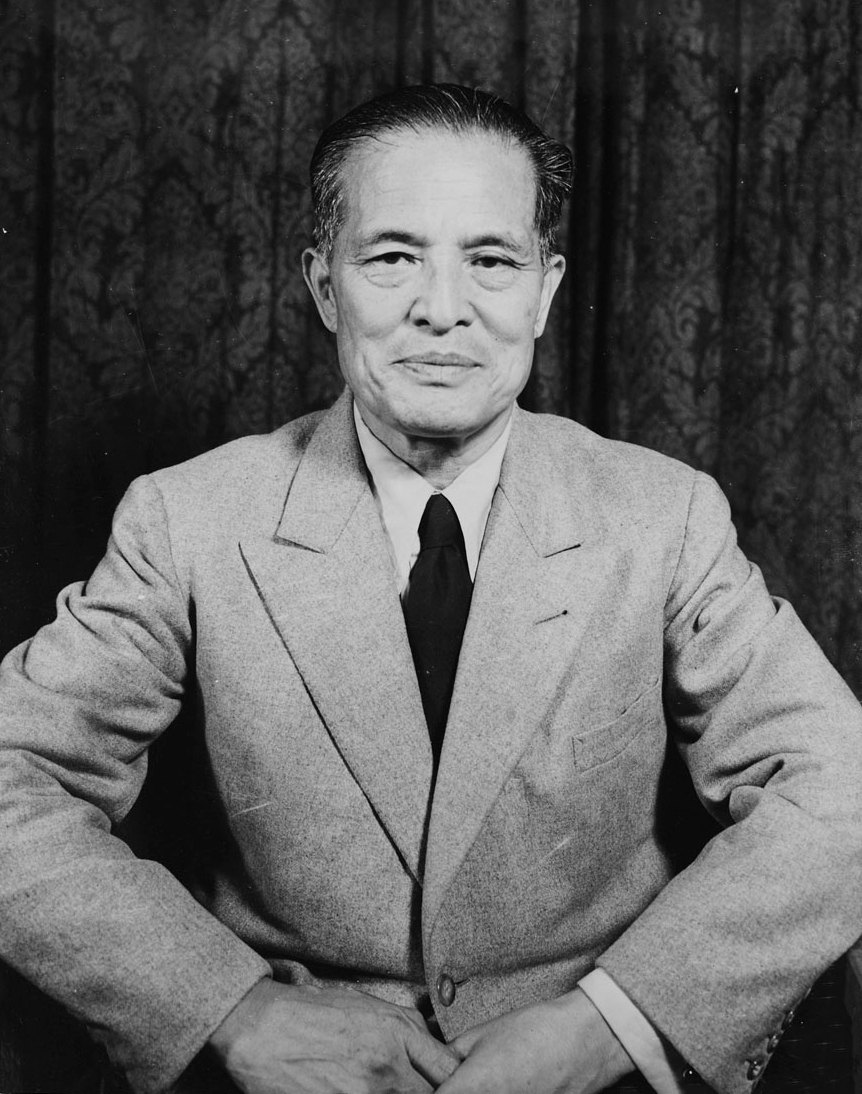
Ōshima reported the collapse of the Reich as carefully as its victories. In March 1945 he warned Tokyo of the “danger of Berlin becoming a battlefield.” According to the NSA’s account, which follows Boyd, he sent his wife and other embassy staff south to Bad Gastein, south of Salzburg, in late March. He meant to stay in Berlin to the end, but Hitler ordered the diplomatic corps out of the city, and in April he joined them, leaving a skeleton staff to keep the embassy nominally open.
There, at the end of the war, the 101st Airborne Division found him. Its commander, Major General Maxwell Taylor, moved his headquarters to Bad Gastein and chose the hotel where Ōshima and his staff were living. When the Japanese tried to stall, Taylor, who had trained as a language officer in Japan before the war, “told them off in very colloquial Japanese and evicted them.” Ōshima was taken into custody, shipped to the United States and interrogated, and then returned to Japan with other internees in late 1945.
In December 1945 he was arrested as a war crimes suspect. He was tried by the International Military Tribunal for the Far East and in November 1948 was found guilty of conspiracy against peace and sentenced to life imprisonment. He was paroled in December 1955. Boyd’s conclusion, quoted by the NSA:
“He died at the age of eighty-nine in Chigasaki, Japan, on 6 June 1975, never knowing that his mail had been read in Washington and London the whole time he was in Berlin during the war.”
The embassy’s Type 97 machine did not survive the Reich either. Before the end, the NSA’s account continues, “the Japanese staff broke it up and buried the largest remaining chunks in the underground air raid shelter associated with the Berlin embassy.” Volume 9 takes up what was dug out of it.
8.11 What Oshima’s Window Showed
Three things made the Berlin circuit unique in the Allied intelligence picture.
First, it reported intentions, not just movements. Signals intelligence on armies — the Enigma traffic of the Wehrmacht and the Luftwaffe — showed what units were where and what orders they had received. Ōshima reported what Hitler, Ribbentrop and the generals told him they meant to do, and how they read the Allies’ plans. Of all the windows into Hitler’s thinking, his was the one that stayed open longest.
Second, it was a trusted channel. The Germans briefed Ōshima as an ally and a soldier, and he reported as one. There was no reason to suspect him of deception, and the Germans had no idea that their confidences were being read by the enemy. The May 1941 warning shows how close they came. A German intelligence organisation had evidently picked up some sign that Japanese messages were being read, and the Germans told their ally directly. The Japanese Foreign Ministry decided the problem lay in some lesser code, and changed nothing that mattered.
Third, it depended on a machine the Japanese believed unbreakable. A Type 97 enciphered every telegram Ōshima sent. Every one was read on a rebuilt version of that machine, first assembled in 1940 by people who had never seen it. The ambassador’s reports from Berlin were the largest return the SIS ever had on its September 1940 break, and they came from a theatre that had nothing to do with Japan.
Next — Volume 9: What Survived — The Berlin Fragment, CORAL, JADE and the Legacy. Three stepping switches dug out of the rubble of the Japanese embassy in Berlin, now in a glass case at the National Cryptologic Museum; PURPLE’s naval cousins, CORAL and JADE, and the American–British team that broke the naval attachés’ machine in 1944; the analogs that outlived the machine they copied; and how a 1940 break made by a handful of people became one of the foundations of the National Security Agency.
Comments (0)