PURPLE · Volume 5
PURPLE — Volume 5 — The Break — Friedman, Rowlett, Grotjan and 20 September 1940
Eighteen months against a machine nobody had seen: the quick fall of the sixes, the long wall of the twenties, the six messages in indicator 59173, a Friday afternoon in September 1940, a copy built from telephone switches for $684.65 — and what the effort cost the man in charge
5.1 About This Volume
On 20 February 1939 the Japanese Foreign Ministry switched its most important circuits to a new cipher machine. Nineteen months later, on 27 September 1940, the U.S. Army’s Signal Intelligence Service (SIS) handed in its first two translations of messages enciphered on it. This volume is about what happened in between: who did the work, what they tried, why it took so long, what finally gave way on the afternoon of Friday 20 September 1940, and how a working copy of the machine was then built from parts bought in Chicago and Washington.
The machine itself — its plugboards, its six-and-twenty split and its stepping switches — is described in Volume 4. This volume describes it only as the codebreakers came to understand it. Its main sources are two documents written by people in the room: William F. Friedman’s Preliminary Historical Report on the Solution of the “B” Machine, dated 14 October 1940, three weeks after the break (scan); and Frank Rowlett’s recollections, published in his memoir The Story of Magic (1998) and, earlier, in an NSA profile drawn from his notes (Hannah, “Frank B. Rowlett — A Personal Profile”). Where they differ, the text says so.
5.2 The Team
The section that attacked the B machine was small. The Army’s codebreaking organisation in Washington had grown from seven people in the early 1930s to about nineteen in 1939. Its work on Japanese diplomatic traffic was led day to day by Frank B. Rowlett, who had broken RED with Solomon Kullback in 1936 (Volume 3), and his deputy Robert O. Ferner. The junior cryptanalysts Genevieve Grotjan, Albert W. Small and Samuel S. Snyder worked the traffic. Leo Rosen, an electrical engineer from MIT, built devices. John B. Hurt and Paul S. Cate were the Japanese linguists, and spent most of their time on the daily translations that went to Army intelligence. Clerks, card-punch operators and tabulating-machine staff did the heavy statistical work.
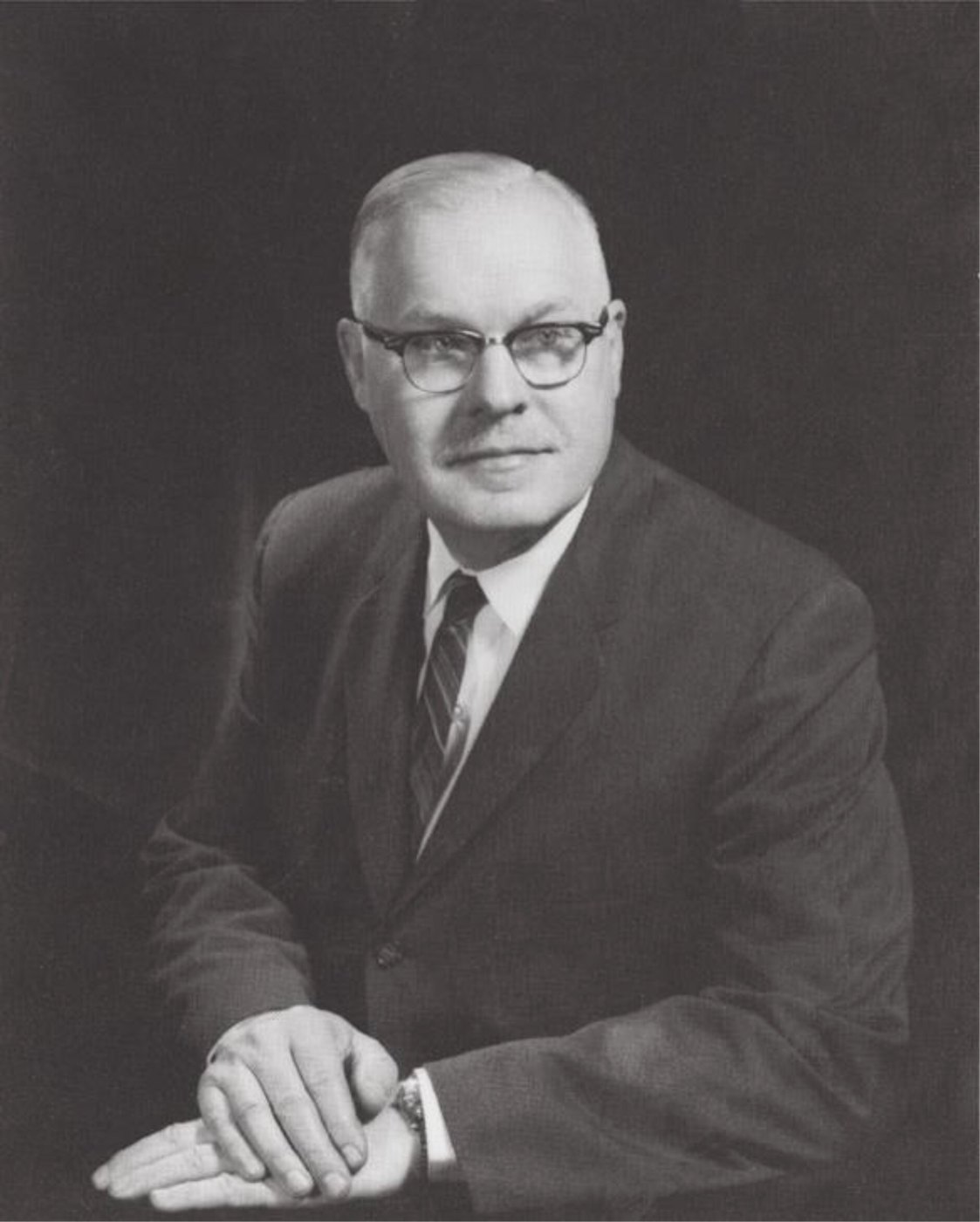
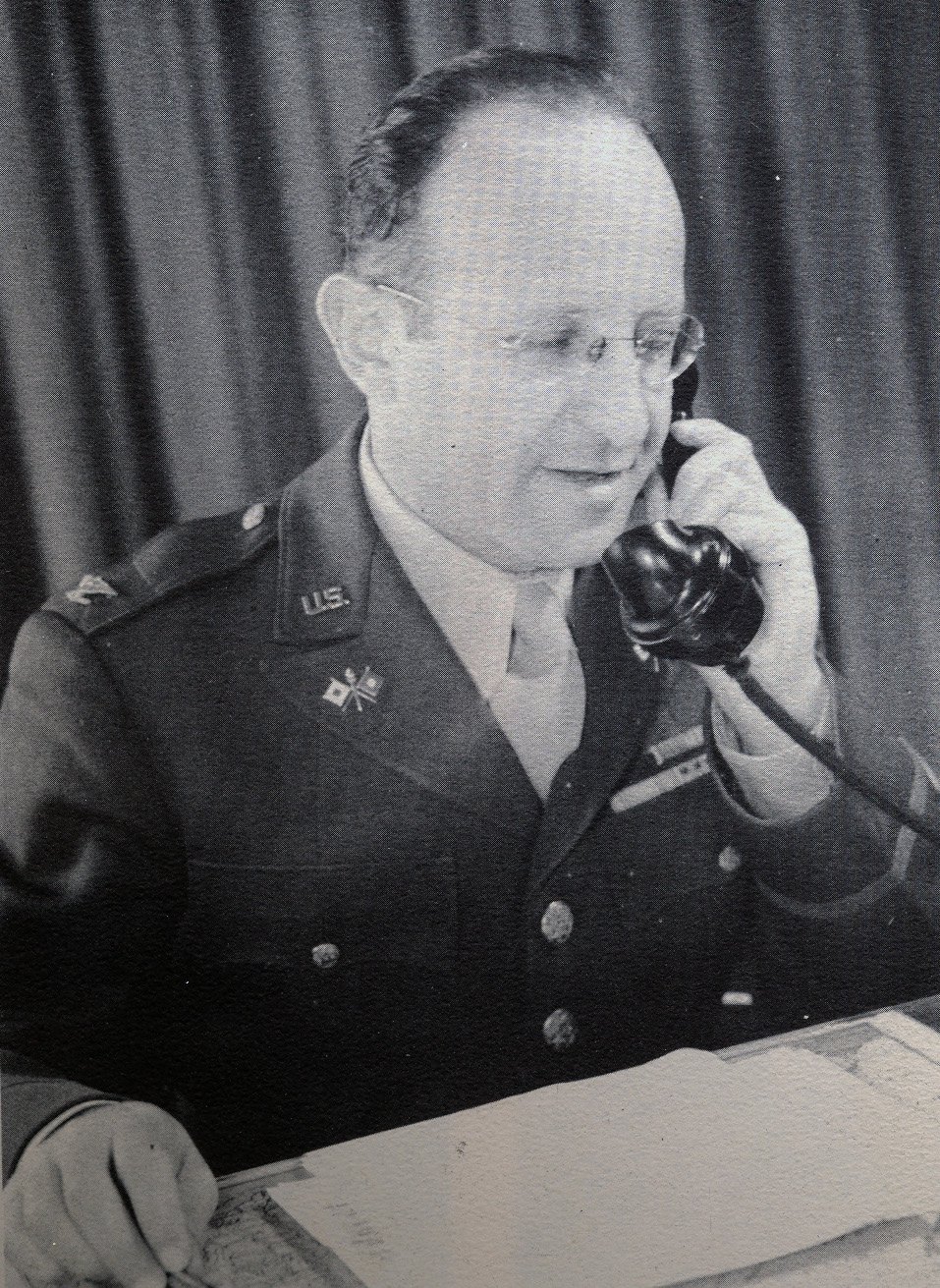
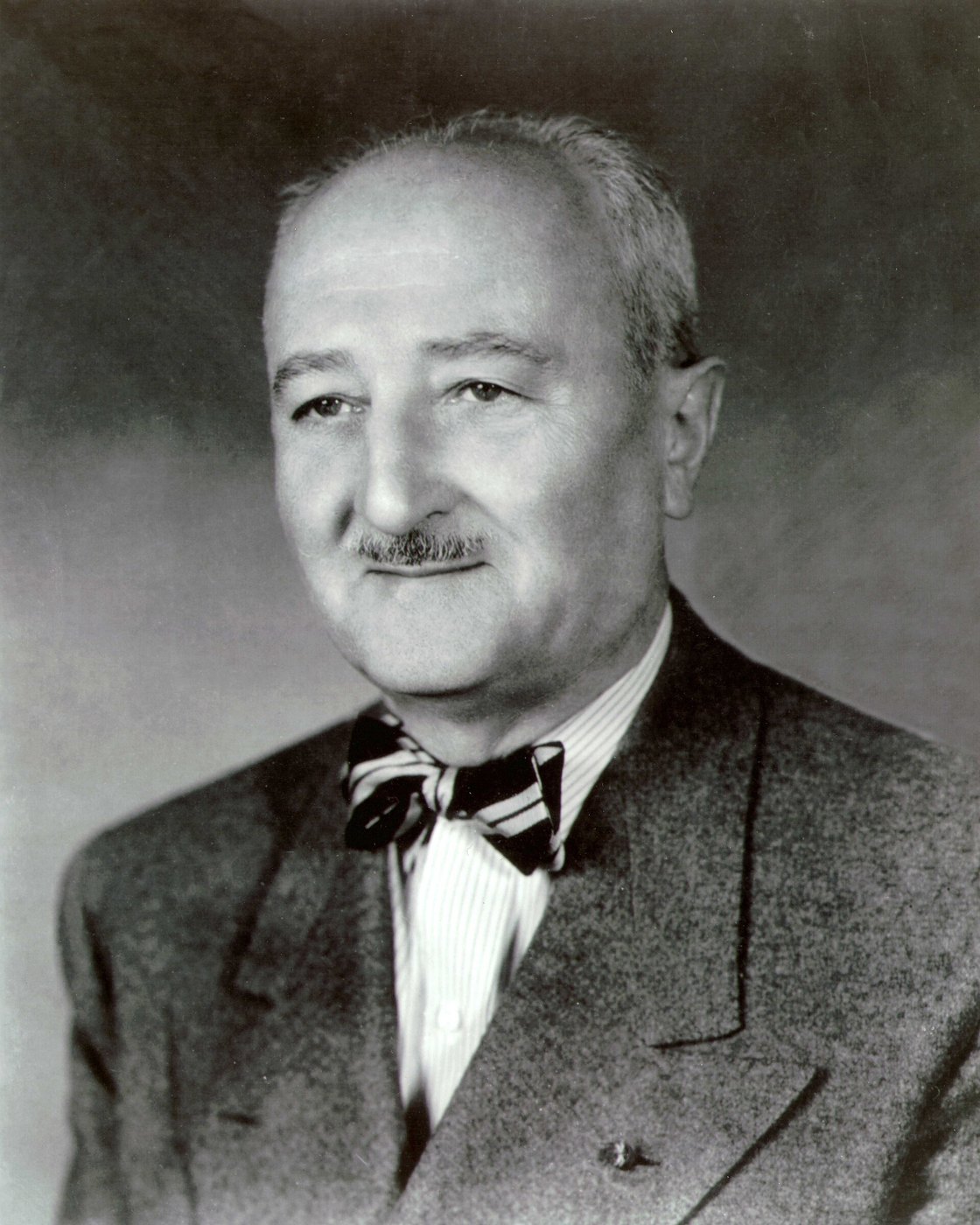
William F. Friedman, the section’s founder and principal cryptanalyst, was directed to join the B-machine studies in August 1939 and from then on had them “under his general supervision”, while keeping some of the other duties “from which he had not been relieved”. Above them were the Officer in Charge of the War Plans and Training Division, Colonel Spencer B. Akin, and the Chief Signal Officer, Major General Joseph O. Mauborgne, himself a cryptologist of note.
The U.S. Navy’s codebreaking section, OP-20-G, was attacking the same traffic. Rowlett recalled that the two groups consulted daily, kept their files organised so that each could follow the other’s progress, and agreed to pass on any significant discovery at once. The Navy’s Radio Laboratory at the Washington Navy Yard would later lend its shop to build SIS’s first full machine.
5.3 First Contact
The SIS knew the B machine was coming before it arrived, because it was reading the machine it replaced. In late 1938 messages in RED authorised travel for a communications expert named Okamoto, who was to put into service at Japan’s important embassies a new “Type B” cipher machine. On 19 February 1939 SIS intercepted a message, dated the day before, giving the effective date: 20 February 1939. RED (the Type A machine) would remain in use for some classes of traffic and at less important posts (Friedman 1940, paras. 1–2).
Among the first messages after that date were three from Warsaw with an indicator of a new type. They were not RED messages, but six of the 26 letters appeared with abnormal frequency — as they would have in RED. The team concluded, correctly, that the new machine kept RED’s division of the alphabet into a group of six letters and a group of twenty. Rowlett’s memory, written decades later, dates the three unreadable Warsaw messages to 20 March 1939 and says that by mid-April the new machine had “virtually replaced the old on the major diplomatic circuits”. Friedman’s report, written at the time, places them simply “among the first messages received after the effective date”. Friedman also listed where the B machine was known to be installed: Washington, Berlin, London, Paris, Moscow, Rome, Geneva, Brussels, Ankara, Shanghai and Peking. RED stayed in regular use at Hsinking and Shanghai, and was occasionally used elsewhere, apparently when a B machine was out of action.
The new system was named PURPLE. Rowlett, Kullback and Hurt had proposed colours of the spectrum as cover names for Japanese machines when RED was broken (Volume 3).
5.4 The Sixes Fall
The six letters were the weak point, and they gave way quickly. The team found that the sixes were enciphered by a series of 25 different, thoroughly mixed alphabets, used one after another in a fixed cycle, “a carefully selected set of 25 of the possible 720 permutations” of six letters. A deciphering chart — a “development”, in SIS language — was built and corrected day by day until every entry was certain. By 10 April 1939 it was complete. From then on, the sixes could be deciphered in “practically every message of any considerable length” (Friedman 1940, paras. 3–4).
The analysis also revealed something about the keys. There were 120 different indicators, but as far as the sixes were concerned they produced only 25 different starting points in the cycle of alphabets, so that four or five indicators mapped to each. The sixes were, in other words, a simple periodic cipher with a short period, disguised by the daily change of which letters were the six.
Deciphering the sixes by hand was slow, and hundreds of intercepts arrived every month. Rowlett recalled that Leo Rosen “hit upon the idea of using standard, six-level, 25-point telephone selector switches” to do it automatically. Akin telephoned a friend at a Chicago telephone-equipment maker, who airmailed a supply of switches; IBM’s Washington office, through its chief, Mr Lamont, supplied two keyboard units from its new alphabetic keypunch machines “no questions asked”; Rosen found the other parts locally or by cannibalising unused cipher machines. In about two weeks he had a working machine, which the section called the six-buster. It saved so much labour that two more were built. Friedman’s report credits Rosen with “the original suggestion of the electrical telephone switching mechanism for duplicating the encipherment of the 6’s” — the suggestion, as it turned out, that fitted the real machine.
5.5 Filling In the Twenties
With the sixes deciphered, scattered letters of plaintext appeared through every message. “The skeletons of words and phrases,” Friedman wrote, “offered themselves for completion by the ingenuity and the imagination of the cryptanalyst.” His report gives an example. On one day the sixes were E, Q, A, D, R and H, and a message began with a string in which only those letters could be read. Context did the rest: the Japanese government requests that.
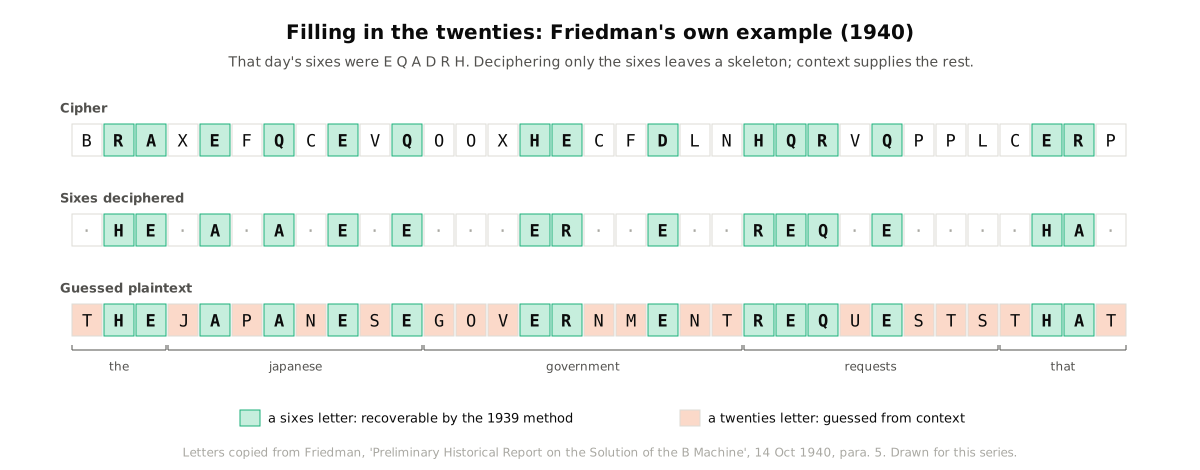
It was rarely that easy. Every guess at a twenties letter had to come from context, because, as Friedman put it, “any cryptographic relationship between the plain text and the constantly-shifting cipher text values in the case of the letters constituting the group of ‘20’s’ had been most carefully eliminated, disguised, or suppressed.” Messages in English were easiest. Messages in romanised Japanese were much harder, and from 1 May 1939 the Foreign Ministry made them harder still by introducing, for B-machine traffic, an abbreviation system that Friedman compared to the Phillips Code of American telegraphers. Frequent words, syllables and numbers became arbitrary letter groups: CFC for a full stop, CCF for a new paragraph, BKW for Beikoku (the United States), TKW for Teikoku seifu (the Imperial Government). Even when such a passage was correctly deciphered it looked, Friedman wrote, “more like code or a random assortment of letters than plain text”, and only the Japanese linguists — whose time was mostly committed to the daily translations — could tell a right reconstruction from a wrong one.
The most productive source of known plaintext was the Japanese habit of quoting. Embassies sent Tokyo the texts of notes and documents they had received from the U.S. government, and when a few deciphered words suggested what a message was about, there followed “a frantic search for a complete document which might be available either in our own files or in the files of other government agencies”, usually through Army intelligence. Some English-text messages were reconstructed to 90 or 95 per cent this way. A second source was the same text sent in two systems — an embassy without a B machine would receive, in RED or in a code, a message that another post received in PURPLE. The section’s records clerk, Mary Louise Prather, found one message in the B machine that was a paraphrase of a message sent in the K-1 code; Friedman credited it with an important part in the final break.
5.6 The Wall
By the summer of 1940 the team had plaintext for parts of about fifteen fairly long messages, and had subjected them to “most intensive and exhaustive cryptanalytic studies”. What they found baffled them. Friedman listed six phenomena (Friedman 1940, paras. 7–8):
Table 1 — By the summer of 1940 the team had plaintext for parts of about fifteen fairly long messages, and had subjected them to "most intensive and exhaustive cryptanalytic studies". What they found baffled them. Friedman listed six phenomena ([Friedman 1940](http://cryptocellar.org/pubs/PURPLEHistory.pdf), paras. 7–8)
| Observation | |
|---|---|
| 1 | The machine started from an initial setting and ran “without cyclic repetition of any sort” to the end of the message — over 1,500 letters in the longest reconstructed. |
| 2 | Two identical plaintext letters in a row were never enciphered as two identical cipher letters; nor were two identical letters exactly 26 apart (“suppression of duplicate encipherments at the 1st and 26th intervals”). |
| 3 | Two messages with the same indicator on the same day were enciphered identically. |
| 4 | Two messages with the same indicator on different days (different plugboard settings) were “absolutely different”. |
| 5 | Two messages with different indicators on the same day showed no relationship at all. |
| 6 | Within a line of 26 letters, identical encipherments were rare at intervals of 2 to 5 and never at interval 1. |
The most disturbing finding was statistical. Repetitions of three or four cipher letters did occur, but never stood for the same plaintext, and the number of repetitions actually present “was less than the number to be expected had the letters comprising them been drawn at random out of a hat!” The machine, Friedman concluded, “had with malicious intent — but brilliantly — been constructed to suppress all plain text repetition. Nevertheless, the cryptanalysts had a feeling that this very circumstance would, in the final analysis, prove to be the ‘undoing’ of the system and mechanism. And so it turned out!”
The team’s instincts had been formed by rotor and commutator machines — the Hebern, the Enigma, the Army’s own M-134 — in which some primary sequence of alphabets repeats cyclically, and they searched hard for one. In a single English message they found a hint: E enciphered as Q, then 26 letters later as Y, then 26 letters later as V, and the same trigraph QYV standing for three equally spaced E’s elsewhere in the same message. Every attempt to extend it failed. The trouble, they realised, was that no single message contained enough text. The sequences they were looking for would show only if several messages in the same key could be laid on top of one another — at least 20 to 25 messages in the same indicator on the same day, Friedman estimated. In a thousand messages on hand, there were only “a mere baker’s half dozen or so” cases of even two messages in the same indicator on the same day.
What the team did not know was that the machine contained no rotors. Its twenties alphabets came from stepping switches whose 25 positions were each wired independently, so that no position’s alphabet was a shifted copy of another’s. The NSA’s later course notes on the problem observe that one reason the solution was so hard was that the analysts “had assumed that Purple was a rotor machine, like Red” (NSA, “Red and Purple: A Story Retold”).
5.7 Homologs and Indicator 59173
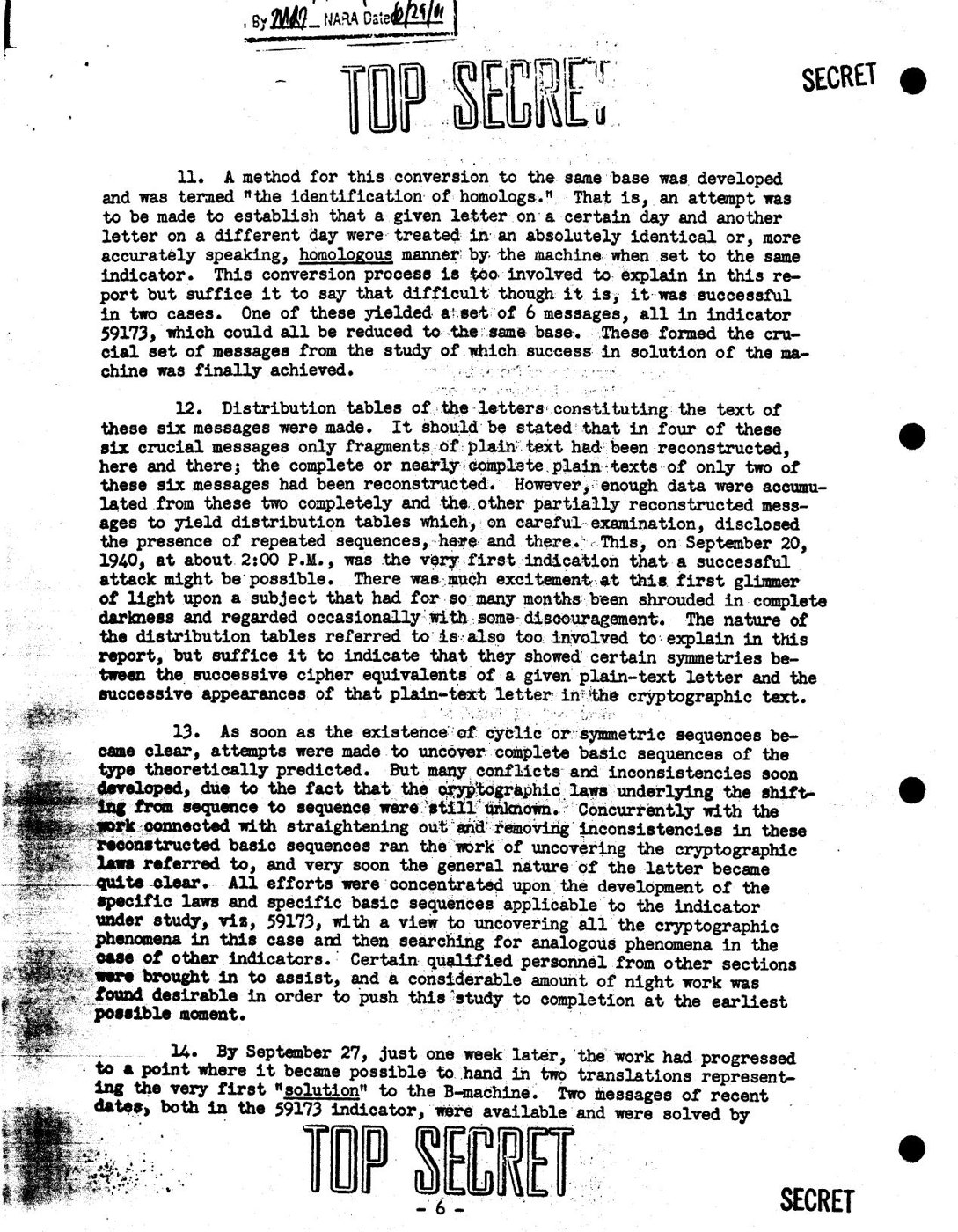
The way out was to make the missing depth. If two messages had the same indicator but were sent on different days, the machine’s switches had gone through the same sequence of positions for both; only the plugboard had changed. A method was developed for establishing that a given letter on one day and another letter on a different day had been treated “in an absolutely identical or, more accurately speaking, homologous manner by the machine when set to the same indicator” — the identification of homologs. Friedman would not describe it in his report; it was “too involved to explain”. It succeeded in two cases. One produced a set of six messages, all in indicator 59173, that could be reduced to a common base. In two of them the plaintext had been reconstructed completely or nearly so; in the other four, only fragments.
The team made distribution tables from those six messages: for each plaintext letter, the succession of cipher letters that stood for it at each point in the text. Those tables were where the wall cracked.
5.8 Friday, 20 September 1940
Friedman’s account, written three weeks afterwards, is restrained:
Distribution tables of the letters constituting the text of these six messages were made… However, enough data were accumulated from these two completely and the other partially reconstructed messages to yield distribution tables which, on careful examination, disclosed the presence of repeated sequences, here and there. This, on September 20, 1940, at about 2:00 P.M., was the very first indication that a successful attack might be possible. There was much excitement at this first glimmer of light upon a subject that had for so many months been shrouded in complete darkness and regarded occasionally with some discouragement.
— Friedman, Preliminary Historical Report, para. 12
Rowlett’s version, from his notes, names the person who found it:
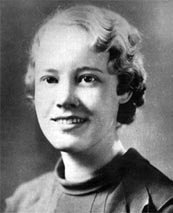
Finally, Genevieve Grotjan finds the evidence we are looking for. Time is about 2 p.m. Ferner, Small, and I are at table in working area discussing prospects and reviewing work. Grotjan enters room, obviously excited, politely interrupts, asks if she can show us what she has found. She takes us to her desk in next room, lays out worksheets, points to one example, then another, then a third. She stands back, with eyes tranced behind her rimless glasses. Al Small dashes around the room, hands clasped above his head like a victorious prizefighter. “Whoopee!” he yells. Ferner, the quiet one, clasps his hands, shouting “Hooray, Hooray.” I jump up and down — “That’s it! That’s it!” The room gets crowded; everyone in section suddenly in room. Friedman comes in and asks, “What’s all the noise about?”
— Rowlett, quoted in Hannah, “Frank B. Rowlett — A Personal Profile”
Rowlett pointed to the worksheets — “Look here, and here, and here.” Friedman examined each one and understood, and “looks suddenly tired.” They took a break and sent out for Cokes.
What Grotjan had seen, in Friedman’s guarded description, was that the distribution tables “showed certain symmetries between the successive cipher equivalents of a given plain-text letter and the successive appearances of that plain-text letter in the cryptographic text”. Put less guardedly, the cipher values were not random after all: they came in cycles that repeated at fixed intervals, the visible trace of a switch that had stepped through the same positions. Once the existence of “cyclic or symmetric sequences” was clear, the team could set about reconstructing them, and the laws that governed the shift from one sequence to the next.
5.8.1 Whose break?
Friedman’s report, written to record credit as well as method, insisted that “the name of no one person can be selected as deserving of the major portion of credit”. It credited Rowlett and Ferner jointly with directing the work, analysing the machine’s principles and solving the sixes, and with organising the reconstruction of the twenties wiring; it credited Grotjan, Small and Snyder with “most excellent work in recovering the ‘6’s’ during many months of apparently hopeless effort”. It does not name the person who found the patterns on 20 September. Rowlett’s account, and the NSA’s later histories, do: it was Genevieve Grotjan, and the NSA inducted her into its Hall of Honor in 2010 for that work and her later VENONA work. The two accounts are compatible — the report deliberately spread credit across a team — but readers of the report alone would not learn her part. Some secondary accounts also credit ideas from Lawrence Clark, whom Friedman lists among the staff brought in to help after the break, with the reconstruction of the twenties; that detail could not be confirmed in the primary sources consulted for this series.
5.9 One Week Later
The work that followed was fast and exhausting. Certain staff from other sections — among them Abraham Sinkov, Lawrence Clark, Delia Ann Taylor, Wilma Berryman and Edward Christopher, some as voluntary overtime — were brought in, and “a considerable amount of night work was found desirable”. All effort went into indicator 59173: its basic sequences, its switch motion, and then the search for the same phenomena under other indicators.
By 27 September 1940, a week after the first glimmer, two recent messages in indicator 59173 had been solved and their translations handed in, “the very first ‘solution’ to the B-machine”. Friedman noted that “it was all the more gratifying that this could be done on the very day that announcement was made of the signing of the Tripartite Agreement among Germany, Italy, and Japan.” Rowlett, recalling the same coincidence, called the pact “aimed directly at the United States”.
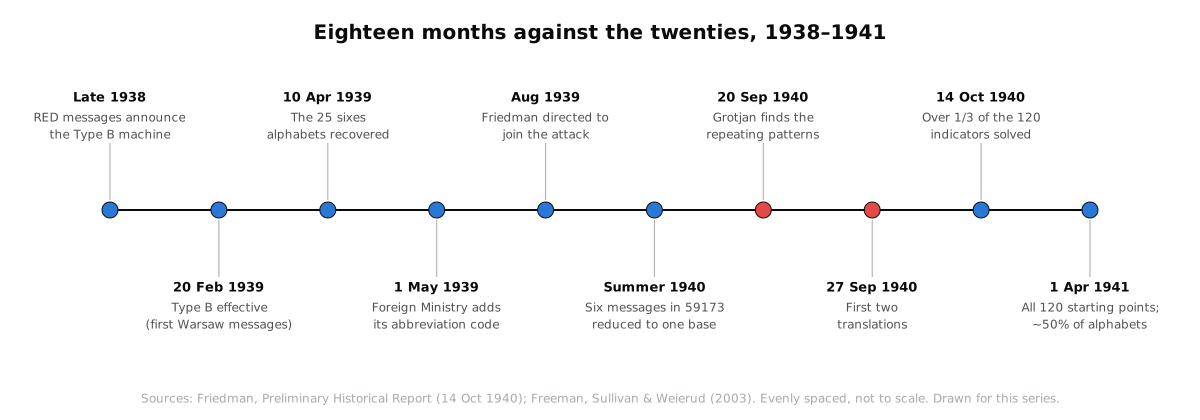
One indicator out of 120 was solved; 119 remained. Each solution meant finding the starting positions of three twenty-level switch stages and the order in which they stepped. The analysis showed that there were six possible orders of motion — the three stages could take the fast, medium and slow parts in any permutation — and that each order was used by 20 of the 120 indicators. The starting points within each group of 20, Friedman noted, “appear to have been very carefully selected so as to preclude or reduce the possibility of ‘overlaps’”, that is, to prevent two messages from being enciphered on the same stretch of key. By the date of his report, 14 October 1940, solutions for over one-third of the 120 indicators were available. Once every indicator was known and the analog was running, reading a day’s traffic would reduce to recovering that day’s plugboard arrangement, for which methods had already been tested.
5.10 Building the Analog
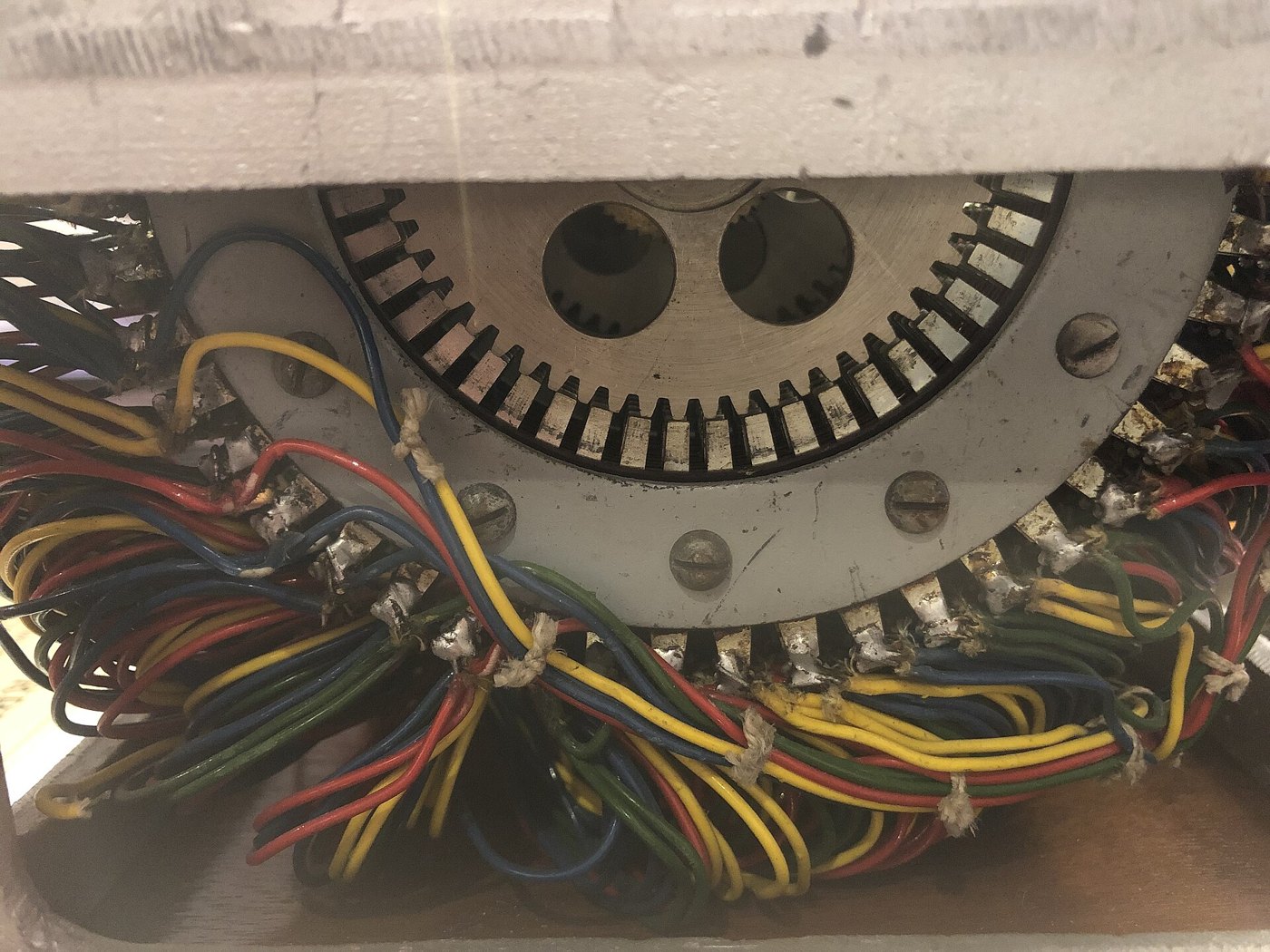
Friedman’s report records the plan: as soon as the principles were understood, “plans were initiated for the construction of an equivalent machine for our purposes”. Materiel for two fully automatic machines was ordered and expedited; in the meantime the section designed and built a hand-operated B machine, already in use by 14 October. The report describes its anatomy in terms that match the real machine: 13 rotary, six-level, 25-point switches “of the type employed in automatic telephony”, one for the sixes with 150 cross-connections and three banks of four for the twenties, each bank with 500 cross-connections. Rosen supervised its construction, assisted by H. F. Bearce, Edward J. Hawkins and Sergeants Wilder and Roy. The shop of the Radio Laboratory at the Washington Navy Yard was put at their disposal through the courtesy of Commander Laurance Safford of OP-20-G.
Rosen then pushed ahead with the two automatic analogs. Each had three components: the cryptographic unit of stepping switches, an input keyboard and a solenoid-operated output typewriter. Rowlett gave the costs to the cent: $290.97 for the parts of the cryptographic mechanism, $393.68 for the keyboard and typewriter, $684.65 in all. The wiring team worked voluntarily through many fourteen-hour days, building and testing banks of switches “each of which required over 500 separate soldered connections”. Rosen used some of the left-over switches to build an improved RED analog for another $174.17.
The first operational test has its own story. A placard displayed with Analog No. 1 at the National Cryptologic Museum, headed “A Little Condenser Saves the Day”, relates that during the dry run Rowlett set the plugs and switches for the day’s key and began typing ciphertext; the machine printed perfect plaintext for the first few groups and then stopped. Rosen found that the contacts of the master relay had fused; another relay was fitted, with a condenser across its contacts, and the machine ran. The placard dates this to “early September 1940”, which sits awkwardly with Friedman’s report that the automatic machines were still awaiting parts in mid-October; the placard’s date should be treated with caution. The historian Stephen Budiansky, quoted by the museum, describes the moment of success: “Late one night, Rosen and Rowlett plugged in the power supply and flipped the main switch. Rowlett began to type in the cipher text of a Purple message. The two cryptanalysts watched in awe as deciphered Japanese text began to emerge from the printer” (NSA, “The Magic of Purple”).
The proof of the machine came later. In a footnote to his recollections, Rowlett wrote that when, after the end of the war in Europe, the Americans had a chance to compare their analog with an actual Japanese machine, “of the several hundred connections we had recovered, only two were incorrect, and their effect on decipherment was negligible.” Intercepts had already shown, he added, that the Japanese were having more trouble with their machines than SIS was with its copies. Volume 4 describes what the comparison showed about construction: the Japanese built each twenties stage from three seven-level switches geared together, where Rosen used four six-level switches, with identical cryptographic effect.
5.11 The Cost
“There was pressure, great pressure,” Rowlett wrote, “so much that it contributed to Friedman’s emotional collapse and hospitalization.” Friedman, a reserve officer placed on active duty for the purpose, was due to lead the mission that would take a PURPLE analog to Britain in January 1941. He did not go. He entered Walter Reed Army Hospital with what was generally described as a nervous breakdown; the exact date is uncertain — Sinkov remembered “somewhere about the middle of December” 1940, Friedman’s official biography gave early January 1941 — and his travel orders were revoked on 24 January, the eve of the voyage. David Kahn dates his discharge to 24 March 1941. Solomon Kullback later told Kahn that Friedman “was just drained of phys[ical] & mental energy”; in the NSA historian David Sherman’s summary, Kullback thought the breakdown more properly called simple exhaustion (Sherman 2016, notes 51–53). He returned to work, but his later contributions were mostly as a senior technical adviser rather than at the head of an operational attack.
5.12 After the Break
The work did not stop with the first translations. By 1 April 1941, according to the U.S. Navy’s PURPLE manual of that month, all 120 original starting points and about half of the alphabets in the Japanese key book had been recovered, and the course notes later prepared at NSA put the share of intercepted PURPLE traffic that could be read at 99 per cent (Freeman, Sullivan & Weierud 2003; NSA, “Red and Purple”). The Japanese helped by announcing forthcoming changes to indicators and additives in PURPLE itself. “The unsolvable problem,” the NSA notes concluded, “had been reduced to a mechanical exercise.”
That did not mean instant reading. The daily plugboard order still had to be recovered whenever it was not already known from the key book, and the bottleneck soon moved from cryptanalysis to translation. A study ordered by Rowlett in November 1944 found that 100 randomly chosen PURPLE messages had taken an average of an hour and a half each to decipher, or 42 minutes once four badly garbled ones were set aside. Volume 6 follows the analog machines out of the Munitions Building — to the Navy, to Britain and to the Philippines — and the decrypts to the people who read them.
Friedman closed his report by expressing gratification at “the demonstration, by his assistants, of their grasp of the cryptanalytic techniques taught them” in the Signal Intelligence School. The section’s watchword, as Rowlett remembered it, summed up how they had worked: “Make no mistakes; record all findings; identify source of data for each recovery; keep the team informed.”
Next — Volume 6: MAGIC — Analogs, Translators and the Mission to Bletchley. General Marshall asks to look under the cover of the PURPLE analog; a dispute over who reads what on which day; four Americans, six crates and a new battleship sailing for Scapa Flow in January 1941; a midnight welcome at Bletchley Park with sherry; and the ten people in Washington allowed to read Japan’s diplomatic mail — on condition that they hand it straight back.
Comments (0)