PURPLE · Volume 7
PURPLE — Volume 7 — Pearl Harbor and the Fourteen-Part Message
What the PURPLE decrypts of 6 and 7 December 1941 said, who read them and when, how a warning written at noon in Washington reached Hawaii hours after the bombs, and why the most famous intercept in American history never named a target — with the documented record set against the revisionist case
7.1 About This Volume
By the autumn of 1941 the Signal Intelligence Service and the Navy’s OP-20-G were reading PURPLE as a matter of routine. Volumes 5 and 6 told how the machine was broken in September 1940 and how the analogs, translators and distribution lists that turned decrypts into MAGIC were built. This volume follows that machinery through its most scrutinised forty hours: from the “pilot message” intercepted on Saturday morning, 6 December 1941, to the moment on Sunday afternoon when the two Japanese envoys handed Secretary of State Cordell Hull a memorandum he had already read, an hour after the first bombs fell on Oahu.
The volume keeps to the documented record. Its main sources are the 1946 report of the Joint Congressional Committee on the Investigation of the Pearl Harbor Attack, the SIS and Navy logs of the messages themselves, the State Department’s memorandum of the Hull meeting, and the National Security Agency’s histories of the period. Times are Washington time (Eastern Standard Time) unless marked otherwise. Hawaii in 1941 kept a time ten and a half hours behind Greenwich, five and a half hours behind Washington, so 1:00 p.m. in Washington was 7:30 a.m. in Honolulu.
Pearl Harbor has attracted more theories than any other event in the history of American intelligence. The last part of the volume sets the main revisionist claims beside the record and labels them as what they are.
7.2 What MAGIC Could and Could Not See
Everything in this volume depends on one limitation, and it is worth stating first. PURPLE carried the traffic of the Japanese Foreign Ministry — the Gaimushō — between Tokyo and its most important embassies: Washington, Berlin, Rome, London and a handful of others. It did not carry the traffic of the Imperial Japanese Navy, which planned and executed the Hawaii operation. The NSA’s own short history of Oshima’s reporting puts it plainly:
“Japan’s Foreign Ministry was not privy to Japanese military planning; thus the Americans received no warning about the Pearl Harbor attack from this source.” — NSA Center for Cryptologic History, Cryptologic Almanac, “Baron Oshima’s Contributions” (1998)
Frederick Parker’s NSA history of naval communications intelligence before Pearl Harbor makes the same point about content: the diplomatic messages between Tokyo and Washington “largely concerned the ongoing negotiations” between Hull, Ambassador Kichisaburō Nomura and, from November, the special envoy Saburō Kurusu, and “contained no Japanese naval or military information” (Parker, Pearl Harbor Revisited, NSA CCH, 3rd ed. 2013, p. 43).
The system that would have carried operational details of the strike force was the Navy’s general-purpose code, JN-25 in its “B” edition. Parker records that the Navy had stripped keys from thousands of JN-25 messages but had not recovered enough of the underlying code values to read them: “The actual reading of current Japanese messages before Pearl Harbor, however, was not to be.” The JN-25 messages that discuss the Hawaii operation were read in 1945 and 1946, as their annotations show, in a retrospective study. The carrier force itself sailed under orders to keep radio silence.
So MAGIC in December 1941 was a window onto Japanese diplomacy: its deadlines, its instructions to its envoys, its orders to destroy codes, its talks with Berlin. It showed with increasing clarity that Japan was about to break with the United States and when the diplomatic break would come. It did not show where the first blow would fall.
7.2.1 Who saw MAGIC in 1941
In late 1941 the Army and Navy split the diplomatic work by date: the Army’s SIS took messages bearing even dates of the month, the Navy’s OP-20-G the odd dates, and each passed copies to the other. Distribution was split too. The Army delivered within the War Department and to the Secretary of State; the Navy delivered within the Navy Department and to the White House. The two couriers who matter in this volume are Lieutenant Commander Alwin D. Kramer, the Navy’s Japanese-language officer who carried the locked pouch on the Navy’s route, and Colonel Rufus S. Bratton, chief of the Far Eastern section of Army intelligence, who did the same for the Army (Joint Committee Report, pp. 210–211).
MAGIC was not sent to Hawaii. As a security policy, Parker writes, “no intelligence material directly from MAGIC was sent to Admiral Kimmel in Hawaii” after July 1941; neither commander there had the means to decipher diplomatic traffic in any case. Washington sent its conclusions instead — most importantly the Navy’s dispatch of 27 November, which opened: “This dispatch is to be considered a war warning.”
7.3 November: The Deadline
The messages that make 6 and 7 December intelligible had arrived through November, all read on PURPLE analogs within hours.
On 22 November Tokyo told its two envoys it would extend its deadline for an agreement from the 25th to the 29th — and no further:
“This time we mean it, that the dead line absolutely cannot be changed. After that things are automatically going to happen.” — Tokyo to Washington, 22 November 1941, as printed in the Joint Committee Report, p. 197
On 26 November Hull handed the envoys the American proposal later called the Hull note. The next day Washington sent the war warnings to the Pacific commands. On 30 November Tokyo instructed its ambassador in Berlin, General Hiroshi Ōshima, to see Hitler and Ribbentrop and tell them “very secretly … that there is extreme danger that war may suddenly break out between the Anglo-Saxon nations and Japan through some clash of arms and add that the time of the breaking out of this war may come quicker than anyone dreams” (No. 985, translated 1 December; Joint Committee Report, p. 204). The Berlin circuit was PURPLE too, and the next volume is about what else it carried. Ōshima’s own report of 29 November had already quoted Ribbentrop: “Should Japan become engaged in a war against the United States, Germany, of course, would join the war immediately” (Nuremberg document D-656, intercepted message No. 1393).
In the first days of December Tokyo ordered its missions in London, Hong Kong, Singapore and Manila to destroy their codes and cipher machines, and told Washington to destroy all but one machine. Each order was read. A machine-destruction order is about as unambiguous a sign as diplomatic traffic can give, and the Joint Committee later found that its substance had reached the Hawaiian commanders before 7 December.
7.3.1 The consulate in Honolulu
One stream of intercepts has drawn more argument than any other: the instructions sent to the Japanese consulate in Honolulu. On 24 September 1941 Tokyo asked the consul to divide the waters of Pearl Harbor into five areas and report which warships lay in each, “tied up at wharves, buoys and in docks”, and when two or more were alongside the same wharf. Later messages asked for “ships in harbor” reports twice a week, then even when nothing had moved. The September message was not translated until 9 October; the November follow-ups were translated on 3, 4 and 5 December (Joint Committee Report, pp. 181–182).
This was not PURPLE traffic. Only the more important embassies were issued the Type 97; other posts kept older and weaker systems (Parker, p. 23). The Honolulu messages went in a lower-grade consular system, competing for translators with everything else. They are rightly called the strongest hint that Hawaii was a target, and the Committee’s majority rejected the commanders’ argument that withholding them was decisive; the “bomb plot” label itself, the majority noted, was coined only in the investigations. What matters for this volume is that they are a separate story from the machine.
7.4 Saturday, 6 December: The Pilot Message
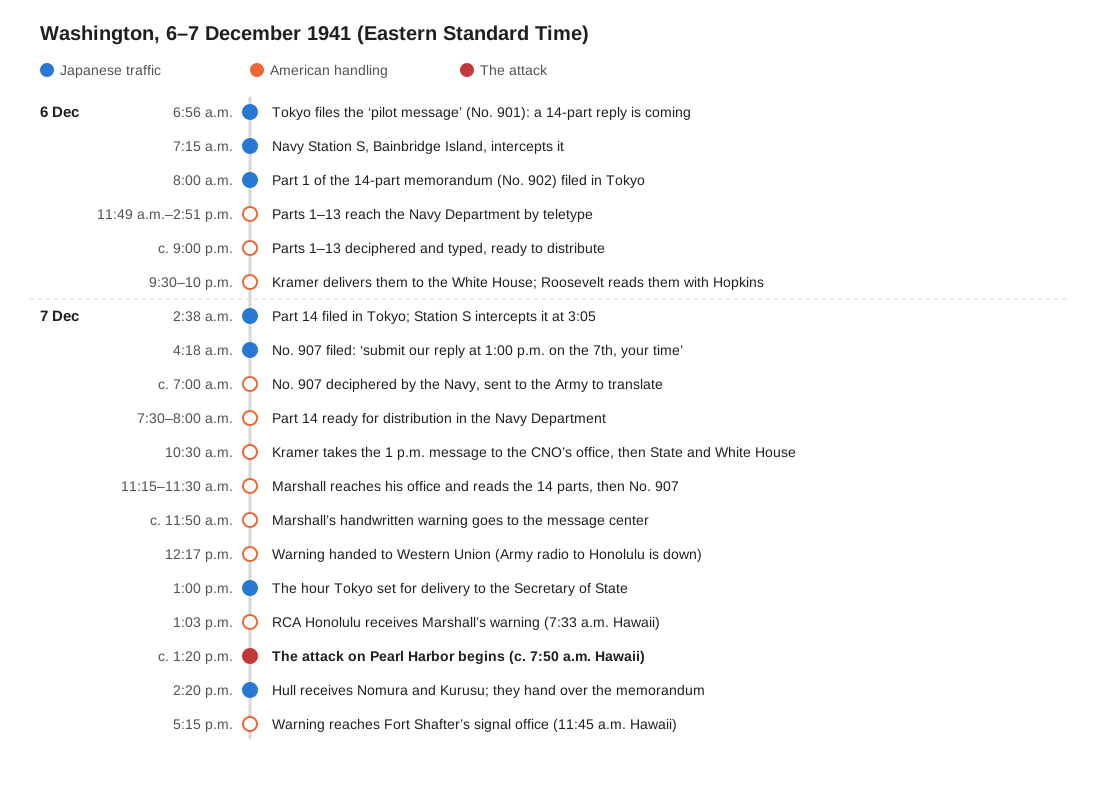
At 6:56 a.m. on Saturday, 6 December, Tokyo filed a short message to its Washington embassy, No. 901. The Navy’s intercept station on Bainbridge Island, across Puget Sound from Seattle — Station S — copied it between 7:15 and 7:20 a.m. and teletyped it east. The Army’s SIS had the teletype sheet by 12:05 p.m. and decrypted and translated it that day (SIS/Navy table “Information from Documentary Evidence on Messages No. 901, 902, 907, 910”, NSA Friedman collection). It is known as the pilot message:
“1. The Government has deliberated deeply on the American proposal of the 26th of November and as a result we have drawn up a memorandum for the United States contained in my separate message #902 (in English). 2. This separate message is a very long one. I will send it in fourteen parts and I imagine you will receive it tomorrow. However, I am not sure. The situation is extremely delicate, and when you receive it I want you to please keep it secret for the time being. 3. Concerning the time of presenting this memorandum to the United States, I will wire you in a separate message.” — Message No. 901, as printed in the Joint Committee Report, p. 210
Colonel Bratton testified that the Army distributed it at about 3 p.m. Kramer testified that the Navy did not circulate it until Sunday morning. The pilot message told Washington three things: a formal reply to the Hull note was coming, it would be long, and its delivery would be timed.
7.5 Thirteen Parts on Saturday Night
Part 1 of message No. 902 was filed in Tokyo at 8:00 a.m. Washington time (10 p.m. in Tokyo), and Station S had it by 8:10. The parts followed through the morning, and all thirteen reached the Navy Department by teletype between 11:49 a.m. and 2:51 p.m. The memorandum was written in English, so it needed no translation once deciphered. It was ready to distribute by about 9 p.m.
Kramer set out with the locked pouch. Between 9:30 and 10 p.m. he gave the thirteen parts at the White House to Lieutenant Lester R. Schulz, an assistant to the President’s naval aide, who took them to Franklin Roosevelt in his study. Harry Hopkins was with the President. Schulz’s testimony to the Joint Committee is the source of the best-known line of the evening: Roosevelt read the parts, handed them to Hopkins, and said in substance, “This means war” (Joint Committee Report, pp. 211–217). Kramer went on to Navy Secretary Frank Knox and to a dinner party at the home of the Director of Naval Intelligence, Admiral Theodore Wilkinson, where the Army’s intelligence chief, General Sherman Miles, was a guest.
The Committee found that the thirteen parts were not seen that night by Hull, by Secretary of War Henry Stimson, by the Army Chief of Staff, General George C. Marshall, or by the Chief of Naval Operations, Admiral Harold R. Stark. The officers who did read them mostly took them for what the text resembled: a diplomatic white paper restating the Japanese case. General Miles told the Committee that “the first 13 parts as such was not of great military significance”; Kramer remembered thinking that the language was “far and appreciably stronger” than in earlier notes. The Committee itself observed that the President’s remark gave “no indication as to when or where war might be expected.”
7.6 What the Ciphertext Looked Like
Part 1 of the memorandum survives in the National Archives as an intercept, and it is the best-documented single PURPLE message there is. Wes Freeman, Geoff Sullivan and Frode Weierud recovered its key and deciphered its opening in their 2003 Cryptologia paper, “PURPLE Revealed” (author copy); this series’ simulator, 03-outputs/tools/purple_sim.py, reproduces their decipherment letter for letter in its self-test.
The key arrived disguised. For Part 1 the embassy’s code clerk received the indicator 62527. To recover the setting he subtracted December’s monthly additive, 03210, giving 59317, then undid a transposition of the five digits to get the true indicator 15739, which named a row in the list of switch starting positions. In the SIS notation that setting is 9-1,24,6-23: the sixes switch starts at position 9; the three twenties switches at 1, 24 and 6; twenties switch 2 is the fast one and switch 3 the middle one. The day’s plugboard alphabet for 6 December 1941 was NOKTYUXEQLHBRMPDICJASVWGZF. (Volume 12 works through the full procedure.)
With that key, the simulator turns the first 120 intercepted letters into the following (output of purple_sim.py -k 9-1,24,6-23 -a NOKTYUXEQLHBRMPDICJASVWGZF):
Table 1 — With that key, the simulator turns the first 120 intercepted letters into the following (output of purplesim.py -k 9-1,24,6-23 -a NOKTYUXEQLHBRMPDICJASVWGZF)
| Intercepted (first 30 letters per row) | Deciphered |
|---|---|
ZTXODNWKCCMAVNZXYWEETUQTCIMNVE | FOVTATAKIDASINIMUIMINOMOXIWOIR |
UVIWBLUAXRRTLVARGNTPCNOIUPJLCI | UBESIFYXXFCKZZRDXOOVBTNFYXFAEM |
VRTPJKAUHVMUDTHKTXYZELQTVWGBUH | EMORANDUMFIOFOVOOMOJIBAKARIFYX |
FAWSHULBFBHEXMYHFLOWD-KWHKKNXE | RAICCYLFCBBCFCTHEGOVE-NMENTOFJ |
The plaintext is not yet English. Freeman, Sullivan and Weierud read it as a Japanese preamble in romanised kana mixed with three-letter code groups for punctuation and formatting. FOV is an opening parenthesis and FYX a closing one; XFC stands for the number sign, and KZ ZR with a garbled DD gives the message number 9 0 2. The words tatakidasi ni muimi no moji wo iru besi — roughly “letters of no meaning shall be typed in” — look like a padding instruction. BTN is betuden, “separate telegram”. FAE and FIO bracket the English word MEMORANDUM (“begin” and “end foreign spelling”), OOMOJI BAKARI asks for capitals only, and RAI CCY marks a new paragraph. Then the English begins: “THE GOVE-NMENT OF JAPAN, PROMPTED BY A GENUINE DESIRE …” — the garble is in the intercept, a letter lost in the copying. The disguise was thorough, but it was the disguise of a known system with a recovered key, and the Navy’s typists produced clean English from it the same afternoon.
7.7 Sunday, 7 December: Part 14 and the One O’Clock Message
Part 14 was filed in Tokyo at 2:38 a.m. Washington time on Sunday and intercepted by Station S between 3:05 and 3:10. It was the shortest part, and its last sentence was the one that mattered:
“The Japanese Government regrets to have to notify hereby the American Government that in view of the attitude of the American Government it cannot but consider that it is impossible to reach an agreement through further negotiations.” — Part 14 of 14, No. 902, as printed in the Joint Committee Report, p. 221
It was available in the Navy Department between 7:30 and 8 a.m. The Committee pointed out what it did not say: there was no declaration of war and no formal breaking of diplomatic relations, only a statement that the negotiations were finished.
Two short messages followed it. At 4:18 a.m. Tokyo filed No. 907; Station S intercepted it at 4:37:
“Will the Ambassador please submit to the United States Government (if possible to the Secretary of State) our reply to the United States at 1:00 p.m. on the 7th, your time.” — No. 907, the “one o’clock message”, Joint Committee Report, p. 223
At 4:44 a.m. came No. 910, intercepted at 5:07: after deciphering part 14 and the messages that followed, “please destroy at once the remaining cipher machine and all machine codes.” The “remaining cipher machine” was the embassy’s last PURPLE machine. The order was read on another one, an American analog of it, a few miles away.
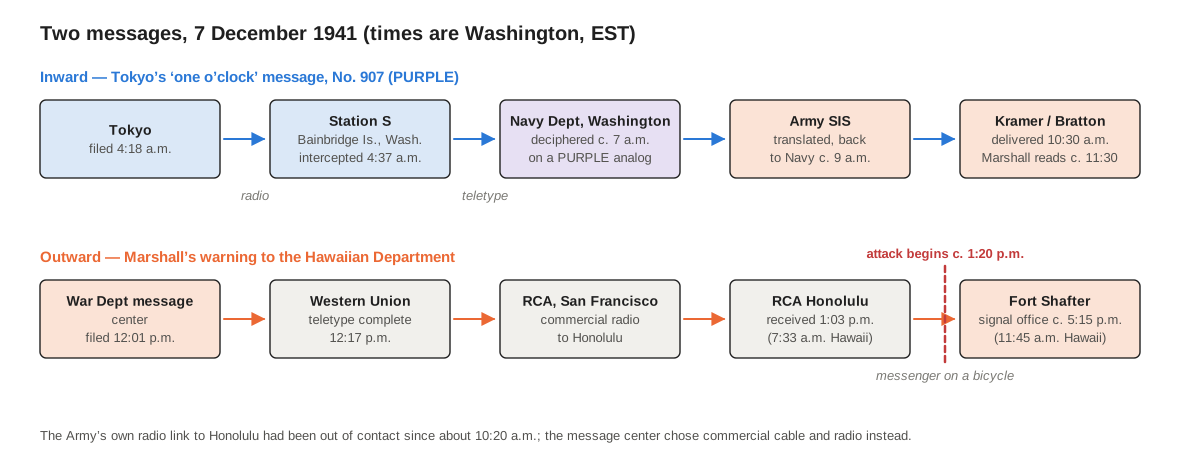
No. 907 was deciphered in the Navy Department at about 7 a.m., but no Navy translator was on duty, and it went to the Army for translation, returning at about 9. Kramer found it when he came back to his office at 10:20. Between 10:30 and 10:35 he delivered it to the office of the Chief of Naval Operations, where a meeting was in progress, then to Hull’s aide at the State Department and to a presidential aide at the White House. On the way, the Committee found, he pointed out that 1 p.m. in Washington was about dawn at Honolulu and the middle of the night in the Far East; “no mention was made that the time indicated an attack at Pearl Harbor” (Joint Committee Report, p. 223).
7.8 Marshall’s Warning
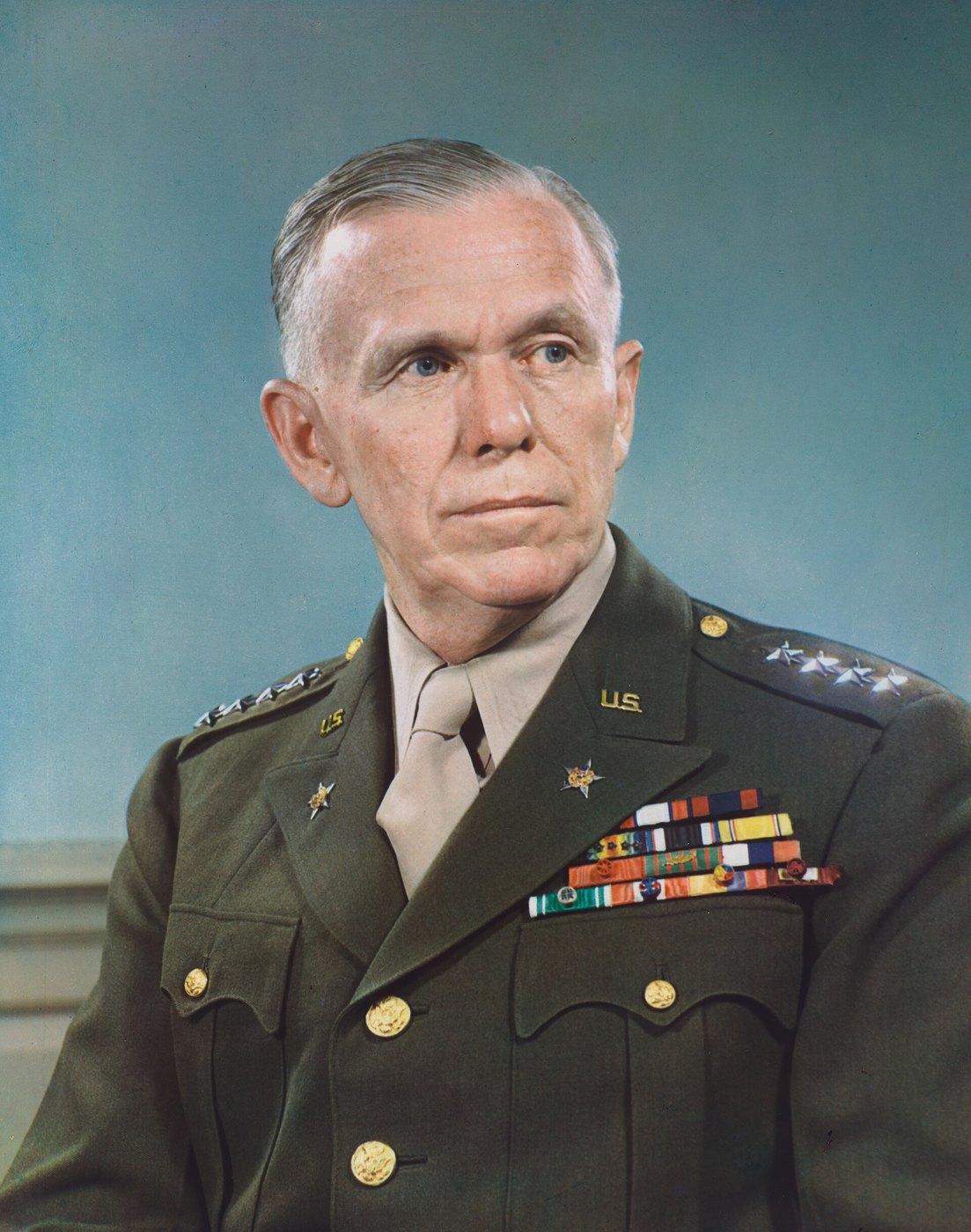
Marshall had spent the morning on his usual ride. Told at his quarters that an important message was waiting, he reached his office at some time between 11:15 and 11:30, with Miles, Bratton and the head of War Plans, General Leonard Gerow, waiting. He read the fourteen parts from the beginning. The one o’clock message, he later complained, had been put “on the bottom of the pile and I read through everything before I came to that” (Joint Committee Report, p. 222 n. 306). He and the officers with him agreed that the hour had “some definite significance”; a delivery fixed to the hour on a Sunday was “a new item of information of a peculiar character.”
At about 11:30 or 11:40 he telephoned Stark. Stark hesitated: the Pacific commands had been warned repeatedly, and he did not want to cry wolf. He called back a minute or two later to agree, and asked that the Army message tell its commanders to inform their naval counterparts. Marshall wrote out the warning in longhand to the Western Defense Command, Panama, Hawaii and the Philippines:
“The Japanese are presenting at 1 p. m. Eastern Standard Time, today, what amounts to an ultimatum. Also they are under orders to destroy their code machine immediately. Just what significance the hour set may have we do not know, but be on alert accordingly.” — with the handwritten addition “Inform naval authorities of this communication” (Joint Committee Report, p. 224)
Bratton had it at the War Department message center by 11:50. Marshall twice sent officers back to ask how long it would take, and was told it would be in the recipients’ hands within thirty minutes. The officer in charge, Colonel Edward F. French, then found that the Army’s radio had been out of contact with Honolulu since about 10:20 a.m. On his own authority, without telling Marshall, he sent the Hawaii copy by commercial channels: by teletype to Western Union, by Western Union to RCA in San Francisco, and by RCA radio to Honolulu. The record shows the message filed at the signal center at 12:01 p.m., handed to Western Union by 12:17, and received by RCA Honolulu at 1:03 p.m. — 7:33 a.m. in Hawaii. The teletype link from RCA to Fort Shafter was not working at that hour, so the message went by a messenger on a bicycle, who was caught up in the attack. It reached the signal office at Fort Shafter at about 11:45 a.m. Hawaii time, after the raid was over. It still had to be deciphered before it reached General Walter C. Short. The copies to the other commands arrived before the attack (Joint Committee Report, pp. 224–226).
Marshall did not telephone, which he regarded as insecure; enciphering the warning was meant to avoid revealing that Japanese codes were being read. The Committee found that “it was the failure of communications and not the selection of an improper channel that occasioned the delay,” while calling it “extremely regrettable” that French had not told the Chief of Staff he could not use the Army radio.
7.9 2:20 p.m. at the State Department
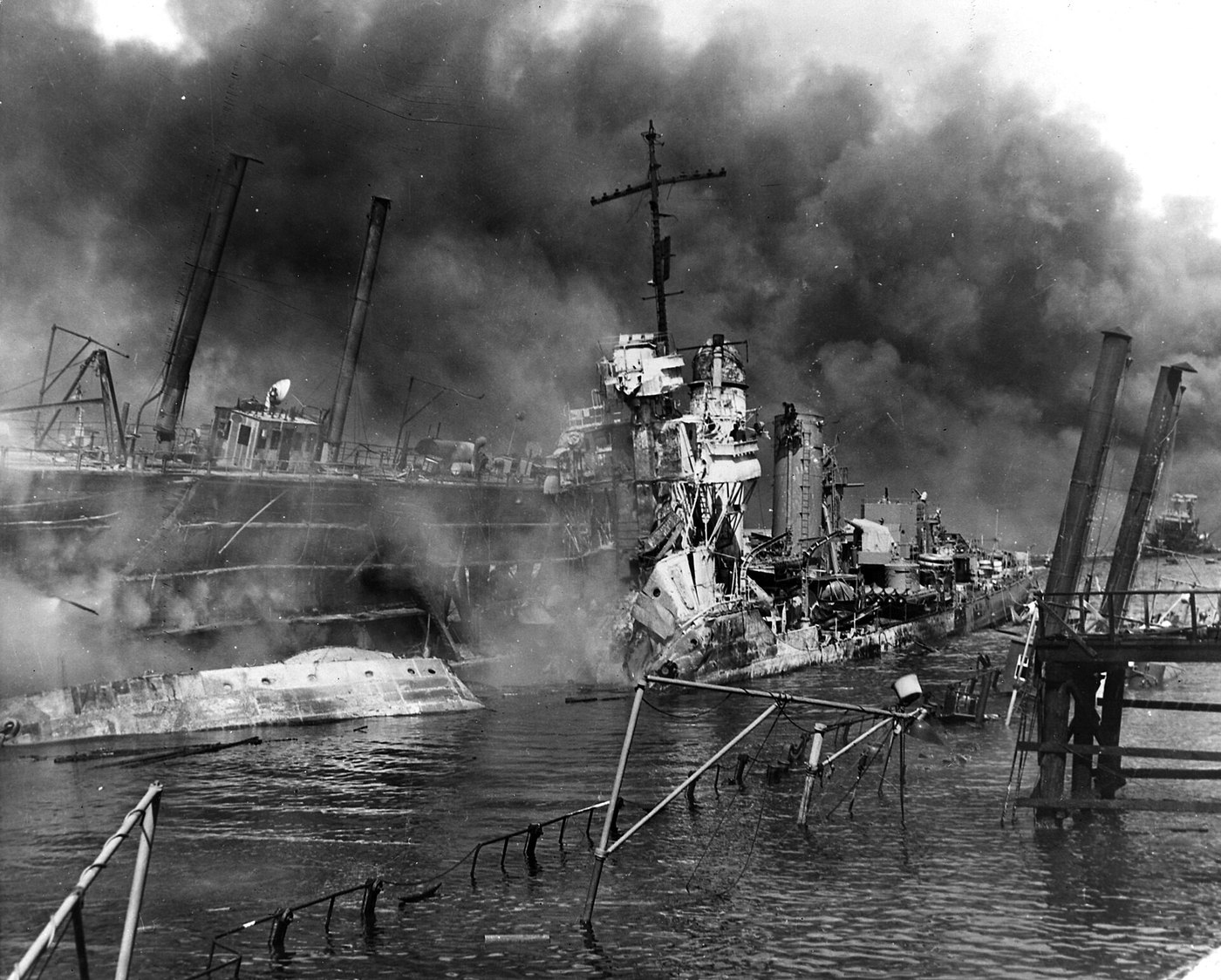
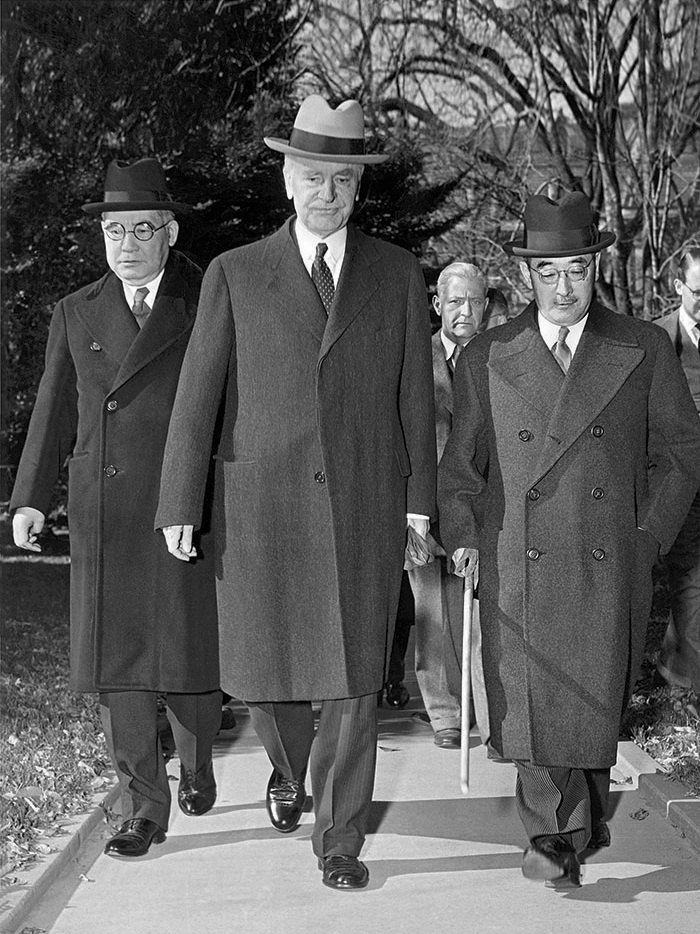
At the Japanese embassy the fourteen parts had to be deciphered and then typed into a clean English copy for delivery. The embassy was working on a Sunday, and the work ran late. Nomura telephoned to ask that his 1:00 appointment with Hull be moved to 1:45. He and Kurusu reached the State Department at 2:05 p.m. and were shown in at 2:20. The attack had begun at about 1:20 p.m. Washington time.
The State Department’s memorandum of the meeting, drafted by Joseph W. Ballantine, records what followed (FRUS, Japan 1931–1941, vol. II, doc. 419; text also at ibiblio). Nomura said he had been instructed to deliver the document at 1:00 p.m. “but that he was sorry that he had been delayed owing to the need of more time to decode the message.” Asked why one o’clock, he said he did not know. Hull read two or three pages, asked whether the document was presented on his government’s instructions, finished reading, and said:
“I must say that in all my conversations with you … during the last nine months I have never uttered one word of untruth. This is borne out absolutely by the record. In all my fifty years of public service I have never seen a document that was more crowded with infamous falsehoods and distortions—infamous falsehoods and distortions on a scale so huge that I never imagined until today that any Government on this planet was capable of uttering them.”
The envoys left without comment. Hull had read the memorandum that morning on paper from an American analog of the machine their own embassy had been ordered to smash. The delivery Tokyo had timed to the minute, half an hour before the planned first strike, would in any case have given no warning: the text, as the Committee noted, declared neither war nor a break in relations.
7.10 The Investigations
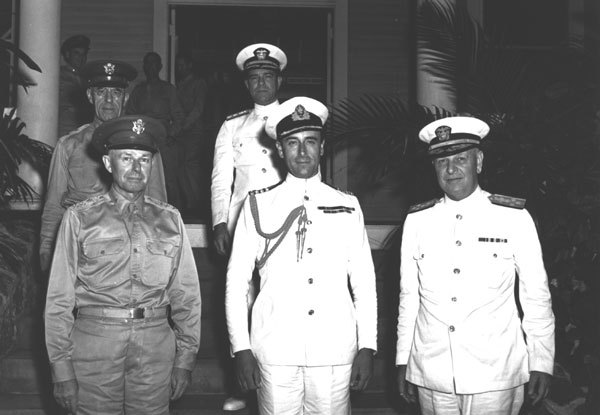
A series of official inquiries followed the attack. The Roberts Commission, appointed in December 1941 and reporting in January 1942, found Kimmel and Short guilty of “errors of judgment and dereliction of duty.” The Army Pearl Harbor Board and the Navy Court of Inquiry sat in 1944, followed by further investigations by Admiral H. Kent Hewitt and Lieutenant Colonel Henry Clausen.
That secrecy was tested in the 1944 presidential campaign. Marshall wrote personally to the Republican candidate, Governor Thomas Dewey, to ask him not to raise the codebreaking side of Pearl Harbor, explaining that Japanese codes were still being read and that the reports of the Japanese ambassador in Berlin were Washington’s main source on Hitler’s intentions. Dewey said nothing. That letter is part of the story of the next volume.
The Joint Congressional Committee on the Investigation of the Pearl Harbor Attack held public hearings from November 1945 to May 1946 and published its report, with 39 volumes of hearings and exhibits, in the summer of 1946. Its Exhibit No. 1 printed the MAGIC intercepts of the second half of 1941. With it, the fact that the United States had read Japan’s diplomatic cipher became public knowledge. The majority report distributed blame among the Hawaiian commands and the War and Navy Departments in Washington; it did not find that anyone in Washington knew where the attack would fall. In 1977 the Department of Defense released The “Magic” Background of Pearl Harbor, a multi-part compilation of the 1941 intercepts first prepared in 1944 (Navy Department Library).
7.11 The Revisionist Case — and the Record
Since 1946 a body of writing has argued that Washington, or Roosevelt personally, knew the attack was coming and let it happen in order to bring the United States into the war. The best-known books are Charles A. Beard’s President Roosevelt and the Coming of the War, 1941 (1948); Rear Admiral Robert A. Theobald’s The Final Secret of Pearl Harbor (1954); Kimmel’s own Admiral Kimmel’s Story (1955); John Toland’s Infamy (1982); and Robert B. Stinnett’s Day of Deceit (2000). These are revisionist claims, and the main lines of the documented response are as follows.
“MAGIC showed the attack was coming.” The PURPLE intercepts show that Tokyo set a deadline, broke off the negotiations and fixed the hour of delivery. None of them names Pearl Harbor or any other military target. Marshall’s own warning said “just what significance the hour set may have we do not know,” and he expected the blow in the Philippines. The Joint Committee concluded that the one o’clock message indicated “no more than the distinct possibility that some Japanese military action would take place somewhere at 1 p.m.”
“The Navy was reading JN-25 and tracking the carriers.” This is the core of Stinnett’s book. David Kahn’s review in the New York Review of Books (2 November 2000) set out the evidence against it. By 7 December the Navy had recovered only a few thousand of the code’s tens of thousands of groups, too few to read current messages. The intercepts Stinnett offers as pre-attack reading carry translation dates from 1945 and 1946. Navy intelligence summaries in late November placed the carriers “in home waters.” Parker’s NSA history comes to the same conclusion about JN-25. Japanese participants and the surviving records agree that the strike force kept radio silence.
“The winds execute message was received and suppressed.” In November Tokyo set up an emergency code to be hidden in short-wave weather broadcasts: higashi no kaze ame, “east wind rain”, would mean that relations with the United States were in danger. After extensive testimony the Joint Committee concluded that “no genuine ‘winds’ message in execution of the code and applying to the United States was received” before the attack. Investigation in Japan indicated that none was sent, and British and Dutch monitors heard none. The Committee added that even a genuine execute “would have added nothing to what was already known” (Joint Committee Report, pp. 191–192).
“The Hawaiian commanders were scapegoats.” This is a separate and more serious argument. It concerns the distribution of intelligence, not foreknowledge. It is a matter of record that MAGIC was not sent to Hawaii and that Kimmel and Short were not shown the Honolulu consulate messages. On 25 May 1999 the U.S. Senate passed, 52–47, a non-binding resolution asking the President to restore both men posthumously to their highest wartime ranks; no president has acted on it. The resolution concerned their treatment, not the existence of a conspiracy.
The scholarly synthesis that most historians follow is older than most of the conspiracy books. Roberta Wohlstetter’s Pearl Harbor: Warning and Decision (1962) argued that the signals of the coming attack were in Washington’s files, scattered among far more noise pointing elsewhere, and divided between agencies that did not share them. Gordon Prange’s At Dawn We Slept (1981) reached a similar conclusion from the Japanese side. Kahn summed up his case against Stinnett in one sentence: “Pearl Harbor succeeded because of Japan’s total secrecy about the attack.”
7.12 What PURPLE Did Do
Measured against the attack, PURPLE failed only in the sense that it was asked a question it could not answer. Measured against what it could see, its record over those forty hours is remarkable. A message enciphered in Tokyo on a machine no American had seen was intercepted on an island in Puget Sound within minutes, teletyped across the country, deciphered on a rebuilt version of that machine, and in front of the President before midnight. Part 14 was read before the embassy that received it had finished typing it. Freeman, Sullivan and Weierud’s study of 1944 processing times found PURPLE messages being deciphered in an average of 42 minutes once garbled cases were set aside. The bottleneck on 7 December was not cryptanalysis. It was a single translator on duty on a Sunday morning, a stack of papers read from the top, and a radio circuit to Honolulu that happened to be down.
The machine itself went on producing for another four years, and its greatest contribution came from a quarter that had nothing to do with the Pacific.
Next — Volume 8: Oshima’s Window — Reading Berlin from Washington. A Japanese general who had known Hitler since 1935, an ambassador who toured the Atlantic Wall, heard out Hitler and Ribbentrop and reported everything to Tokyo in long PURPLE telegrams — and the codebreakers at Arlington Hall and in London who read them all. How the Allies learned of Barbarossa, of German defences in Normandy and of Hitler’s expectations about D-Day from the man Marshall called their main source on Hitler’s intentions.
Comments (0)